Share this post
Trip Solutions
4-min read
Why does your travel proposal workflow feel harder than it should?

By
Gwenydd Jones
Published
09 June 2026
You’re getting proposals out. Clients are booking. By most measures, your process works. So, why do you have the feeling it never quite flows?
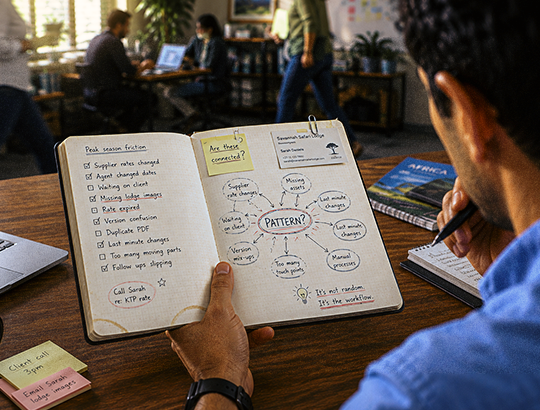
Perhaps there’s something that always takes longer than you expect. Or you somehow end up with two versions of the itinerary and they don't quite match. Maybe part of the formatting never comes out right and needs fixing before you can send, or there's this one tool you end up opening, closing, and opening again. Small things. But they’re never quite gone.
This is low-level friction. And it's worth paying attention to, as it may be reducing your conversions and tiring your team out.
What a “good enough” travel proposal workflow looks like
The workflows that come with the most hidden drag rarely feel like a problem when you and your team are the ones who created them. You follow them every day. They feel normal. Your team knows the workarounds. Nobody’s complaining because everyone’s managing.
But managing isn’t the same as thriving. And when you look at the specific places where time disappears, most tour operators, DMCs, and travel agents find similar patterns emerge:
- switching between software to pull together information that should live in one place;
- creating duplicate versions of itineraries with manual attempts at keeping them in sync;
- formatting and layout work eating into time that should go towards selling;
- rebuilding content from scratch that’s been built before and either forgotten about or lost.
None of these aspects stops the trip proposal email from going out to destination. But every one of them adds friction (and time) to a process that should feel easy.
The cost you’re not counting
It’s tempting to wave this off. The work gets done, after all. But consider what the time adds up to. If your proposal process involves interruptions like switching between Word and Canva, fiddling with font sizes and spacing, and tracking down versions among endless files and folders, each one creates a pause that costs you and your team time.
Imagine you build 30 itineraries a month. If these disruptions add up to an extra 45 minutes per itinerary, then they cause 22.5 hours of extra work each month, the equivalent of three full working days. That’s seven weeks and close to R55,000 a year per agent that isn’t going towards selling.
But it's invisible. Because the minutes drip away like water out of a leaky tap that slowly drains your tank and ups your water bill.
Run the numbers for your own travel business. The results will be illuminating.
And it isn't only about actual time spent. There's also a cognitive cost of tool-switching. Research published by the American Psychological Association shows that repeatedly switching between tasks can consume up to 40% of productive time. This is because the shift creates a brief mental block, where our brains have to ramp up again every time we make them reorient. In a proposal workflow that moves across multiple platforms, this productivity loss is measurable, and the fatigue that comes with it is something most agents will recognise.
Why friction doesn’t feel urgent until it is
The hardest part about a workflow that mostly functions is that it doesn’t trigger the kind of alarm that demands attention. There’s no single failure point. No moment where someone shouts help!
Instead, the signals are quieter. The vague frustration that things are slower than they should be. A version of peak season that feels unmanageable because a process that was already effortful becomes painful when the volume of requests grows. That nagging voice, easy to ignore, that keeps telling you it should all feel easier.
The voice is worth listening to because a proposal workflow with friction baked in is a ceiling that stops business growth. It limits how fast you can respond, how many enquiries you can handle, and how much energy your team has left for the work that actually closes bookings: relationships, storytelling, selling.
How can you remove friction in your trip proposal workflow?
The fix isn’t always a complete overhaul. The biggest efficiency gains often come from consolidating: fewer tools and manual steps, up-to-date supplier content that lives in one place and can be pulled into any itinerary without rebuild.
For tour operators, DMCs, and travel agents working with the Wetu Itinerary Builder, the shift looks like this: build your content once, in one place, and draw on it every time. No duplication, no version conflicts, no reformatting. The Get Africa Travel team reduced their itinerary creation time by 90% by removing the unnecessary steps in their process.
And you can use that extra time to boost your sales strategy and turn your workflow into a growth engine. Find out how in our article about the tour operator sales strategy hiding in your proposal workflow.
It’s also worth thinking about what clients experience on the other side. Internal processes with less friction typically produce more consistent, polished proposals that are primed (rather than just good enough) to send. If you’re wondering how to match what clients receive to where they are in the buying journey, this post on what to include in a travel proposal is a useful starting point.
Find out how your workflow compares
If any of the friction points in this post felt familiar, it’s worth taking a closer look at where your proposal process is costing you more than it should. Start a free Wetu trial and see how you can automate the manual effort you're putting into itinerary creation, so you can put your brain to better use elsewhere.
No items found.

Blog
Keep the inspiration flowing
Explore related stories, tips, and updates to help you bring magic to your clients.