


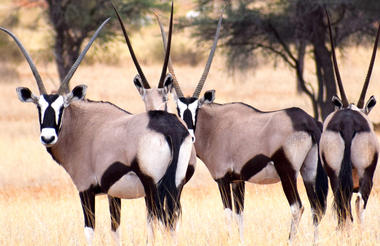
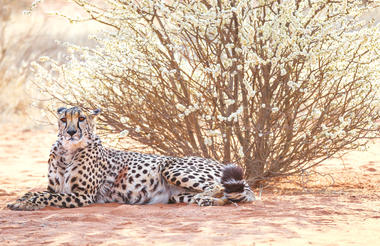
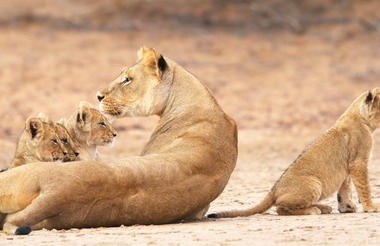
Known for its rust-red sand, grassy plains, and terracotta-painted landscapes, the Kalahari Desert situated on Namibia's east border is a place that holds the heart of the African continent in its hands. Scattered herds of antelope, zebra and the aloof leopard exist among the Camelthorn Trees of this barren homeland. The Kalahari is a destination that provides an insight into wildlife and culture unmatched anywhere else on Earth. From the pink and red seamlessly cloudy waves in the mornings to the draw dropping golden sunsets in the evening, the true lure lies in the Kalahari's solitude and eerie silence.
Southern Namibia is home to the second-largest canyon globally and is one of Namibia's most remarkable geological wonders - Fish River Canyon. Plunging ravines and looming rock faces dominate the landscape, with natural hot springs dotted throughout the area. Dramatic sunrises cast heavy shadows while light plays on the rocks; various breath-taking views unfold one after another throughout the day. Yet, gazing at the starry night sky after dark is undoubtedly one of the most sought-after experiences. With the ever-changing crevasses and the raw magnitude of nature’s creation, this canyon is not to be forgotten.


Isolated on private land at the edge of the Namib Desert, the tiny village of Helmeringhausen was founded during the German colonial era. The entire land of Helmeringhausen is privately owned. Here, one can enjoy an atmosphere of peace and tranquillity that only the wilderness can provide. Besides a small airport, the town has a country hotel and a private agricultural museum. The town serves as an idyllic and convenient base for exploring the breath-taking Fish River Canyon, the largest in Africa, with its technicolour scenes and refreshing turquoise pool; nearby Luderitz, with its mysterious ghost town and stunning coast; the astonishing landscapes of Sossusvlei; and the enthralling Naukluft National Park.


If you only have time to see one thing in Namibia, make it the soaring sand dunes of Sossusvlei. Few words can describe the towering red dunes spread across the landscape or walking amongst the fossilized Acacia trees in the vast white clay pan of Deadvlei. The ever-changing dunes are the arid lands most iconic feature, and hiking to the tops will allow you to view the Martian-like landscape below. Sossusvlei shows off its beauty by housing many plants and animals that have adapted to life in the dry, yet dreamy terrain. This natural wonder is a perfect example of Namibia's unspoiled desert landscape.

Swakopmund, known simply as ‘Swakop’ to Namibians, is the capital of the Erongo Region. It was founded in 1892 and was regarded at the time as Germany’s main port in South-West Africa. The townscape of this small town is characterised by numerous historic buildings from the German colonial era: wide streets, German street names, German pubs, cafés and bakeries. During the colonial era, ‘Swakop’ was described as ‘Germany’s southernmost coastal town’. Even today, German is still spoken everywhere. Swakop offers many tourist attractions, such as charming pubs, a beautiful seafront promenade, an aquarium and much more. You can go on lovely day trips to the surrounding area, such as south to Walvis Bay or north to Cape Cross to visit the largest seal colony on the African mainland. In and around Swakop, there are plenty of activities on offer, such as boat trips to see seals, exciting desert tours, quad bike safaris, kayaking trips and helicopter flights. You’ll be spoilt for choice.


In the northwest corner of Namibia, approximately 30 kilometres from the small town of Uis, lies the country's highest mountain - the Brandberg, which looms large over the grey gravel plains of the central Namib Desert. Many of the San people who live in this region consider the Brandberg to be a sacred site. Today, the site is renowned for the concentration of San rock art that can be found there - the most famous of these rock paintings is The White Lady. Namibia's Brandberg Mountain Range is a popular hiking destination and can make for a great highlight during your visit - and the sights are astounding.

Featuring breath-taking panoramas, unforgettable sunsets, and abundant wildlife, Etosha National Park is Namibia's premier wilderness conservation area. The Etosha Pan - a shallow salt pan covering an area of 5.000 Square kilometres lies in the heart of the park. Natural springs are found in this dry terrain, making for excellent game viewing. Throughout the Park, the landscape is generally flat, with various habitats ranging from mopane woodland to wide, open, virtually treeless plains. Etosha is home to one of the world's most stable black rhino populations, along with lion, elephant, leopard, cheetah, and hyena.
Etosha's southernmost section is known for its rich population of both white and black rhino. Etosha South is home to the Okaukuejo Rest Camp, which is famous for its floodlit waterhole. The many viewpoints overlook picturesque bush-scapes and abundant wildlife. Getting into the South is accessible by Andersson's Gate. Here, visitors can expect to see many animals, including lion and the rare, black-faced impala. However, the most notable of animals found here are elephants. Enjoy guided nature walks, game drives, or simply watching the sunset from this breath-taking location.


The capital Windhoek (translated as “windy corner”) is the political, cultural, industrial and economic center of Namibia with 400,000 inhabitants. Windhoek was founded on October 18, 1890, when the foundation stone for what is now known as the “Alte Feste” fortress was laid. Other popular sites include the Tintenpalast, the Christuskirche, the Kaisergymnasium and the Heinitz und Sanderburg. The quiet and well-organized city with a colonial German touch, offers German restaurants and shops, a widespread use of the German language, the celebration of German customs (such as Carnival or Oktoberfest) - the German tradition is reflected everywhere. Even the beer is still brewed according to the German "Reinheitsgebot" (special purity law). Mixed with African traditions and roots, Windhoek offers a unique atmosphere and a relaxed lifestyle that makes the city so endearing.


