


The capital Windhoek (translated as “windy corner”) is the political, cultural, industrial and economic center of Namibia with 400,000 inhabitants. Windhoek was founded on October 18, 1890, when the foundation stone for what is now known as the “Alte Feste” fortress was laid. Other popular sites include the Tintenpalast, the Christuskirche, the Kaisergymnasium and the Heinitz und Sanderburg. The quiet and well-organized city with a colonial German touch, offers German restaurants and shops, a widespread use of the German language, the celebration of German customs (such as Carnival or Oktoberfest) - the German tradition is reflected everywhere. Even the beer is still brewed according to the German "Reinheitsgebot" (special purity law). Mixed with African traditions and roots, Windhoek offers a unique atmosphere and a relaxed lifestyle that makes the city so endearing.


Known for its rust-red sand, grassy plains, and terracotta-painted landscapes, the Kalahari Desert situated on Namibia's east border is a place that holds the heart of the African continent in its hands. Scattered herds of antelope, zebra and the aloof leopard exist among the Camelthorn Trees of this barren homeland. The Kalahari is a destination that provides an insight into wildlife and culture unmatched anywhere else on Earth. From the pink and red seamlessly cloudy waves in the mornings to the draw dropping golden sunsets in the evening, the true lure lies in the Kalahari's solitude and eerie silence.
Southern Namibia is home to the second-largest canyon globally and is one of Namibia's most remarkable geological wonders - Fish River Canyon. Plunging ravines and looming rock faces dominate the landscape, with natural hot springs dotted throughout the area. Dramatic sunrises cast heavy shadows while light plays on the rocks; various breath-taking views unfold one after another throughout the day. Yet, gazing at the starry night sky after dark is undoubtedly one of the most sought-after experiences. With the ever-changing crevasses and the raw magnitude of nature’s creation, this canyon is not to be forgotten.


Namibia's colourful and unique town of Luderitz is located on the Atlantic Ocean shoreline, where coastal rocks meet the Namib Desert. Despite the waves and winds brought by the Benguela Current, the town is home to an abundance of marine life and birds. Flamingo and penguin colonies can be found nestled on the rocky coasts of the Lüderitz Peninsula, while the Sperrgebiet National Park preserves the areas wildest landscape. Bogenfels Arch, located just outside of town, is a 30m natural arch carved in the cliff face. Luderitz has kept its sleepy old-world atmosphere throughout the years and begs to be explored.

If you only have time to see one thing in Namibia, make it the soaring sand dunes of Sossusvlei. Few words can describe the towering red dunes spread across the landscape or walking amongst the fossilized Acacia trees in the vast white clay pan of Deadvlei. The ever-changing dunes are the arid lands most iconic feature, and hiking to the tops will allow you to view the Martian-like landscape below. Sossusvlei shows off its beauty by housing many plants and animals that have adapted to life in the dry, yet dreamy terrain. This natural wonder is a perfect example of Namibia's unspoiled desert landscape.

Swakopmund, known simply as ‘Swakop’ to Namibians, is the capital of the Erongo Region. It was founded in 1892 and was regarded at the time as Germany’s main port in South-West Africa. The townscape of this small town is characterised by numerous historic buildings from the German colonial era: wide streets, German street names, German pubs, cafés and bakeries. During the colonial era, ‘Swakop’ was described as ‘Germany’s southernmost coastal town’. Even today, German is still spoken everywhere. Swakop offers many tourist attractions, such as charming pubs, a beautiful seafront promenade, an aquarium and much more. You can go on lovely day trips to the surrounding area, such as south to Walvis Bay or north to Cape Cross to visit the largest seal colony on the African mainland. In and around Swakop, there are plenty of activities on offer, such as boat trips to see seals, exciting desert tours, quad bike safaris, kayaking trips and helicopter flights. You’ll be spoilt for choice.


Very few natural landscapes match up to the spectacular views of Spitzkoppe. The peaks stand out dramatically against the flat, desolate scenery below, making it one of Namibia's must-see attractions. Here, the famous Rock Arch can be found - a photographer's dream. Climbing the Spitzkoppe is no easy task. However, if conquered, the views from above are unlike any other! Spend sunrise and sunset sitting tranquilly in nature's beauty, watching the rocks' colours change from bright reds to light yellows, granting endless opportunities to relish in the contrasting light and shadowy patterns of the cliffs.


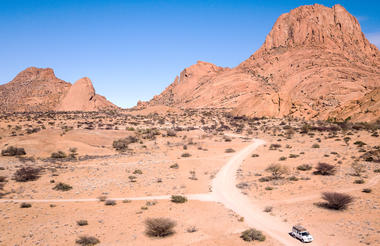
In northern Damaraland, where the flat-topped mountains of rich red rock greet the Uniab River, lies the small region of Palmwag. The area is set amid an endless basalt landscape created by magma eruptions millions of years ago. It is a refuge area for rare animal species such as the black hooked-lipped rhinos and the fascinating desert-dwelling elephants. Large predators, such as leopards, cheetahs, and spotted hyenas, are attracted to healthy antelope populations, and a group of "desert lions" occupy the arid climate. Palmwag is a place that will leave you feeling content in the generous arms of a wild Namibia.
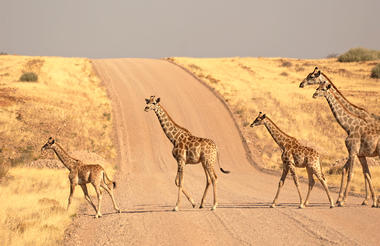

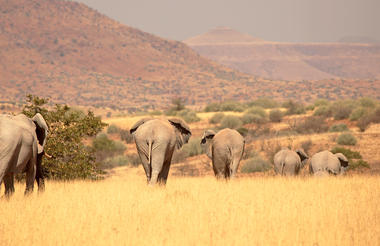
Featuring breath-taking panoramas, unforgettable sunsets, and abundant wildlife, Etosha National Park is Namibia's premier wilderness conservation area. The Etosha Pan - a shallow salt pan covering an area of 5.000 Square kilometers lies in the heart of the Park. Natural springs are found in this dry terrain, making for excellent game viewing. Throughout the Park, the landscape is generally flat, with various habitats ranging from mopane woodland to wide, open, virtually treeless plains. Etosha is home to one of the world's most stable black rhino populations, along with lion, elephant, leopard, cheetah, and hyena.
The western side of Etosha National Park has its own charm and appeal - plus the all-important wildlife encounters. In comparison to the east and centre of the Park, the west offers different vistas and biomes - the most obvious being that the terrain isn't as flat, and the soil doesn't always seem chalky white but appears to be more reddish. A great reason to visit the west is its famous lion population. Other unique species that frequent this side of the park include Hartmann's mountain zebra, black-faced impala and brown hyena. The west flaunts its magical aura through its enchanting landscape and unique scenery.
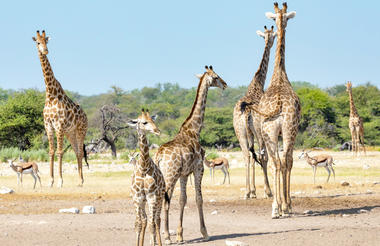
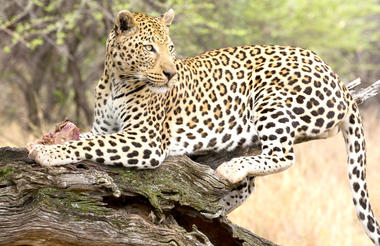
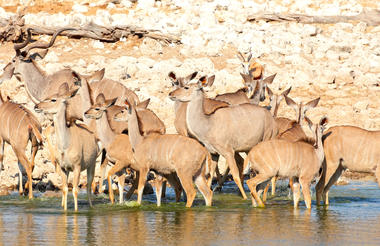
Featuring breath-taking panoramas, unforgettable sunsets, and abundant wildlife, Etosha National Park is Namibia's premier wilderness conservation area. The Etosha Pan - a shallow salt pan covering an area of 5.000 Square kilometres lies in the heart of the park. Natural springs are found in this dry terrain, making for excellent game viewing. Throughout the Park, the landscape is generally flat, with various habitats ranging from mopane woodland to wide, open, virtually treeless plains. Etosha is home to one of the world's most stable black rhino populations, along with lion, elephant, leopard, cheetah, and hyena.
Etosha's southernmost section is known for its rich population of both white and black rhino. Etosha South is home to the Okaukuejo Rest Camp, which is famous for its floodlit waterhole. The many viewpoints overlook picturesque bush-scapes and abundant wildlife. Getting into the South is accessible by Andersson's Gate. Here, visitors can expect to see many animals, including lion and the rare, black-faced impala. However, the most notable of animals found here are elephants. Enjoy guided nature walks, game drives, or simply watching the sunset from this breath-taking location.


Situated on the eastern side of Etosha, bordering Fisher's Pan, Onguma Game Reserve is one of In the eastern parts of the Etosha National Park, bordering Fishers Pan lies the Onguma Private Game Reserve. Protecting more than 34,000 acres of land, this private reserve is home to over thirty species of animals, from kudu, giraffe and oryx, to predators such as lion, cheetah and leopard. The Onguma water hole is also a great place to spot game. Game drives, guided walks, and rhino research drives can be enjoyed within the reserved area, and safaris into Etosha National Park are available to see the abundance of animals. Here you will have the opportunity of experiencing Africa in all her beauty and diversity.


With a backdrop of rolling hills and grassy plains – Okonjima Nature Reserve is best known for its diverse animal species - such as cheetahs, lions, hyenas and leopards. Boasting mixed woodland and thornveld plains, the land is home to Africa's most extensive wild cat population. Established in 1991, the AfriCat Foundation is a non-profit organisation committed to the long-term conservation and education of Namibia's large carnivores - and even allows you to track the cheetah on foot! Okonjima, with its rugged bushveld and mountainous outcrops, is a truly unique Southern Africa experience.
As previously described


