The Central Kalahari Game Reserve is the second-largest wildlife reserve in the world. The vastness of the 52,800 km reserve in the midst of the Kalahari desert of Botswana is mind-numbing. Here time comes to a standstill as the wide white earth conspires to meet the open, blue sky. Golden grass can be seen in all directions, occasioned by short trees and scrubs while wide sand pans beckon the tourist to come closer and feel awed.
While the summer rains bring together scores of wild animals eager to graze on the lush and sweet grass, the dry season has its own beauty that attracts the visitor, though lucky visitors might spot an animal or two. The wildlife usually seen includes wildebeest, brown hyena, warthog, hartebeest, eland, wild dog springbok, giraffe, gemsbok, cheetah, lion and leopard. The northern deception valley, so named because it is a 80km long ancient riverbed where mirages take place, has the highest concentration of herbivores and predators seen in and after the rains. Hence, it is the most visited area of the reserve also close to the eastern Matswere Gate. There is also a large diversity of bird life and a number of endangered species. A number of public campsites cater to the visitors. The Sunday and Leopard Pans, Passarge Valley and Piper's Pan are popular spots to visit.
Access is from Ghanzi on the west for about 3 hours to the gate at Xade, Rakops and Maun (3 and a half hours to Matswere) on the north east and Khutse from the south. The gates at Xade and Tsau also house campsites. Petrol and diesel are available at Ghanzi and Rakops. By air, the tourist can land at one of the four airstrips at Deception Pan, Xade, Xaka or at the game scout in Khutse.
The reserve was formed originally in 1961 with the issue of protecting the San in mind. It was proposed that the San could live a private life and continue their hunter/gatherer ways without intrusion from the external world. Now they have mixed with people from other tribes and some have found employment in the various lodges as guides. Using their traditional wisdom passed down through generations, the Bushmen can show visitors how to survive life in the great arid desert.
The two permanent accommodation options are the private camps Kalahari Plains Camp and Tau Pan Camp. There is an old-style safari camp near the Kalahari salt pans called the Meno a Kwena Tented Camp that offers 2-3 days short trips. Visitors may also find lodges just outside the reserve including the Deception Valley Lodge and the Grassland Bushman Lodge.
The reserve conditions though harsh, reward the tourist with the ultimate African holiday. A night sky full of stars, fascinating reptiles, scorpions and insects, immense number of grazing animals and the peace and solitude that the great Kalahari Reserve has to offer are a visitor's dream come true.


Botswana is one of the most popular safari destinations in Africa. The vast untamed wilderness of this land-locked country with miles of open space attracts the minds of those who want an exclusive and unmatched safari experience in close quarters with nature. There are few places that offer a similar kind of experience especially if we consider the famous Okavango Delta in the northwest part of the country and the Chobe National Park with the highest density of elephants in Africa. Botswana offers a lot as a country- safaris by vehicle, nature walks, horseback or motorboat game drives, river cruises and so much more! There is plenty of game like buffalo, zebra, hippo, antelope and rhino (recently reintroduced) and the resultant population of predators is therefore good. You might be lucky to see lions, hyenas, leopards and wild dogs. Not only is the wildlife good but also the bird watching is a truly captivating experience.
The most popular safari destination in Botswana is the Okavango Deta, which is an amazing and one of the world's largest natural inland water deltas. The game viewing here is best during the dry season when the place is teeming with wildlife and birds and a variety of different animal life. In addition to this truly spectacular place to go to for wildlife watching, The Moremi Game Reserve (part of the delta), Linyati region and Chobe National Park towards the north are the other truly engaging places to visit. The game-turner is that these places are fed by 4 rivers- Okavango, Kwando, Linyati and Chobe that have turned this region into a rich wetland with an ecosystem most varied and beautiful. The Chobe has a very high density of wildlife and is popular for its proximity to the Victoria Falls.
As you travel towards the south, the landscape changes into a semi-desert Kalahari desert region for miles together only occasioned by a village and a farmland. You can also see the Makgadikgadi salt pans, the 1000th World Heritage Site, stretch south of the delta. Here is where you can experience some exciting quad-biking safaris and the seasonal migration that happens after the rains when scores of zebra, wildebeest and antelope visit to feed on the newly grown grasses. Taking advantage of these thousands of prey are the predators, especially the lions who do not miss any opportunity to feed! This presents some good photo ops for wildlife enthusiasts who in turn make most of these interactions between prey and predators. Also meet with the San for a believably real cultural exchange in the fine desert and also enjoy the Tsodilo Hills, where rock paintings date back thousands of years.
The type of safari that can be booked depends on the requirement of the tourist. Botswana has on offer fine photographic safaris exclusive for eager photographers but can also be a purely exploratory safari experience for the enthusiastic wild lifer. There are also exclusive honeymoon safaris included in few lodges. Botswana safaris are generally quite exclusive and the game lodges are classy and luxurious. Visitor numbers are usually limited. The high standards maintained by the lodges in their service and also the guides are one of the best across the continent. A superb migration takes place in the dry season and the rains also offer some truly exciting opportunities to see the residents, especially birds who breed in this season. Botswana offers best-for-value holidays and hence it is becoming a must-see destination for serious safari enthusiasts.


The Savuti channel from the Linyanti feeds the Savuti marsh, an area famous for being a stage for a dramatic and fascinating safari experience owing to its location and landscape. The peculiarity of the channel is that it stopped flowing completely from 1888 to 1957 and then from 1980 to 2008 and started flowing again, first creating grasslands then a clear waterway home to aquatic life and a new source of water for the wildlife. It is tucked away in the heart of Chobe National Park.
The landscape of the Savuti (also spelled Savute) is diverse with lush grasslands in some areas and desert-like stretches with camelthorn acacia trees in others. The Gubatsa Hills located in the area were formed nearly one billion years ago due to volcanic activity. These dolomite rock outcrops rise to a mighty 290 feet high out of nowhere creating a beautiful contrast landscape.
The seasonal rains create many waterholes around the region leading to a congregation of big groups of animals in the dry season. Large lion prides have been seen around the area feasting on the abundant plains game like tsessebe, wildebeest and especially zebras that pass through the region for their annual migration to the grasslands of the Mababe Depression. Lions have also been seen attacking elephants that are found in plenty having a tug of war over the water sources. Endangered wild dog is a promising find here.
Lions have found competition in cheetah and hyena as predators while leopard, jackal and bat-eared fox are also spotted roaming around. While watching wildlife is an immense experience in this area, bird enthusiasts are also not disappointed. The diverse list of species includes kori bustards, red billed francolins, quelea finches and secretary birds to mention a few.
Usually accessed by air, the Savuti is nicely paired up with the Okavango Delta in the tourist itinerary. It is an exceptional destination as safari sightings are brilliant throughout the year and not only in the dry season. In the rainy season, there are countless migrant birds like Abdim's storks, carmine bee eaters and fish eagles arriving from the cold up north, baby animals like baby impala are born in hundreds and thousands of zebra migrate to grassier plains.
Camps are few and top-notch - The Savute Elephant Camp, Savute Safari Lodge and Savuti Camp (nearer to the channel than the marsh). These can be driven to or flown into (Game Reserve has an airstrip) though the road might be closed if the reserve gets good rain.


Situated in the northwestern area of the Okavango Delta, the Panhandle is a stretch of the Okavango River that follows a more-or-less straight course for approximately 70 kilometres before entering the wetlands.
This deep channel serves as the main water source feeding the delta and offers excellent tiger and bream fishing, while the surrounding woodlands and the river’s shallow waters teem with a myriad of birds.
The Okavango Panhandle is dotted with several villages and serves as a gateway to the scenic Tsodilo Hills, some 40 kilometres west, with their various tribal cave paintings, some dating back as far as 20 000 years.
Visitors can enjoy excellent fishing, first-class birding, boating on the Okavango river and game viewing in the Mahangu National Park.


The Okavango Delta is an area of staggering pristine beauty offering beautiful ecosystems and the chance for the best wildlife safaris in Africa. It is one of the world's largest inland delta systems. The floodwater of the Okavango River gushes down through the Angola highlands through the northwestern part of Botswana and thins out over the Kalahari Desert forming around 15,000 km2 of an enchanting delta system. This is an annual occurrence from May through July and there is quiet period October onwards. This cycle of events results in a versatile nature of the delta system and hence there is a constant wildlife activity around this place throughout the year. It causes the migration of thousands of animals in addition to more than 400 species of birds and 1000 species of plants! This magnificence of the Delta has made it one of the Natural Seven Wonders of Africa.
The Okavango Delta is made up of two parts - the Moremi game reserve and a number of private reserves. The Moremi Game Reserve is a public place consisting of the Chief's Island where many self-drive tourists visit. The Chief's Island is where safari-related activities are permitted. The private reserves offer accommodation in small camps and exclusive activities to the resident guests who fly in to these camps by air in light aircraft from main airports at Maun and Kasane. Guest numbers are usually low and the services are top class offering a low-impact but high quality personalised experience to one and all. Also, since these are private, the guides are allowed some freedom during safaris. For e.g. they are allowed to do night-safaris with the guests and are allowed to move off course when spotting any wildlife. They do this with utmost caution and high expertise. Also offered are walking safaris not allowed in the national parks. Also one of the good ways to explore the Okavango is by horseback.
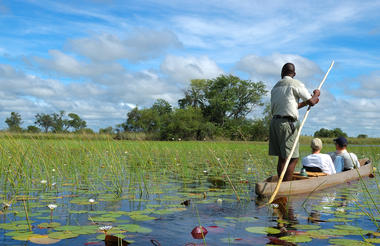
An Okavango Delta safari is a highly unusual and exciting because tourists haven't usually experienced the feeling of sitting in a traditional dug out canoe, locally called a 'mokoro' and watching the wild animals at close quarters. Waddling through the clear blue waters, you get this mystical feeling of being in a faraway land. Fish swim besides you shining in the heat while birds of prey await their time at a distance. Walking on the islands with an expert guide or exploring on horseback will take you real close to the wildlife. It is once in a lifetime experience to do this in the wild. This is the real Africa!
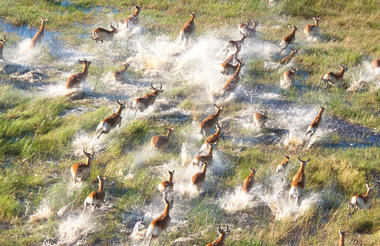
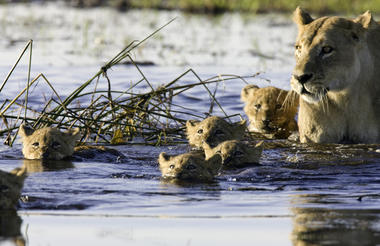
The wildlife is plentiful and gorgeous. With the reintroduction of rhino, it is a good place to get the Big Five out of your system! There are elephants all year round along with big herds of buffalo, giraffe, impala, zebra, kudu, waterbuck, bushbuck, reedbuck, tseesebe and many more. The predators include lion, cheetah, leopards frequently spotted at dusk, hyena and wild dog. Your guide will very likely also spot a large variety of birds, many which are particular to their preferred habitats. There are egrets, cranes, hornbills, eagles, kingfishers, jacanas, firefinches, storks, ibis, owls and coucals. You might also spot otters swimming across the waters in certain places. On night drives you might be lucky to find civets, servals, porcupines, honey badger and white tailed mongoose.
May to October is the dry season whence there are huge numbers of animals congregating towards the delta in search of water and food. In the 'green' season from December to April, most migrants have moved out leaving the residents behind along with a lot of baby animals and beautiful surroundings. This is also a good time to spot the nesting of few migrant birds. Most dry part of the delta is dominated by mopane woodland. Other than mopane, the papyrus and reed rafts make up most of the vegetation and during the flood season, they float on the water giving shelter to crocodiles in the gap between plants and river beds.
The camps in Okavango Delta are categorised as 'wet', 'dry' or 'mixed' according to the nature of the habitat near which they are situated. The wet camps offer mokoro safaris when the flow of the river is subtle and boating safaris when the river is in flood. They are set near very picturesque locations and can offer great wildlife views. The dry camps offer land-based safaris and are great to view big game and predators. The mixed camps, as the name suggests, offer walking, driving and boating safaris since they are located in areas with not much flooding but with enough dry areas to do dry camp activities.
There are nineteen sub-areas in Okavango each having it's own camps so there is lot to choose from when thinking about a best-suitable itinerary for any guest. The type of camp that's chosen will be in accord with the guest's interest, time of the year and budget. Hence it is possible to mix and match and opt for an amazing holiday at 2 or 3 different camps that might also be connected via the waterway.
The different sub-areas or concessions as they are called are: Abu, Chitabe, Duba Plains, Gudigwa, Gunns, Jao Flats, Khwai River, Kwara, Moklowane, Moremi Central (heart of the delta), Moremi Mopane, Nxabega, Okavango Mababe, Okavango Selinda South, Ranns, Shinde, Stanleys, Starlings and Vumbura.