
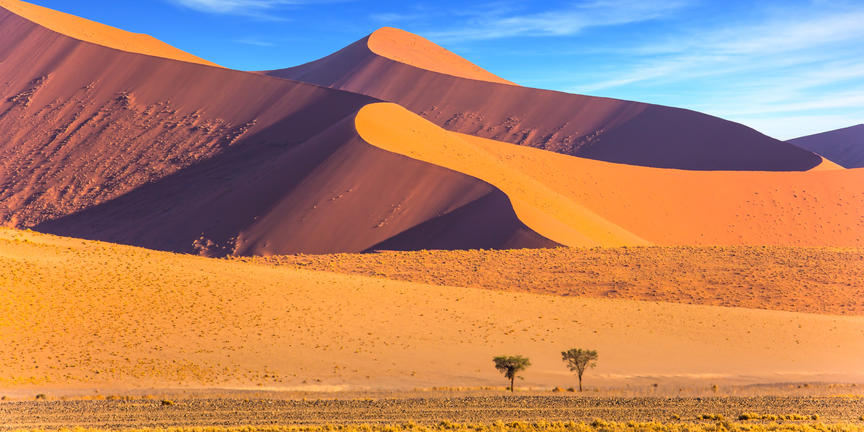


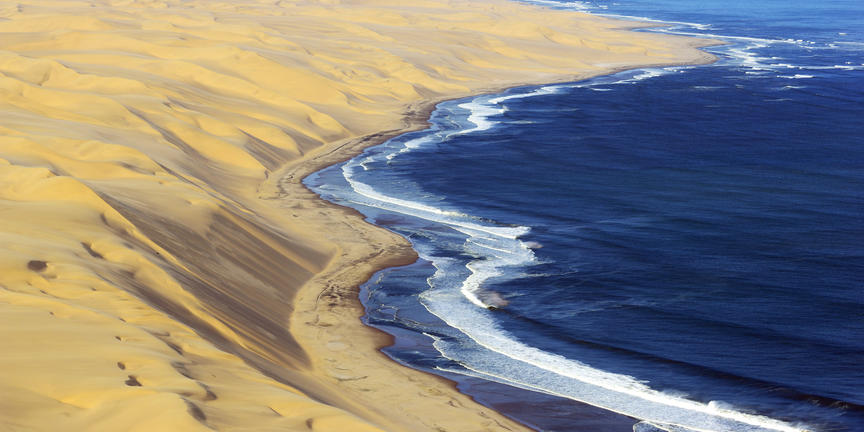

The Namib is the world’s oldest desert, and although it stretches along the entire length of Namibia’s coastline, the Namib commonly refers to the vast sea of sand from Luderitz to Swakopmund. For a big sandy desert the scenery is remarkably varied, with the giant red dunes of Sossusvlei being the most famous part. Because of how old it is the Namib is home to numerous species that don’t occur elsewhere and although no humans live in the desert an amazing array of flora and fauna manages to survive here. Famous species include the Welwitschia – a living fossil plant, endemic chameleons, fur seals along the coast, brown hyenas, jackals and remarkably one of Africa’s largest antelope the Gemsbok. The name Namib is of Nama origin and means "vast place" and vast it certainly is.


Isolated on private land a the edge of the Namib Desert, the tiny village of Helmeringhausen was founded during the German colonial era. Here, one can enjoy an atmosphere of peace and tranquility that only the wilderness can provide. The town serves as an idyllic and convenient base for exploring the breathtaking Fish River Canyon, the largest in Africa, with its technicolor scenes and refreshing turquoise pool; nearby Lüderitz, with its mysterious ghost town and stunning coast; the astonishing landscapes of Sossusvlei; and the enthralling Naukluft National Park.


Namibia is one of the most diverse and fascinating countries on Earth and a top travel destination. Namibia is world-famous for the Namib Desert, which has the highest dunes in the world, and for Etosha National Park, a unique nature reserve.
The official name of Namibia is the "Republic of Namibia." Since 1990, Namibia has been an independent country, a presidential republic with a democratic constitution. Namibia upholds democratic principles such as freedom of the press, opinion, and religion. The motto of Namibia is "Unity, Liberty, Justice."
The country has an area of 824,268 km² and a population of only about 2.1 million. Namibia is one of the least densely populated countries in the world.
The capital of Namibia is Windhoek, with about 350,000 inhabitants. Some of them live in informal settlements on the outskirts of the city.
General Information from A to Z:
- Hitchhikers: It is recommended not to pick up hitchhikers.
- Car Breakdown: If you stop directly next to the road (e.g., due to a flat tire), please stay with your vehicle. Other vehicles regularly pass by and may either help you or contact assistance. It is therefore very important always to carry enough water and some snacks when traveling in Namibia. Adventure Africa Safari knows where you are staying. If you do not arrive at your booked accommodation, we will arrange a search for you.
- Bank Opening Hours: Usually from 8:00 or 9:00 AM to 4:00 PM on weekdays and from 8:00 or 9:00 AM to 11:00 AM on Saturdays.
- Cash: Most major cities in Namibia have ATMs (Automated Teller Machines). You can withdraw money with Visa or Mastercard (not all ATMs accept Mastercard). Often, EC cards are also accepted. Do not accept help from strangers at ATMs and make sure to enter your code discreetly.
- Electricity: The voltage in Namibia is 220/240 volts. South African 3-pin plugs are used. Most hotels provide adapters for 2-pin plugs. Charging batteries is not always possible, as many rural areas rely on solar or generator power.
- ATMs: Follow the usual security precautions when using an ATM, as you would at home. Never accept a stranger’s help with transactions. Always keep an eye on your card and the ATM while withdrawing money. If your card is retained by the machine, immediately call the service number displayed on the ATM or go directly to the bank to report it. Report lost or stolen cards immediately
Entry into Namibia:
General Tips
Starting point for your online application is the website of the Ministry of Home Affairs, Immigration, Safety and Security (MHAISS) https://eservices.mhaiss.gov.na/visaonarrival
As long as you choose the correct visa option for yourself (Visa on Arrival !!), the process is manageable. (We have experienced an application process with a German client via screen sharing.)
For the online application, you have to register an account on the website https://eservices.mhaiss.gov.na/visaonarrival first, before starting the application process.
Once registered, a family member can submit applications on behalf of other family members. For each individual, a visa application form must be filled in.
Per individual online application, the applicant has an approximately 30-minute window, to complete and submit the form. Thereafter, the applicant receives a time-out message and has to start the process all over again. (But don't worry, you'll be much faster on the second attempt😉)
The E-Visa on Arrival will be issued immediately once the application and payment process is complete. It is automatically issued as a multiple entry visa (that means you can go on a trip to Victoria Falls, and re-enter Namibia with the same visa).
However, visa applicants who fill in their visa application forms at their point of entry, please ask the immigration officer for a multiple visa, if required.
What you need to prepare before you tackle your online application!
In the application form, travelers have to provide their personal and travel details, and upload
- a passport scan (PDF format, smaller than 2M) and
- a passport photo (smaller than 300KB).
In the application form (Field 10), you have to provide “Places to Be Visited”. Our contact at the MHAISS support service confirmed that international travellers only have to provide the first and the last place of their stay in the online application form as well as the destinations.
- First place (e.g. lodge name, Windhoek)
- Destinations: (e.g. Kalahari, Sossusvlei, Swakopmund etc)
- Last place of stay (e.g lodge name, Etosha).
For a visit to family and friends, one full contact address and telephone number is sufficient. Unfortunately, it is not possible to copy/paste information into this field of the online application (you must type it in).
Upon arrival in Namibia, be prepared to present the following documents:
- Return ticket or proof of onward ticket
- Approved e-visa, or fill in the Visa on Arrival form at your point of entry
- Valid passport with a validity of 6 months beyond the stay and at least three blank pages
- Invitation letter or Booking confirmation(s) for accommodation or Travel itinerary
- Confirmation of sufficient funds (present booking confirmation(s) and your credit card)
- Medical/travel insurance (in English)
- Full birth certificate or parental consent letter if travelling with children.
Business Hours: From Monday to Friday, 8:00 AM – 5:00 PM. On Saturdays, most shops close at 2:00 PM. On Sundays and public holidays, businesses are usually closed, except for large grocery stores and some souvenir shops.
Stolen Items: If an item is stolen from you, report it immediately to the nearest police station. You will receive a police report with a case number, which you will need to file a claim with your insurance.
Internet Access: Telecom Namibia offers a service called Wi-Space. You can buy a Wi-Space voucher, which allows you to connect to Wi-Fi wherever you see the Wi-Space logo (about 40 locations in Namibia).
Alternatively, most holiday accommodations across the country offer good Wi-Fi access (free or paid).
Credit Cards: VERY IMPORTANT!!! Under no circumstances should you let your credit card out of your sight!
Mobile Network: Namibia has a well-developed mobile network with Telecom Namibia and MTC. It’s best to get a prepaid SIM card at the airport or other sales points (e.g., gas stations or supermarkets) and top it up with available vouchers. In remote rural areas, there may be no signal.
Safety: Namibia is a peaceful, democratic country and is easy to travel around. While the crime rate is generally low, you should always take precautions:
- Always lock your car and activate the alarm system.
- Never leave valuables visible in the car; store them in the trunk.
- Keep photocopies of your travel documents in a safe place.
- Leave travel documents, cash, and valuables at your accommodation rather than carrying them in a handbag.
Safety Tips for Tourists in Swakopmund:
- Do not walk alone along the beach promenade or in dark alleys, especially at night. Stay in well-known areas and always be accompanied.
- Do not buy from street vendors who are not in designated markets. Unauthorized vendors often operate illegally.
- Most people collecting donations on the streets are doing so illegally—please do not give money.
Beach Promenade:
The swimming beach is at the Mole. The Atlantic Ocean is cold and has dangerous currents. Use sunscreen even on cloudy days.
Visiting Restaurants:
- Make a reservation in advance and check the restaurant's location before heading out. Avoid walking alone at night.
- Ask your hotel reception whether the area you plan to visit is safe.
- Avoid wearing flashy jewelry. Keep cameras and bags securely held.
- Avoid deserted areas, especially at night.
- Limit the amount of cash you carry and keep phones and wallets hidden. Use alternative payment methods like debit/credit cards.
- When using a credit card in a restaurant, ask the waiter to bring a portable card machine to your table. If the restaurant does not have one, accompany the waiter to where the transaction takes place. If your card is declined, verify with the management that the alternative payment method belongs to the restaurant.
Street Vendors: In some places, there is a real concentration of vendors. They either try to sell souvenirs or deceive tourists into donating money under false pretenses. Politely but firmly decline, as this is the way to avoid being harassed.
Gas Stations: It is recommended to always carry enough cash, as credit cards or debit cards are not accepted in very rural areas! Most larger villages and national parks have gas stations. In Namibia, it's better to fill up a little too early than too late!
Tipping: The custom of tipping is roughly the same as everywhere in the world. Porters, gas attendants, and parking attendants typically receive 2 – 5 N$. Some restaurants include service charges, otherwise, 10% of the total bill is customary. In Namibia, if you're not satisfied with the service, don't leave a tip. The tip for tour guides is not fixed and is at your discretion.
Traveling to South Africa: In South Africa, only SA Rand can be used for payments; Namibian Dollars are not accepted here. Please consider this if you plan to travel to South Africa, so that you have enough SA Rand. The SA Rand is accepted in Namibia, however – the exchange rate is 1:1.
Wildlife Crossing: Since Namibia has extensive grazing areas, many antelopes and other animals are found near the roads. Always watch for wildlife such as kudus and warthogs, which can cross the road at any time.
Time Zone: Namibia has discontinued the change between summer and winter time, so the time zone is always GMT+2.
Traveling in the Country
General Rules
If your rental car is registered in South Africa, make sure to obtain an "Exit Permit" at the designated office in Katima Mulilo, or you will be denied departure from Namibia.
In Namibia, driving is on the left. There is a general seatbelt law, both for the driver and passengers. The speed limit on paved national roads is 120 km/h, but it is advised not to exceed 100 km/h. The speed limit in towns and villages is 60 km/h unless otherwise indicated. On highways, headlights must be turned on at all times of the day. The maximum speed on unpaved roads (gravel roads) is 80 km/h. These roads are not all the same! Always adjust your speed according to road conditions and circumstances. Always keep both hands on the wheel. Avoid driving at dusk or at night. Visibility is low, and animals are very active during these times.
Gravel Roads (Unpaved Roads / Nature Roads)
The main cause of severe accidents on gravel roads is usually excessive speed.
In foggy weather or poor visibility, always turn on your headlights.
When encountering oncoming traffic, reduce your speed and stay entirely on the left side of the road. Be prepared for the other vehicle to create a large dust cloud.
Avoid overtaking on unpaved roads. If absolutely necessary, ensure that the vehicle ahead of you is aware of you, turn on your headlights, move slightly to the right, and make sure you can see and be seen. Overtake only if you have a long, clear stretch of road ahead.
When passing another car, stay on the right side of the road until you have sufficient space, then return to the left side. Keep in mind that stones can be kicked up by the wheels on unpaved roads, potentially damaging the windscreen of the overtaken vehicle. Keep this in mind when passing pedestrians and donkey carts in rural areas, and reduce your speed.
Avoid sudden movements and overreactions with the steering, especially with power steering vehicles.
Avoid sharp and sudden braking as you may lose control of your vehicle and skid.
If you get a flat tire, have it repaired at the earliest opportunity so that you always have a spare tire on board.
Tire pressure is crucial on unpaved roads to maintain good road handling. Always check tire pressure and keep it at the level recommended by the manufacturer.
Also, check engine oil and coolant levels when the vehicle has cooled down.
Roadblocks
A few kilometers before larger cities, there are roadblocks. This is more of a formality than a problem. If you follow Namibian rules and regulations, there should be no difficulties. When renting a car in our country, you should have the following documents:
- Police certificate for the vehicle (provided by the rental company)
- ID card / Passport
- Driver's license (International)
- Road usage fee, to be paid at the border (not relevant for rental cars from Namibia, paid by the rental company)
- Firearm license, if carrying a weapon
Health/Medical Information
Precautions for Namibia
Health
Namibia has a warm, dry climate and is therefore, with few exceptions, free of tropical diseases. Vaccination certificates are not required. Please consult your doctor regarding vaccinations before your trip. If you rely on medications, we advise you to bring enough supplies for the duration of your trip.
Sun
The sun is very intense in Southern Africa, and UVA and UVB exposure is very high. Please always wear a hat and apply sunscreen with a sun protection factor of at least 25, especially when hiking or taking a boat ride.
Drinking Water
Tap water in Namibia is drinkable in almost all regions. Only a few rural areas and the north recommend drinking bottled mineral water. In Windhoek and Swakopmund, the water is heavily chlorinated and does not taste great. You should drink plenty of water as the warm, dry air can easily lead to dehydration, which can result in symptoms like headaches, fatigue, and heart rhythm disorders. It's recommended to drink at least 2 liters of water per day.
Malaria
There is an increased risk of malaria in the northern part of the country. To protect yourself from the Anopheles mosquito, which can transmit the disease, please follow these guidelines:
- Wear light long-sleeved shirts/blouses and long pants. Dark clothing attracts mosquitoes.
- Apply mosquito repellent to exposed skin.
- Whenever possible, sleep under a mosquito net.
- It's best to buy mosquito repellent in Namibia as it's tailored to local conditions. You can buy it in pharmacies, drugstores, or supermarkets.
If you experience flu-like symptoms such as headaches, nausea, body aches, and/or diarrhea, seek medical attention immediately. Consult your doctor before traveling for malaria prophylaxis.
Bilharzia
Bilharzia is transmitted by a parasite that enters the skin when you swim or wade through the slow-flowing waters in the northern part of the country. Therefore, avoid unfamiliar water sources.
Nosebleeds
Namibia's high altitude and dry air can cause nasal mucous membranes to dry out, leading to nosebleeds or even sinus infections. We recommend bringing a moisturizing nasal spray. Consult your doctor or pharmacist for advice.
Snakes, Scorpions, and Spiders
Although Namibia has many species of snakes, they are very rarely found in inhabited areas. However, if you are going hiking, we recommend wearing sturdy shoes or boots to protect yourself from potential snake bites and also from ticks. Scorpions and spiders are more active during the rainy season but are not a major threat in residential areas. As a precaution, do not leave shoes outside at night, as scorpions or spiders may crawl into them. When camping, it may happen that a jackal steals your shoes at night.
Climate and Weather
Namibia is characterized by low rainfall and high, seasonally fluctuating temperatures.
In the western part of the country, rainfall is extremely rare. The coastal climate is influenced by the cold Benguela current, which, along with the strong southwest wind, prevents cloud formation but regularly creates dense fog. Temperatures are pleasantly cool in the summer, while in the winter, they can be quite cold during the day. The water temperature ranges from 12 to 14°C and is not very inviting for swimming.
In the Namib Desert, it is very hot year-round. Even in the southern winter, 25°C is normal. During the hottest months, December and January, temperatures often exceed 40°C during the day, while in the coldest months, July and August, nighttime temperatures can drop below freezing. During the day, temperatures rise again to around 25°C.
In the interior highlands, it is generally wetter with 100 to 400 mm of rainfall. The area is characterized by hot summers and mild winters. July temperatures average around 13°C, and there can be frost at night. At the start of the rainy season, temperatures can reach an average of 23°C.
The Caprivi Strip, on the other hand, belongs to the alternating wet tropics. It is characterized by a hot, humid climate, with air humidity much higher than in other parts of the country.
Between December and March, Namibia can experience short, heavy rainfalls (main rainy season). The rest of the year is mostly dry. The rain comes from the southwest towards the northeast, with 20 to 50 mm of rain annually in the southwest and up to 800 mm in the Caprivi Strip.
Before continuing your journey, please be sure to check road conditions with your lodge and the next one.
Clothing Recommendations
Light cotton clothing and sturdy footwear for outdoor activities are recommended.
In the morning and evening, especially in Namibian winter, it can be quite cold, and temperatures can fluctuate greatly. Therefore, it is recommended to dress in layers. Even in summer, a warm jacket is an essential part of your travel gear.
In general, the dress code is quite casual.


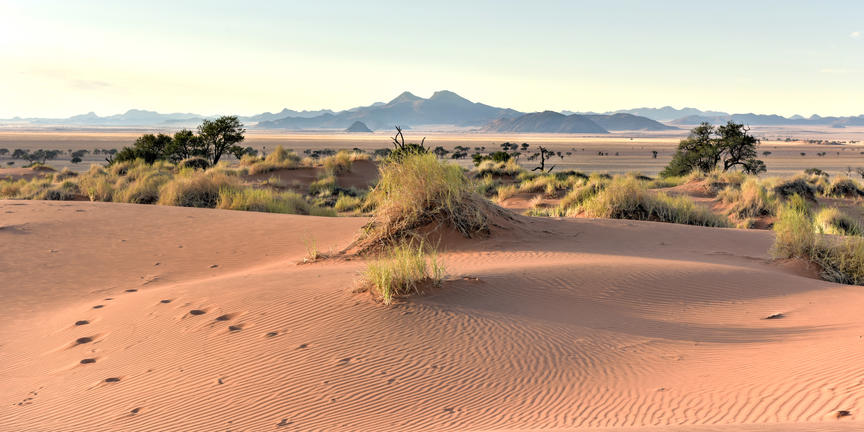
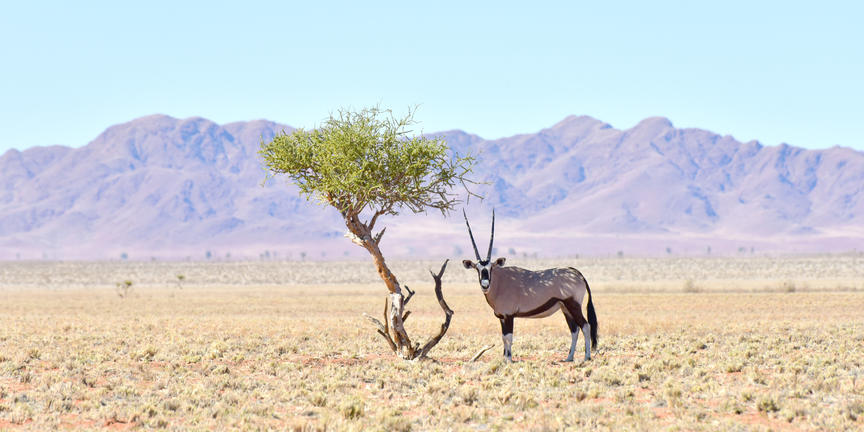
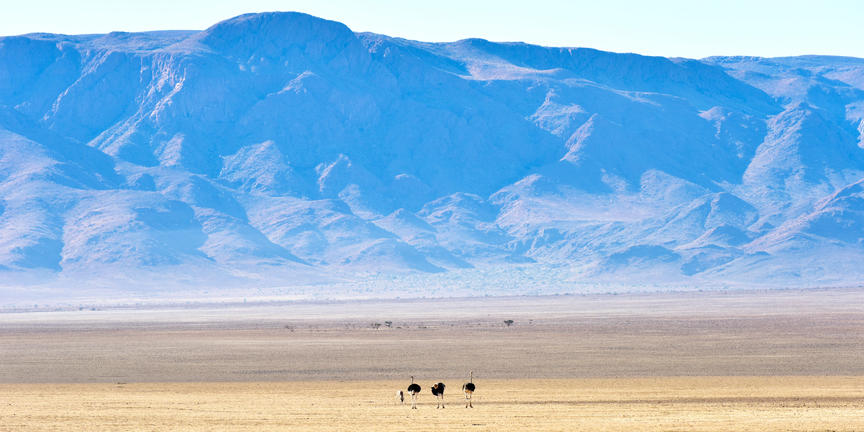
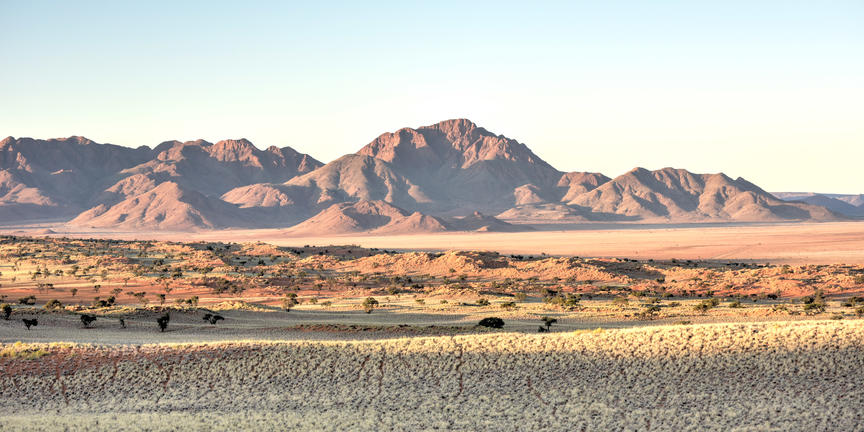
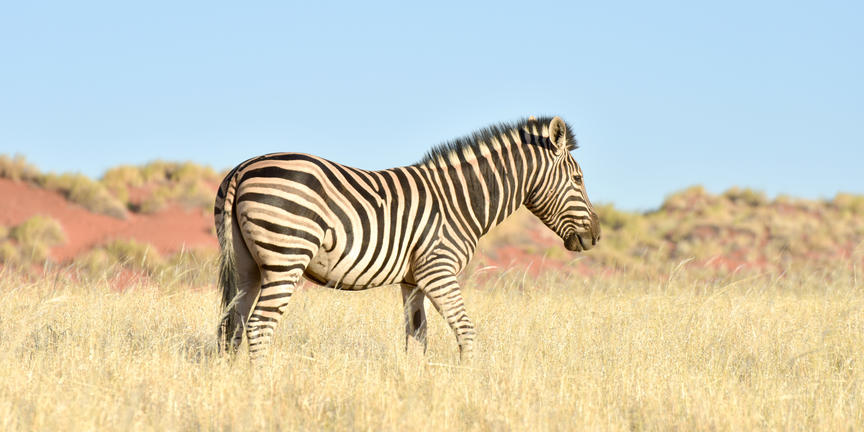
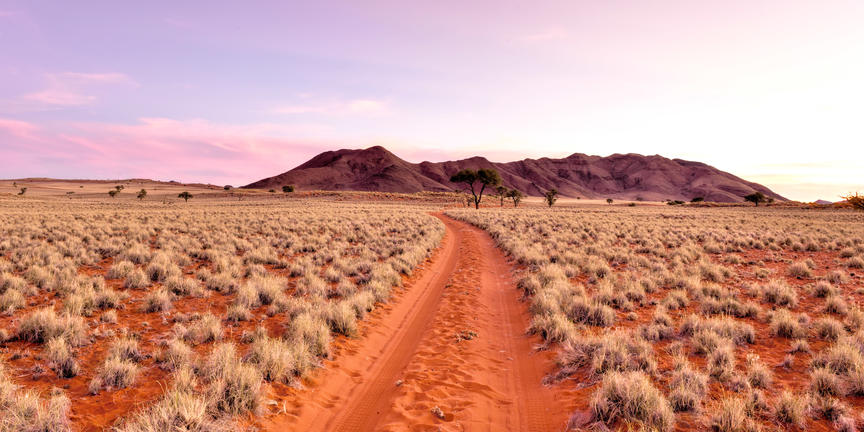
Spanning an area of 200,000 hectares and encompassing four distinct ecosystems, the Namib Rand Reserve is among the largest privately owned game parks in Southern Africa. Founded to conserve the unique environment and wildlife species of the south-western Namib Desert, the park’s mix of dunes, mountains, rocky outcrops, sandy flats and gravel plains provides habitats for a diversity of mammals – including hyenas, jackals, foxes, antelopes and various wild cats – as well as a plethora of bird species, reptiles, insects, frogs and flora. Visitors can discover the mysterious ‘fairy circles’, which dot the landscape and sip on sundowners while watching the sunset over this unspoilt ancient landscape. Having been named Africa’s first International Dark Sky Reserve, it is one of the least light-polluted areas in the world, so don't miss this excellent star gazing opportunity.


Set on the edge of the Swartrand escarpment and serving as a popular stopover for visitors travelling to Sossusvlei and the Duwisib Castle, the village of Maltahohe was established when the District Commissioner of 1899 decided that an outpost further west of the vast, Central Namibian district was required. Maltahohe is home to the oldest hotel in the country, equipped with its original bar and serves as an excellent base from which to explore the scenic surrounding area including a local farm 35 kilometres north of the town that has an 800-hectare shallow pan that, after flooding, is carpeted by a blanket of colourful lilies for about a week before they are devoured by elephant-nosed beetles. Visitors can also look forward to viewing the imposing Dutch Reformed Church in the heart of the village, watching a concert by the local Ama Buruxa choir group, and enjoy a hearty traditional meal. Maltahohe is the perfect spot to take a breather from the road and stock up on supplies before heading off again.


