


Bordering on South Africa, Namibia's southern region is equipped with wild desert landscapes and thrilling adventures. Sandy plains and jagged granite mountains make up Southern Namibia's gorgeous desert scenery. However, the standout highlight of the region is the world-famous Fish River Canyon. The nearby town of Kolmanskop is one of Namibia's most photographed places and lies on the edge of the Sperrgebiet National Park. At its border with South Africa, the Orange River meanders its way through barren lands filled with wildlife such as springbok and oryx, set against a backdrop of apricot dunes and silvery plains.

Southern Namibia is home to the second-largest canyon globally and is one of Namibia's most remarkable geological wonders - Fish River Canyon. Plunging ravines and looming rock faces dominate the landscape, with natural hot springs dotted throughout the area. Dramatic sunrises cast heavy shadows while light plays on the rocks; various breath-taking views unfold one after another throughout the day. Yet, gazing at the starry night sky after dark is undoubtedly one of the most sought-after experiences. With the ever-changing crevasses and the raw magnitude of nature’s creation, this canyon is not to be forgotten.


Namibia's colourful and unique town of Luderitz is located on the Atlantic Ocean shoreline, where coastal rocks meet the Namib Desert. Despite the waves and winds brought by the Benguela Current, the town is home to an abundance of marine life and birds. Flamingo and penguin colonies can be found nestled on the rocky coasts of the Lüderitz Peninsula, while the Sperrgebiet National Park preserves the areas wildest landscape. Bogenfels Arch, located just outside of town, is a 30m natural arch carved in the cliff face. Luderitz has kept its sleepy old-world atmosphere throughout the years and begs to be explored.

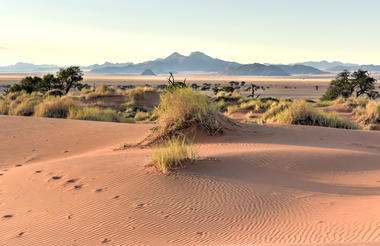
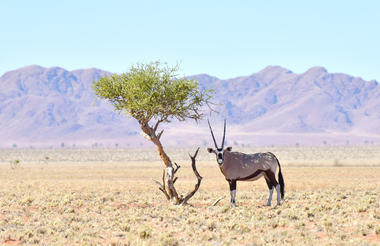
The NamibRand Nature Reserve, located in southern Namibia, is privately established to help protect the unique ecosystems and animals of the Namib Desert. Being the largest private reserve in Africa, the dramatic landscapes consist of sand dunes, gravel plains and rocky mountains. Several activities are to be had amid one of Namibia’s most breathtaking environments - the nature walks and thrilling night-time game drives are a must! The mars-like stretch of land homes animals in abundance - from herds of oryx and springbok to the hyenas and leopards lurking in the shadows - just waiting to be found.
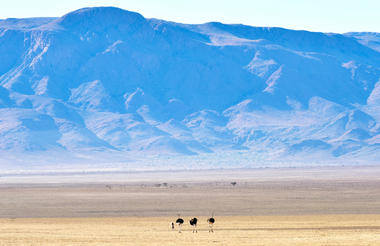
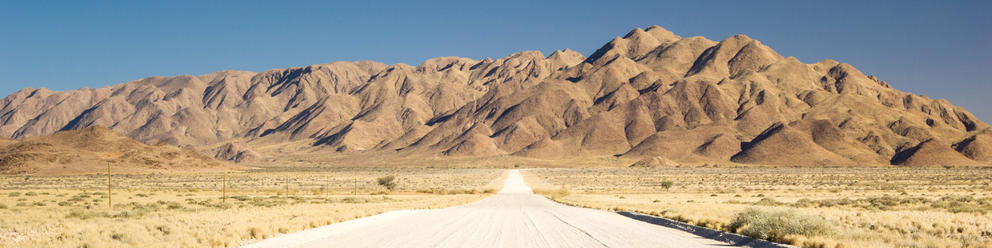
The Naukluft Mountains are perched in the centre of Namibia, making a striking silhouette against the vast, open skies. Several private farms occupy the range's northern reaches, while the spectacular Namib-Naukluft National Park lies south. The rugged landscape of Central Namibia rises steeply from the plains and has a fascinating history, interesting geology and a variety of deep gorges. An array of wildlife can be found in the area, including over 50 species of mammals, such as leopards and zebras, and more than 200 species of birds. Here, the air is crystal clear, and sunsets over the mountains are breathtaking.
Swakopmund, known simply as ‘Swakop’ to Namibians, is the capital of the Erongo Region. It was founded in 1892 and was regarded at the time as Germany’s main port in South-West Africa. The townscape of this small town is characterised by numerous historic buildings from the German colonial era: wide streets, German street names, German pubs, cafés and bakeries. During the colonial era, ‘Swakop’ was described as ‘Germany’s southernmost coastal town’. Even today, German is still spoken everywhere. Swakop offers many tourist attractions, such as charming pubs, a beautiful seafront promenade, an aquarium and much more. You can go on lovely day trips to the surrounding area, such as south to Walvis Bay or north to Cape Cross to visit the largest seal colony on the African mainland. In and around Swakop, there are plenty of activities on offer, such as boat trips to see seals, exciting desert tours, quad bike safaris, kayaking trips and helicopter flights. You’ll be spoilt for choice.


Outjo’s central position makes it an excellent stopover en route to Etosha National Park, the Skeleton Coast or Damaraland, but that’s not the only reason to visit this small town. It’s also a charming getaway boasting attractive forest and savannah surrounds, hospitable locals and several historical sites. Roughly an hour’s drive to the west you will find the Ugab Rock Finger, a 35-metre high stone monolith, while slightly further on is a 250-million year old petrified forest.
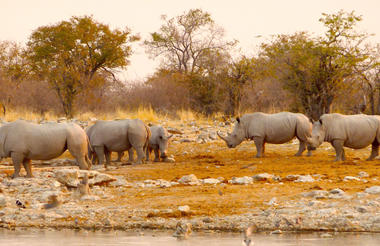
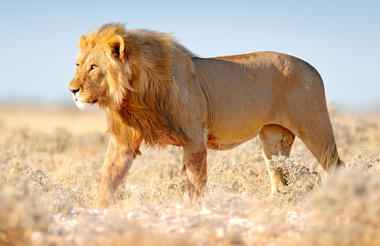
Featuring breath-taking panoramas, unforgettable sunsets, and abundant wildlife, Etosha National Park is Namibia's premier wilderness conservation area. The Etosha Pan - a shallow salt pan covering an area of 5.000 Square kilometres lies in the heart of the park. Natural springs are found in this dry terrain, making for excellent game viewing. Throughout the Park, the landscape is generally flat, with various habitats ranging from mopane woodland to wide, open, virtually treeless plains. Etosha is home to one of the world's most stable black rhino populations, along with lion, elephant, leopard, cheetah, and hyena.
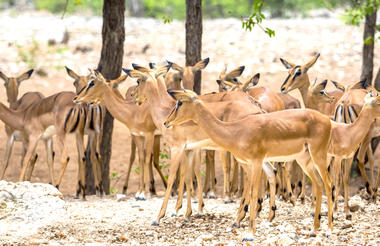
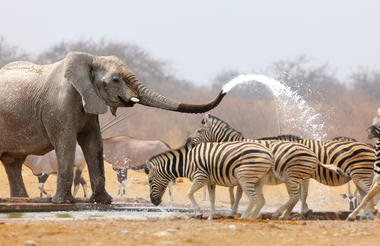
Etosha's southernmost section is known for its rich population of both white and black rhino. Etosha South is home to the Okaukuejo Rest Camp, which is famous for its floodlit waterhole. The many viewpoints overlook picturesque bush-scapes and abundant wildlife. Getting into the South is accessible by Andersson's Gate. Here, visitors can expect to see many animals, including lion and the rare, black-faced impala. However, the most notable of animals found here are elephants. Enjoy guided nature walks, game drives, or simply watching the sunset from this breath-taking location.


Surrounded by grassland and mopane shrublands, eastern Etosha is best-known for its remarkable variety of wildlife. Springbok are found abundantly within this region, while the many waterholes attract black rhinoceros and various antelope. During the rainy season, animals tend to migrate near the eastern Von Lindequist Gate. Makalani palms sway around waterholes on this side of the park, and the nearby pans are hotspots for blushing pink flamingos. Pure bliss is finding a quiet spot to wait for action, be it zebra jostling for a drink or sudden drama as elephant arrive in rumbling groups to quench their thirst.
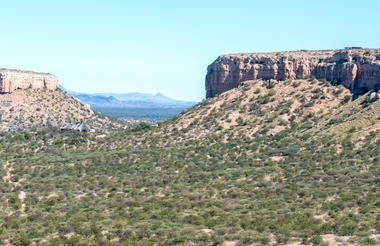
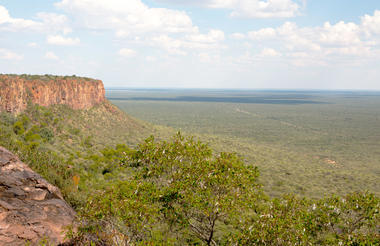
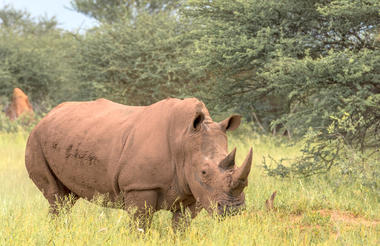
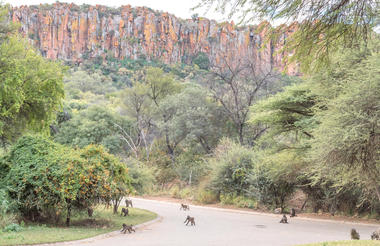
With its striking copper and red sandstone cliffs, Waterberg Plateau is one of Namibia's most magnificent natural wonders. Surrounded by freshwater springs, the brick-red peaks rise up out of the surrounding Namibian savannah, overlooking the Kalahari Desert. Dinosaur footprints, mysterious rock engravings and a thriving number of Black and White Rhino scatter the plains. Natural canyons of the plateau feature open grasslands and lush woodlands. With vivid landscapes and an indescribable atmosphere, Waterberg is a must-do when visiting the country. The sheer beauty of the plateau is an unforgettable experience.
The capital Windhoek (translated as “windy corner”) is the political, cultural, industrial and economic center of Namibia with 400,000 inhabitants. Windhoek was founded on October 18, 1890, when the foundation stone for what is now known as the “Alte Feste” fortress was laid. Other popular sites include the Tintenpalast, the Christuskirche, the Kaisergymnasium and the Heinitz und Sanderburg. The quiet and well-organized city with a colonial German touch, offers German restaurants and shops, a widespread use of the German language, the celebration of German customs (such as Carnival or Oktoberfest) - the German tradition is reflected everywhere. Even the beer is still brewed according to the German "Reinheitsgebot" (special purity law). Mixed with African traditions and roots, Windhoek offers a unique atmosphere and a relaxed lifestyle that makes the city so endearing.


