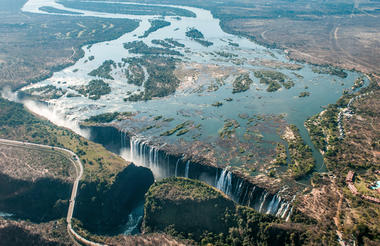
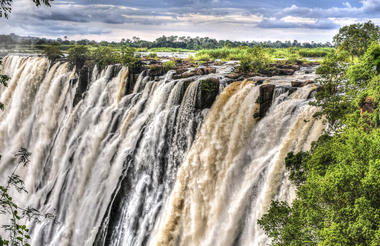
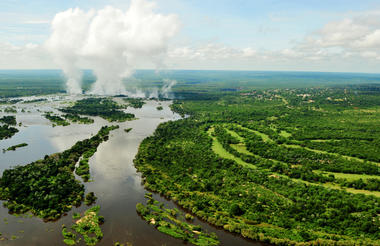
Situated on the Zambia–Zimbabwe border along the Zambezi River, Victoria Falls is experienced from the Zambian side within Mosi-oa-Tunya National Park, where walkways trace the cliff edge above a vast basalt gorge. Knife Edge Bridge pushes visitors into the spray line for a close view of the Main Falls, a continuous curtain of water, and the Eastern Cataract, where the flow breaks into narrower channels across the far side. Rainbow Falls, the highest section of the cascade, often reveals shifting arcs of colour in fine mist when light breaks through the spray. The Boiling Pot viewpoint looks directly into a deep whirlpool where the river is forced into the Batoka Gorge. Upstream, boat access reaches Livingstone Island, a rocky outcrop on the lip of the falls, and the seasonal Devil’s Pool, a natural rock pool at the edge of Victoria Falls that becomes safely accessible during low water when river levels drop and currents weaken. Activities extend beyond the rim, including white-water rafting through gorge rapids, kayaking, ziplining across the chasm, bungee jumping from the bridge, bridge swings, sunset cruises, game viewing along the riverbanks, and visits to the local market.
The Chobe River forms the northern boundary of Chobe National Park and is one of southern Africa’s most rewarding wildlife riverfronts, especially in the dry season when animals concentrate along its banks. Elephant herds gather in large numbers at the water’s edge, hippos crowd the channels, and buffalo move regularly through the floodplain grasslands, while lions range through the wider system and may hunt buffalo in the surrounding landscape. The river also supports exceptional birdlife across reeds, sandbanks, and woodland edges, and visitors typically explore it through guided game drives on designated park tracks as well as boat safaris that bring them level with elephants and hippos along the shoreline.