Hwange National Park dominates nearly 15,000km² of western Zimbabwe. The areas’ status as the royal hunting ground of Mzilikazi, King of the Matabele people, in the 1800s testifies to its superior quality as a wildlife destination. https://www.youtube.com/watch?v=HG2P-UpFJHw
The Park hosts over 100 mammal and 400 bird species, including 19 large herbivores and eight large carnivores. All Zimbabwe's specially protected animals are to be found in Hwange and it is the only protected area where gemsbok and brown hyena occur in reasonable numbers.
Grazing herbivores are more common in the Main Camp Wild Area and Linkwasha Concession Area, with mixed feeders more common in the Robins and Sinamatella Wild Areas, which are more heavily wooded. Distribution fluctuates seasonally, with large herbivores concentrating in areas where intensive water pumping is maintained during the dry season.
The population of African wild dogs to be found in Hwange is thought to be of one of the larger surviving groups in Africa today, along with that of Kruger National Park and Selous Game Reserve. Other major predators include the lion, whose distribution and hunting in Hwange is strongly related to the pans and waterholes, leopard, spotted hyena and cheetah.
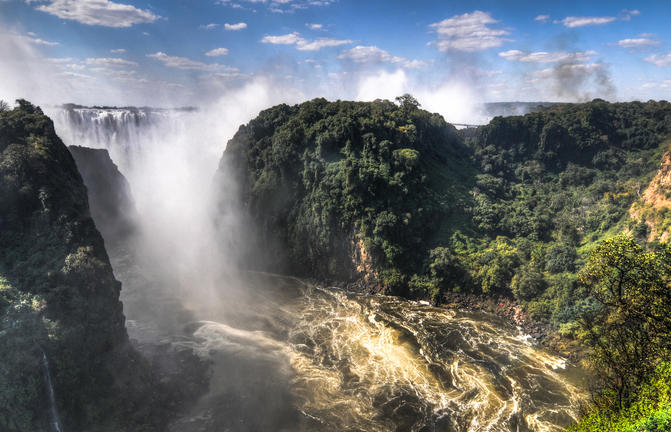
Victoria Falls also known as "Mosi oa-Tunya" ("the smoke that thunders") is positioned almost exactly half way along the mighty Zambezi River's 2700 km journey from it's source to the sea. Here the river plunges headlong into a 100m vertical chasm spanning the full one-and-a-half kilometre width of the river. Creating the biggest curtain of falling water in the world and also one of the seven natural wonders of the world.
https://www.youtube.com/watch?v=XCXPRtPnUac
The power of the falls is awesome with the highest ever flow recorded in 1958 when it reached more than 700 000 cubic meters of water a minute. The water in the gorges rose 18 metres (60 feet) above its normal flood level.
This constant pounding by the currents of the mighty Zambezi has, over the millennium, cut through the rock faults and fissures and carved out not one but eight successive precipices (and now the ninth has begun). When our early ancestors inhabited this area some 1.5 million years ago , they would have seen a different Victoria falls to he one we see today.
Being one of the greatest physical spectacles in Africa it stands to reason that it has attracted so much much interest from us humans over time and therefore the area is steeped in history and mystery.