
Ecuador, a jewel of 109,483 square miles in northwestern South America, sits proudly on the Equator between Colombia and Peru. This enchanting land is home to the majestic Northern Andes, the verdant edges of the Amazon Basin, and a Pacific coastline caressed by both warm and cold ocean currents. Farther out, 600 miles offshore, the legendary Galapagos Islands await—a world of wonder and discovery.
From the towering peaks of the Andes to the vibrant biodiversity of the Galapagos, Ecuador promises an experience unlike any other. Here, ancient cultures thrive alongside stunning natural beauty, inviting you to explore, connect, and marvel. Whether hiking among volcanic landscapes, wandering through historic colonial cities, or encountering wildlife found nowhere else on Earth, Ecuador will leave you inspired and transformed.
Different parts of the island have varied origins, some with fresh lavas and spatter cones and others consisting of eroded tuff formations. Baltra Island used to be a US Air Force Base during World War II.
American soldiers in Baltra Island patrolled the nearby waters of the Pacific Ocean, including the entrance to the Panama Canal, for enemy aircraft carriers, warships, and submarines. When the war ended, the facilities in Baltra Island were handed over to the Ecuadorian Government.
Up until 1986, Baltra Island was home to the only airport in the Galapagos Islands. The airport now shares flights to the Galapagos with the San Cristobal Island airport, but it still receives the majority of flights from the mainland. Most cruise operators also start their cruise operations from Baltra Island. Also, because of its proximity to the largest port town in the Galapagos Islands (Puerto Ayora), most tourists who do island-based tours choose to arrive at the airport on Baltra Island.


North Seymour is an excellent nesting site for magnificent frigate birds and blue-footed boobies. Sea lions are also a common resident.
The island consists of a series of submarine lavas containing layers of calcareous sediment uplifted by tectonic activity. North Seymour Island was lifted from the ocean floor by a seismic event, and its origins as a seabed give the island its low, flat profile. Cliffs only a few meters long-form the shoreline, where swallow-tailed gulls sit perched in ledges. A tiny forest of silver-grey Palo Santo trees stands just above the landing at North Seymour Island, usually without leaves, waiting for the rain to bring them into bloom. Prickly pear cacti are also very common in the edges of cliffs and shores.
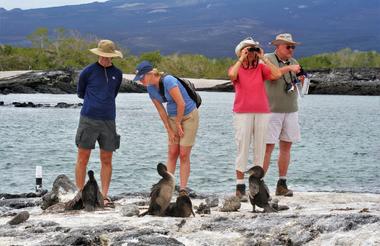
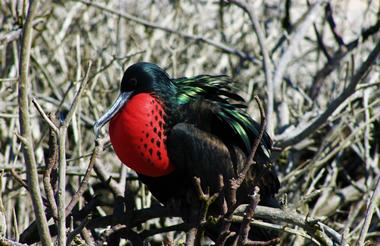
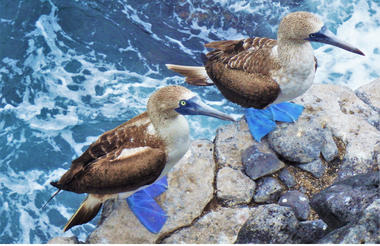
North Seymour is teeming with life and is an excellent visitor site on your Galapagos cruise! You might have to give way to a passing sea lion or marine iguana. Blue-footed boobies nest on either side of the trail where mating pairs perform their courtship dance. Further along the rocky shore, a strand of white sand lies inland, and large flocks of sea birds mass for outstanding feeding frenzies, rendering a tableau for us from ages long past. The trail in North Seymour Island turns inland to reveal the largest nesting site in the Galapagos of the magnificent frigate bird. These huge, dark acrobats have 5-foot wingspan, and males, with inflated scarlet gular pouches, sit precariously in low bushes to watch over their equally fat chicks.


As previously described


By definition, this is a bird Island! Also known as Tower Island, this island is home to red-footed boobies, masked boobies, frigate birds and swallow-tailed gulls nesting. Moreover, red-billed tropicbirds nest on the cliffs and short-eared owls are often spotted. The vegetation of Tower Island is typical of the Arid Zone, and the tree called palo santo (holy stick) is small in size and abundant.
Genovesa Island lava originated primarily from a crater found in the center of the island, forming a shield volcano. The crater is circular, approximately 2000 feet wide at the rim and 200 feet deep, with a lake 1150 feet across on its floor.
Genovesa Island is possibly one of the most exciting Islands of the archipelago to visit on a Galapagos cruise! It could serve as a film set for a secret submarine base! The southwestern part of Tower Island is an ocean-filled caldera ringed by the outer edges of a sizeable and mostly submerged volcano. The island sits to the northeast, somewhat removed from the Galapagos archipelago. It is also known as "Bird Island," a name it lives up to in a spectacular way. Landing on the white coral sands of Darwin Bay and walking up the beach, you will be surrounded by the bustling activity of magnificent frigate birds.
Puffball-chicks with their proud papas - who sport their bulging scarlet throat-sacks - crowd the surrounding branches, while both yellow-crowned and lava herons feed by the shore. Farther along, you will discover a stunning series of sheltered pools set into a rocky outcrop, forming another natural film set. A trail beside the pools leads up to a cliff overlooking the caldera, where pairs of swallow-tailed gulls, the only nocturnal gulls in the world, can be seen nesting at the cliff's edge. Lava gulls and pintail ducks ride the sea breezes nearby.
Across the bay is Prince Philip's Steps, named for a visit by the British Monarch in 1964. The 81-foot stairway leads to a narrow stretch of land that opens out onto the plateau surrounding Darwin Bay and extends to form the north side of the island. Red-footed boobies wrap their webbed feet around branches to perch in the bushes, and, in contrast, their "Nazca booby" cousins dot the surface of the scrublands beyond. Crossing through the sparse vegetation, you will come to a broad lava field that extends towards the sea-this forms the north shore. Storm petrels flutter out over the ocean in swarms, then return to nest in the cracks and tunnels of the lava field, where their predator, the short-eared owl, is a frequent visitor.


Darwin Bay is a nesting spot for many marine birds. Puffball chicks of Great frigate birds and their proud papas crowd the surrounding branches, while yellow-crowned herons and lava herons feed by the shore. Watch your step for marine iguanas, lava lizards and Galapagos doves that blend with the trail. Swallow-tailed gulls, the only nocturnal gulls in the world, can be seen nesting at the cliff’s edge. Lava gulls and pintail ducks ride the sea breezes nearby.
As previously described


Besides land iguanas, South Plaza has one of the most significant sea lion colonies in the archipelago.
South Plaza Island is one of two small adjacent islets uplifted from beneath the sea by faulting or tectonic activity.
This is the southern partner of two small crescent-shaped islands that lie just a few hundred meters off the east coast of Santa Cruz Island. South Plaza Island is one of the most minor yet richest islands in the archipelago. Only 426 feet, it was formed from uplifted seabed, giving it a titled tabletop quality. Our landing is in the channel between North and South Plaza Island, where the island tilts toward the water.
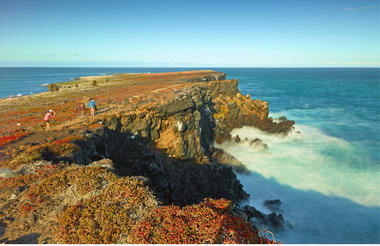
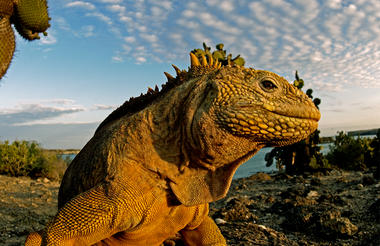
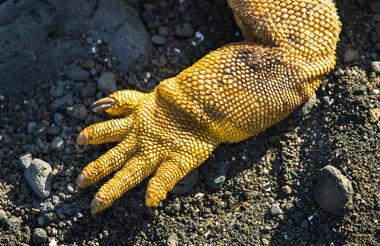
The approach makes for a lavishly, colorful sight! The turquoise waters of the channel contrast brilliantly with the black lava of the shoreline. The rocks have grown thick with green seaweed in places, speckled with bright orange Sally lightfoot crabs. Further up the shore of South Plaza Island, a carpet of scarlet ice plant (Sesuvium) serves as groundcover for a grove of luminescent green prickly-pear cactus. Yellow-gray land iguanas sit beneath, waiting patiently for pears to drop.
The trail on South Plaza Island gradually follows the tilt of the island to the cliffs that overlook the ocean to the south, where swallow-tailed gulls nest. Red-billed tropicbirds, Nazca, and blue-footed boobies ride the windy currents. An overlook is an excellent place for spotting abundant marine life, including manta rays. Surf pounds an inlet at the western corner of the island, where a colony of male sea lions makes their home at what is referred to as a bachelor's site. The oils from their fur leave the surrounding rocks looking polished and shiny.

Santa Fe Island is one in which lavas were extruded beneath the sea and later were uplifted (although recent evidence suggests subsequent sub-aerial activity); the island is crossed by several parallel cliffs formed by fault activity. This island has lavas of 3.9 million years of age, making it the oldest island successfully dated in the archipelago.
Santa Fe Island besides offering one of the more beautiful and sheltered coves in the islands it also has endemic species of land iguana, endemic species of rice rat, subspecies of cacti, beautiful landscape. Its turquoise lagoon is protected by a peninsula of tiny islets forming an ideal anchorage. The island lies southeast of Santa Cruz Island within sight of Puerto Ayora. Geologically it is one of the oldest islands in the archipelago and for many years, was thought to be a product of an uplift event. Through satellite imagery, it has been possible to determine the island's volcanic origins.
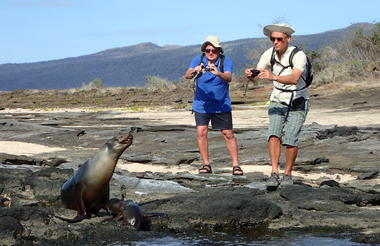
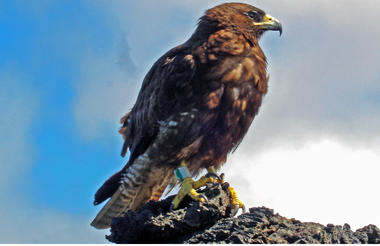
A Santa Fe Galapagos travel adventure includes a wet landing on a sandy white beach that brings visitors into contact with one of many sea lion colonies. Bulls contend for the right of being the Beach Master, while smaller males mask as females to make stealthy mating moves. Galapagos hawks are often easily approached, perched atop salt bushes, and an ascending trail leads toward the cliffs, where a dense thicket stands to the inland side. The cliffside provides an expansive view of the ocean. The giant prickly pear cactus found here live up to their name, with tree-sized trunks!

As previously described

As previously described
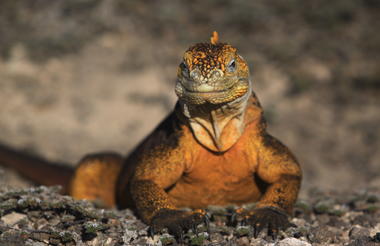
San Cristobal Island is made up of two coalesced volcanoes. The southwestern half is asymmetric shield volcano made up of gently-dipping lavas and capped by a thick, deeply-weathered pyroclastic blanket and numerous satellite cinder cones. The southwestern shield became emergent around 2.4 million years ago; activity continued up to about 650,000 years ago. The northeastern half of the island is a more recently active volcano, dominated by eruptions from NE-trending fissures. The most recent flows are no more than a few centuries old.
San Cristobal Island is the only island with permanent freshwater, located near the highest part of the island (south) in a small lake called El Junco. The southern portion of the island is characterized by its rich vegetation, a result of the more humid climate.
Charles Darwin reported encountering a pair of giant tortoises feeding on cactus during his first landing on San Cristobal Island in 1835. Today the airport of this easternmost island in the chain is increasingly used as the arrival point for flights into and out of the Galapagos. The administrative capital for the province is Puerto Baquerizo Moreno on the southwestern shore, and in 1998 the Galapagos National Park Interpretation Centre opened for the benefit of islanders and travelers alike, presenting a comprehensive exhibit of the islands' natural history, human interaction, ecosystems, flora, and fauna. It is also the place where cultural activities take place, including theatre, exhibitions and workshops. From the Interpretation Center, a 3-kilometer loop trail arrives at Frigate Bird Hill, where both magnificent-frigates” and great-frigates can be seen in the same colony—ideal for learning to distinguish the two bird species. A 45-minute bus ride from town takes you to “El Junco,” one of the few permanent freshwater lagoons in the islands. Its location in the highlands of San Cristóbal ( 2,300 feet or 700 meters ) ensures our passage through a variety of vegetation zones. The lagoon on San Cristobal Island offers a scenic setting for exceptional bird watching including frigate birds that, in spite of being sea birds, go there to rinse the accumulated salt from their feathers.
Heading up the coast from Wreck Bay and Puerto Baquerizo, you will see Isla Lobos across a small channel off the coast of San Cristobal Island. This basalt island outcropping lives up to its name of “Sea Lion Island,” with its noisy population of frolicking and barking beasts. It is also a nesting place for blue-footed boobies and an excellent spot for snorkeling while on Galapagos cruises.
Playa Ochoa is located 6 miles from Puerto Baquerizo Moreno, the capital of San Cristobal Island and the Galapagos. The beach is small with easy access; here you'll find the Chatham mockingbird and various species of Darwin finches. Toward the rear of the beach is a little hyper-saline pond where white cheek pintails can often be seen wading. The beach also provides a chance for some introductory snorkeling.
Leon Dormido, also know as Kicker Rock, is a spectacular formation that rises 152 meters ( 500 feet ) out of the Pacific 4 miles off the central western coast of San Cristóbal. It takes the form of a sleeping lion or the Sphinx if you look at the rock from the south, but from the north, you can see that the stone is split, forming a large tablet and, piercing the sea, an excellent chisel ready for etching. Small vessels can navigate through the narrow channel between the two rocks that form Kicker Rock.
La Galapaguera is a tortoise reserve in seminatural conditions. This beautiful facility was built by the Galapagos National Park Service to provide the chance for visitors to San Cristobal Island to take a look at another race of giant tortoise, the Saddle Back. To reach the reserve, it's necessary to take a bus across the island from west to east. The ride takes 1 hour and the facility offers a dirt trail of easy access where 25 adult tortoises can be found in company with the very first babies to be born in captivity in this facility.


As previously described


As previously described


As previously described


As previously described
As previously described
Hood Island, or Espanola Island, is the southernmost island of the archipelago and is one of the most popular due to the breathtaking variation and a sheer number of fauna that greet the visitors.
A relatively flat island, with some hills; considered as one of the islands whose lavas were extruded beneath the sea and later uplifted to form the island. A group of geologists found evidence (1980) of volcanic activity, which occurred after the uplift.
On the northeastern shore of Hood Island, Gardner Bay offers a magnificent long white sandy beach, where colonies of sea lions laze in the sun, sea turtles swim offshore, and inquisitive Hood mockingbirds boldly investigate new arrivals. Your Galapagos cruise yacht will be anchored just a few hundred feet away. You will be lured into the turquoise water for a swim, but just a little further off-shore, the snorkeling by Tortuga Rock and Gardner Island offers peak encounters with playful young sea lions and large schools of surprisingly big tropical fish, including yellow-tailed surgeonfish, king angelfish and bump-head parrotfish. Sleepy white-tipped reef sharks can be seen napping on the bottom and sometimes Hammerhead sharks in a nearby location.
The quantity and variety of wildlife at Punta Suarez, on Hood Island, is remarkable. Sea lions surf the waves beyond the breakwater landing, and tiny pups are known to greet your toes upon arrival. A few steps inland you will find the most peculiar population of marine iguanas in the Galapagos. They bear distinctive red markings, some with a flash of turquoise running down their spine and legs, and nap in communal piles. The trail then takes us beside the western edge of the island where Nazca boobies (formerly known as Masked boobies) nest along the cliff’s edge and then descends to a rocky beach before rising to an open area and a large gathering of nesting blue-foot boobies. Galapagos doves, cactus finch, and mocking birds forage nearby, unconcerned by human presence on all of Hood Island. The trail continues to the high cliff edge of the southern shore; below, a shelf of black lava reaches out into the surf where a blowhole shoots a geyser of ocean water into the air. Within this area, along the cliffs is the “Albatross Airport” where “Waved albatross” line up to launch their great winged bodies from the cliffs, soaring out over the dramatic shoreline of crashing waves and driven spray. In the trees set back from the cliff is one of only two places in the world where the Waved albatross nests. In fact, the 13,000 pairs that inhabit Hood Island constitute a total endemic population of this species of birds, with the exception of a very small population that occasionally nest elsewhere on the continental part of Ecuador. Lucky visitors can watch courtship ‘fencing’ done with great yellow beaks and necks among the large, fluffy, perfectly camouflaged chicks. Mating occurs year-round.
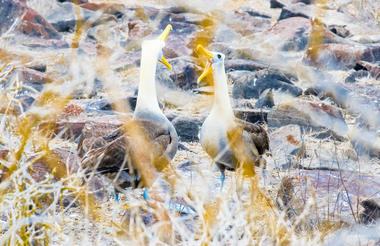


As previously described
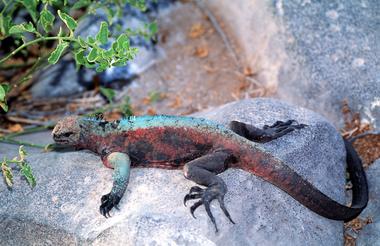

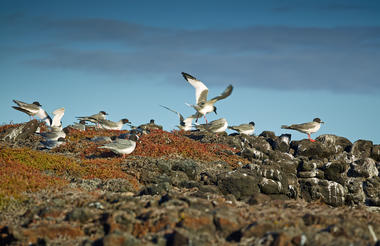
As previously described
Floreana is composed of a series of eroded volcanic hills whose form makes it virtually impossible to identify a central volcano. There are no signs of recent volcanic activity.
As reflected in its many names, Floreana Island has had a colorful history: Pirates, whalers, convicts, and a small band of somewhat peculiar colonists—a self-proclaimed Baroness among them—who chose a Robinson Crusoe’s existence that ended in mystery and death. Today roughly a hundred Ecuadorians inhabit the island. In 1793 British whalers set up a barrel as Floreana Island's Post Office to send letters home on passing ships. The tradition continues to this day, only by dropping a postcard into the barrel without a stamp. The catch is you must take a letter from the barrel and see that it gets to the right place. That is how the system began and continues to this day.
Punta Cormorant in Floreana Island offers two highly contrasting beaches; the strand where we land is composed of volcanic olivine crystals giving it a greenish tint that glitters in the sun. We descend here on our Galapagos cruises, and a trail crosses the neck of an isthmus—that rises from behind a small cinder cone—to a beach of very fine white sand known as “Flour Beach.” The erosion of coral skeletons formed Flour Beach. Between the two shores of Floreana Island is a hyper-saline lagoon frequented by flamingoes, pintails, stilts and other wading birds. Some 700 ft. north from the point is an old submerged volcanic cone that has been worn down by waves; Devil's Crown is home to a myriad of marine species including several species of corals, sea urchins, and many other creatures including a significant number of fish species, making this place one of the best snorkeling sites in the Galapagos. The eroded crater walls of Devil's Crown form a popular roosting site for sea birds including boobies and pelicans.

As previously described


As previously described


