
AM: Arrival in Baltra Island.
Your guide will escort you to the M/C Seaman. This is a short transfer from the airport to Baltra´s dock. Boarding and cabin assignment. Lunch on board.
PM: North Seymour Island
North Seymour is an uplifted (as opposed to volcanic) island. Therefore, it is generally flat and strewn with boulders. There are good nesting sites here for a large population of magnificent frigate birds. Blue-footed boobies perform their courtship dance in the more open areas and swallow-tailed gulls perch on the cliff edges.
Despite the tremendous surf that can pound the outer shore, sea lions haul out onto the beach and can be found bodysurfing.


AM: Genovesa Island, El Barranco
The visitor site of El Barranco is located in the southern part of Darwin Bay from Genovesa Island. The trail is on volcanic rock, consists of 1.5 km, and can be done in about 2 hours. The youngest area of the island, from a geological point of view, lies in this area. The cliff is located in the south, is composed of very fragile lava. The natural erosion in these lava flows has become the ideal place for nesting Storm Petrels. You can see two species of petrels that nest in cavities and holes in the lava.
One of its main predators is the short-eared owl. The red-footed booby nests only in the outer islands of the archipelago, Punta Pitt, Gardner (Floreana), Wolf, Darwin, and Genovesa. Also present on this island is the masked booby. During the “panga rides” along the cliffs, fur sea lions and several species of seabirds can be seen.
PM: Genovesa Island: Darwin Bay
This bay has its origin when the crater of this island collapsed below sea level. The wet landing is on a beautiful white coral sandy beach. This is a favorite island for birdwatchers that allow the following species to be seen: red footed-booby, masked boobies, wandering tattlers, lava gulls, whimbrels, yellow-crowned, and black-crowned lava herons, and yellow warblers.
Continuing on the trail, visitors climb gradually to the edge of the cliff seeing Red-Foots nesting in the Mangrove trees below. Bird watching includes sightings of sharp-beaked finches, large cactus and ground finches, Galapagos doves, and swallow-tailed gulls. Reaching the end of the trail, at the cliff's edge, an incredible view of the island and the many birds living there can be observed.


AM: Plazas, Santa Cruz
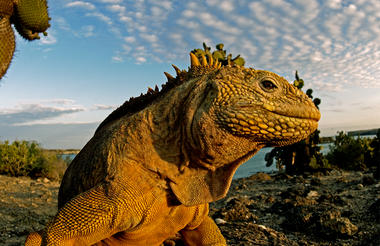
Plazas Islands are located at the east of Santa Cruz Island and forms part of two islands known as Islas Plazas. Despite its small size, some of the most interesting and outstanding species of the Galapagos are found here. The Plaza's land iguanas are smaller than their relatives found on other islands.
Throughout the island are several hybrid iguanas, a result of crossing a male marine iguana and a female land iguana, they are unique, recognizable at first glance by their black/gray color, with a land iguana's crest, but face and tail of the marine iguana. The big population of iguanas is due to the presence of tunas, their favorite food. Swallow-tailed gulls nesting in the rugged cliffs is seen along with other seabirds as Audubon shearwaters, red-billed tropicbirds, frigate birds, and brown pelicans.
PM: Santa Fe Island
Located in the southeastern part of the Galapagos, this island was formed from an uplift instead of a volcanic origin, this is why it is mostly flat. There are some theories that assure this could be the oldest island in the Archipelago. Santa Fe is the home of a number of endemic species like the Galapagos hawk, Galapagos snake, Galapagos mockingbird, rice rats, and one of the two species of land Iguanas of the islands.
After disembarking in the beautiful and clear waters you will be in contact with one of the many sea lion colonies. Along the trail many salt bushes can be seen as well giant Prickly pear cactus: gigantism is a characteristic of oceanic islands. There are great possibilities of snorkeling with playful sea lions and tropical fish.

AM: San Cristobal, Cerro Colorado
At the Jacinto Gordillo Breeding Center, located in Cerro Colorado, San Cristobal Island, a breeding and rearing facility for young tortoises was established in 2004. Named after a prominent settler, the center was established to care for young tortoises. In 2008, an assisted reproduction program was initiated on the island following the birth of a turtle in captivity. Visitors to the center can learn about breeding processes and actively engage in understanding the center's mission and activities.
AM: San Cristobal, Interpretation Center
The interpretation center boasts lush gardens and breathtaking ocean vistas. Visitors can delve into the rich geological and human history of the islands, learn about conservation efforts, and explore the natural history of the region. As the oldest museum of Natural History in the Galapagos Islands, its mission is to preserve the archipelago. Witnessing their research and conservation efforts firsthand is both inspiring and motivating.


AM: San Cristobal, The Galapaguera
A short visit will take place at the Galapaguera, a good place to observe Galapagos tortoises in their natural habitat. San Cristobal Island has endemic species such as the Mockingbird (Nesomimus melanotis), lava lizard (Microlophus bivittatus), Chatham Leaf-toed Gecko (Phyllodactylus leei), and the tortoises. All of these species can be observed in this place; the beach is really big and serves as a nesting zone for marine tortoises. Between January and May, it is common to find the footprints of female tortoises who have climbed to the dunes to deposit their eggs. This truly is a worthy experience to be a part of.
PM: Cerro Brujo
Cerro Brujo is a beautiful white coral beach where you can swim, watch birds, and sea lions, and snorkel. This is the first coast where Charles Darwin walked in 1835. In this marvelous lava landscape, you can watch seabirds like blue-footed boobies, Nazca boobies, herons, frigate birds, and shorebirds. The protected bay is well known for its young tortoises which like to swim around. The pools with salty water behind the dunes were used by the fishermen as a salt mine to preserve food for the local population. Among the fauna, you can observe the Chatham Mockingbird and the San Cristobal Lava Lizards, both species are endemic to the island and unique to the area. Furthermore, you will see the Galapagos turtles, and with luck, the little bird known as the Pájaro Brujo in Spanish, an endemic species in San Cristobal Island. The vegetation covers the entire route, where you can find species like the candelabrum cactus and carob trees. Located on the north coast of Isla San Cristobal, it is a peaceful place with white sand and crystal water, a perfect combination for an incredible stay.


AM: Gardner Bay, Española Island
Situated on the northeastern coast of Hood, Gardner Bay offers an excellent beach for relaxation, swimming, and even kayaking, along with the opportunity to observe sea lions (Zalophus wollebaki). Here, you can also witness sharks in the crystal-clear ocean waters. This location is renowned for its sighting of three species of Darwin finches: a subspecies of the large-billed cactus finch (Geospiza fuliginosa), resembling the large-billed terrestrial finch, the small-beaked ground finch (Geospiza fuliginosa), and the singing finch (Certhidea Olivacea), another endemic subspecies. Both resident and migratory birds can be observed here.
PM: Suarez Point, Española Island
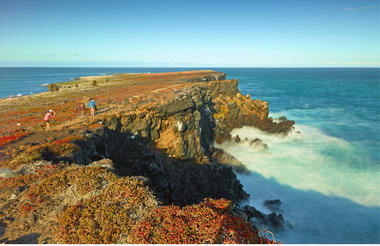
This area is ideal for spotting blue-footed boobies, albatrosses, and Nazca boobies. Along the beautiful oceanfront, the large waved albatrosses utilize the cliff as a launching pad. The highlight is the magnificent blowhole, ejecting water high into the air, reaching heights of 50 to 75 meters. This site offers splendid photographic opportunities.


AM: Cormorant Point, Champion Islet, Floreana Island
This site offers probably the best flamingo lagoon in the Galapagos; it is also one of the largest in the islands. Situated between two tuff lava cones, it gives the area a special atmosphere. Besides flamingos, there are various species of shorebirds to observe, with the most frequent being common stilts, white-checked pintail ducks, and other migratory birds. It is fascinating to see the two distinct beaches: "The Green Beach" (due to its high percentage of olivine crystals in the sand) and the "Flour Sand Beach," which is made up of coral. After the interesting walk, the group is taken to Champion Islet, a great place to enjoy snorkeling and underwater wildlife. Some of the animals that can be seen include sea turtles, sea lions, and multiple fish, thanks to the nearby coral reef.
PM: Post Office Bay, Floreana Island
Historically, this site is the location of a wooden barrel that was placed in the 18th century by the crew of a whaling ship. It has been used since this time by mariners and tourists as a post office. The idea is to carry letters or postcards to their destination by hand. Besides, this site was the landing area for some of the first colonists. This afternoon is thought to be a relaxing time for visitors to enjoy the beach and the beauty of the Galapagos.


AM: Turtles Trail, Baltra Island
Although the great majority of Galapagos visitors come here to observe and appreciate natural wonders, it is also interesting to learn how the protection and conservation of the islands are carried out. This path offers the possibility to learn aspects and feel synchronized with nature. After the morning excursion, you will be taken to the airport for your flight to the mainland. Transfer to Baltra airport.


