


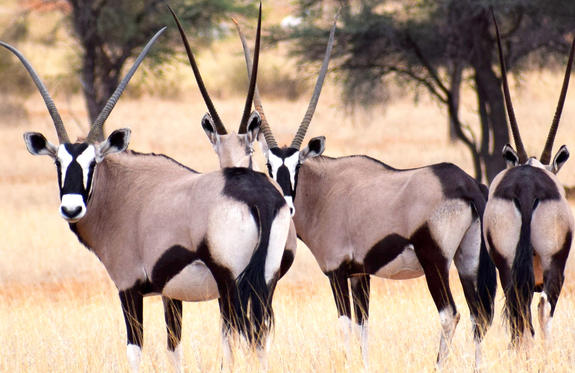
Spreading across Botswana, South Africa and Namibia, the Kalahari, meaning 'the great thirst', is an exceptionally beautiful living desert. The landscape is characterised by a large semi-arid sandy savannah, draped over a gently rolling inland sea of sand that covers most of Botswana and large parts of Namibia and South Africa. It is inhabited by the indigenous San people, with the modern world having enveloped all the other areas they once roamed. The Namibian portion is made up of red sands covered in thin, wispy, mostly golden grass and dotted with acacia trees and wide-ranging wildlife, including gemsbok, impala, jackals and cheetah.

Deep within Namibia’s Namib Desert, Sossusvlei is a striking landscape of towering red sand dunes, among the highest in the world, pale salt pans and immense open skies. Part of the Namib-Naukluft National Park, it has a remote, almost otherworldly atmosphere shaped by silence, shifting light and extreme desert conditions. Visitors can climb famous dunes such as Big Daddy or Dune 45 at sunrise, when the sand glows orange and shadows stretch dramatically across the valley floor. Nearby Deadvlei, with its blackened camel thorn trees standing against white clay and rust-coloured dunes, offers one of southern Africa’s most distinctive desert scenes. The dry heat, the soft crunch of sand underfoot and the vast sense of space create a powerful atmosphere, though early starts and challenging temperatures are part of exploring this remarkable region.

Set between the rolling dunes of the Namib Desert and the icy Atlantic coastline, Swakopmund is a relaxed seaside town in western Namibia known for its German colonial architecture, cool coastal climate, and adventurous spirit. Palm-lined streets, historic buildings, and ocean fog create an atmosphere unlike anywhere else in the country. Travellers visit for desert activities such as quad biking, sandboarding, and scenic flights over vast dunes and shipwreck-strewn shores. Cafés, bakeries, and small museums add to the town's laid-back charm, though the Atlantic waters are brisk rather than tropical. With its striking desert-meets-ocean setting and mix of adventure and history, Swakopmund is one of Namibia's most distinctive destinations.

Situated in northwestern Namibia, the Brandberg, meaning 'Fire Mountain', Massif is Namibia’s highest peak, at its zenith, the Königstein (King’s Stone), standing at a whopping 2573 metres above sea level. Named for the vivid shade of orange it sometimes turns at sunset, this is undoubtedly the main highlight of the region. The Brandberg has been sacred to the San people for centuries. The Tsisab Ravine at its base is permeated with over 45 000 ancient San rock paintings, including the famous ‘White Lady’. Visitors flock here to view this unique bushman painting, said to be over 2000 years old. Other popular drawcards include its untouched natural beauty and its free-roaming wildlife such as mountain zebra, kudu, springbok, and desert elephant.

Situated along the southern boundary of Etosha National Park in northwestern Namibia, Etosha South encompasses the park's southern safari region and a collection of private game reserves and lodges. The park is accessed via Andersson Gate, placing visitors within easy reach of renowned waterholes and excellent wildlife viewing. Lions, elephants, giraffes, white and black rhinos, and a wide variety of antelope are among the species commonly seen. Guided 4×4 game drives are the main attraction, with half- and full-day safaris available, some including picnic lunches in the bush.

Located along the eastern boundary of Etosha National Park in northern Namibia, Etosha East is a rewarding safari destination known for its excellent wildlife viewing and convenient access to the park through the Von Lindequist Gate near Namutoni. Characterised by open savannah, mopane woodland and seasonal waterholes, the region attracts an abundance of wildlife, including elephant, lion, giraffe, zebra and a variety of antelope species. Visitors can enjoy self-drive or guided game drives, with the waterholes offering some of the best opportunities to observe animals gathering to drink, particularly during the dry season. Golden grasslands, distant birdsong and expansive African skies create an immersive safari experience in one of Namibia's most celebrated conservation areas.

Set in the heart of Namibia’s Otjozondjupa region, Otjiwa Game Reserve spans 12,000 hectares of open bushveld, rolling plains and acacia-studded savanna. The reserve exudes a serene and private atmosphere, where wildlife roams freely, and the horizon stretches unbroken beneath vast African skies. Visitors can embark on guided game drives to spot giraffe, zebra, antelope and rhino, or enjoy walking safaris that reveal the subtle rhythms of the bush. At sunrise, the air carries the scent of dry grass and earth, while the calls of birds and distant wildlife punctuate the quiet, a place where Namibia’s wild beauty is both immersive and unforgettable.


