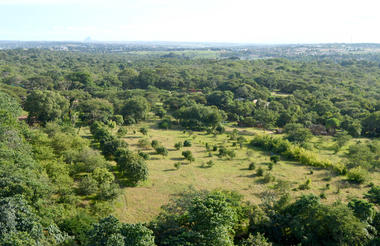
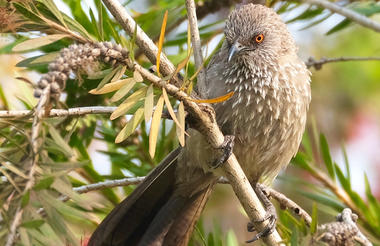
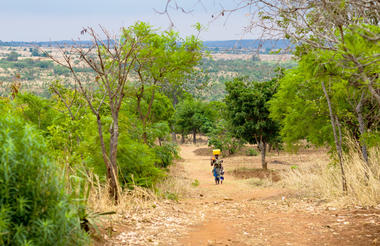
Located between Blantyre and Mount Mulanje in what is arguably the most beautiful region of Malawi, the town of Thyolo serves as the administrative capital of the Thyolo District. The area is best known for its historical tea and coffee estates, some of which date back as far as the early 1900s. With its tidy landscape of undulating hills and immaculately kept tea and coffee estates, the Thyolo area is a pleasure to explore whether by bike, vehicle, or on foot. Magnificent views of Mount Mulanje and the Shire River Valley in the distance are a highlight of the region, as are the excellent opportunities for birding, hiking, and mountain biking. Some of the estates also offer guided tours where one can explore the farm, learn how the plantations work, and enjoy tea or coffee tastings.


Liwonde National Park lies along the Shire River in southern Malawi. One of the country's premier safari destinations, it is celebrated for its abundant wildlife, scenic river landscapes and successful conservation initiatives. The park is home to large populations of elephants, hippos and crocodiles, while black rhinos, cheetahs and lions have been successfully reintroduced. Boat safaris offer close-up wildlife encounters, complemented by game drives through floodplains, mopane woodlands and open grasslands. Liwonde is also one of Malawi's leading birdwatching destinations, with more than 400 recorded species, and its palm-fringed riverbanks create striking scenery for photographers and nature lovers alike.


Dedza District is a large area in Malawi’s Central Region, best known for its four forest reserves. Of these, the most exceptional is Chongoni, which encompasses an archaeological area featuring over 100 ancient rock art sites. Scientists believe these were made in the Stone and Iron Ages, constituting the most significant collection of cave paintings in Central Africa. Dedza Mountain is a popular hiking spot - it stands at over 2 000 metres and takes about two hours to reach the top. At the base of the mountain lies the capital of the region, Dedza City, surrounded by forested hills. It is a convenient place to stock up on essentials and buy local pottery, for which the area is famous.


Nyika is Malawi’s largest park extending across the great plateau which rises up to 1800m. Aside from conventional safaris Nyika is wonderful for walking, mountain biking and horse riding safaris, as well as more 4x4 excursions. And it is not just the game that attracts visitors the rolling scenery is often covered in wildflowers and in the rainy season when over 200 types of orchid are in flower. Animals include duiker, eland, roan, leopard, zebra, lion, elephants and buffalo. And there are over 400 species of birds.


Although in Mozambican waters Likoma Island is Malawian territory. This is where the headquarters of the University Mission to Central Africa (Livingstone’s mission) were set up and hence it remained British territory when the Lake was divided politically after World War II. Likoma is reached by the Ilala Ferry, boat or charter aircraft. The island is famous for its cathedral which is as big as Winchester Cathedral although situated on a little, sparsely inhabited island. The vast building, which was begun in 1903, has numerous interesting stained glass and carved soapstone features.

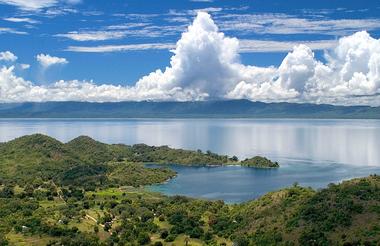

At 1,050 metres above sea level in Malawi's central region, Lilongwe bridges traditional and modern Africa within its dual cityscape. The Old Town, characterised by bustling markets, small shops, and historic golf clubs, contrasts sharply with the organised structure of the New Town, a hub of embassies, government ministries, and modern infrastructure. Lilongwe's lush green spaces, particularly the Lilongwe Nature Sanctuary, provide an urban oasis that rehabilitates injured animals while promoting environmental education. The Kamuzu Mausoleum, built of marble and granite, is the final resting place of Malawi's first president, with pillars bearing his principles of unity, loyalty, obedience, and discipline. The Parliament Building, located near Capital Hill, houses the government's operations and is an example of modern Malawian architecture. Other sights worth seeing include a day trip to the Kumbali Cultural Centre, offering the opportunity to view traditional Malawian dancing and drumming, as well as an excursion to Chongoni Rock Art Area featuring one of the densest clusters of rock art in Central Africa.