
One of the most culturally and geographically diverse places on earth, South Africa, fondly known by locals as the 'Rainbow Nation', boasts 11 official languages, and its inhabitants are influenced by a fascinating mix of cultures. Discover the gourmet restaurants, impressive art scene, vibrant nightlife, and beautiful beaches of Cape Town. Enjoy a local braai (barbecue) in the Soweto township, browse the bustling Indian markets in Durban, or sample some of the world's finest wines at the myriad wine estates dotting the Cape Winelands. Some historical attractions to explore include the Zululand battlefields of KwaZulu-Natal, the Apartheid Museum in Johannesburg, and Robben Island, just off the coast of Cape Town. Above all else, its untamed wilderness is astonishing: wildlife roams freely across massive unfenced game reserves such as the world-famous Kruger National Park.

The interior of the Northern Cape is known as the Great Karoo with vast majestic vistas in every direction. Here you will find diamond town of Kimberley. Once the second largest settlement in South Africa and home to the first stock exchange in the country, Kimberley was also the first town in the southern hemisphere to install electric street lights.
For visitors, Kimberley is best known for the Big Hole, all that was left by the early Diamond Rush. It is amazing to think that it was dug by hand. The Big Hole as well as the restored diamond village, forms the Kimberley Mine Museum. There’s a reconstruction of a typical Kimberley Street during the diamond boom. There is also a remarkable display of vintage cars.
The other fascinating aspect of Kimberley for history enthusiasts is that it is surrounded by some well-known battle sites of the Anglo-Boer War such as Magersfontein Battlefield and Modder River Battlefield. The Magersfontein site can be easily visited under your own steam, but we recommend a private tour with a local guide.
Originally called Olijvenhoutsdrift, the historic town of Upington is set in the Northern Cape Province of South Africa. The Orange River Valley runs through the harsh and mysterious Kalahari landscape that surrounds Upington and it becomes obvious why this area is known as the Green Kalahari, with fertile valleys contrasted against semi-desert. Upington offers lush manicured gardens, stately trees lining wide boulevards and colourful flowers, creating a sense of peace and serenity. Meanwhile, the town’s bustling business centre provides visitors with more lively entertainment. Upington serves as the gateway to the impressive Augrabies Falls and to the expansive wilderness of the Kgalagadi Transfrontier Park. Visitors can learn about local history at the Kalahari Orange Museum, enjoy wine tasting at the local Orange River Wine Cellars, or take a sunset cruise down the Orange River on a floating bar.
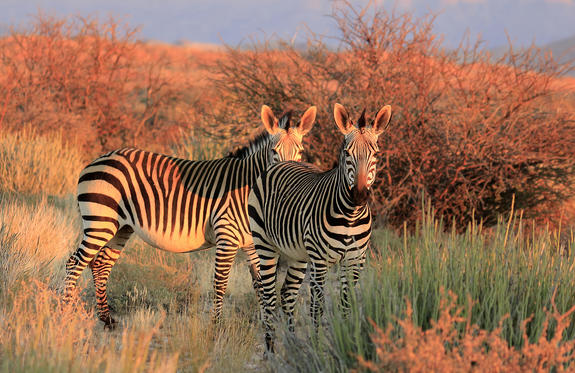
Located in southwestern Africa, Namibia boasts a well-developed infrastructure, some of the best tourist facilities in Africa, and an impressive list of breathtaking natural wonders. Visitors can explore the capital of Windhoek and discover the lovely coastal town of Swakopmund boasting remnants of the country’s German influence, reflected in the architecture, culture, cuisine and the annual Oktoberfest celebrations. To properly appreciate this extraordinary country, you will have to venture out of the cities to explore the remarkable natural landscapes Namibia has to offer. These include: the impressive Fish River Canyon; the vast Etosha National Park teeming with abundant wildlife, such as lions, desert-adapted elephants and the Hartmann's Mountain Zebra; the hauntingly beautiful Kalahari Desert; and of course the Namib Desert stretching for over 2000 km along the magnificent Atlantic Coast. Namibia is an ideal destination for travellers seeking an unforgettable African experience in a uniquely beautiful untamed wilderness.

Second in size only to the Grand Canyon in the USA, the Fish River Canyon is one of the world's great natural wonders. But unlike its more famous big brother, you will not have to share the experience with thousands of other people. Its comparative remoteness means that it is little visited. It meanders for 160km through the barren landscape of southern Namibia, reaching a depth of 550m and a width of 27km. Geologically, it is in fact a canyon within a canyon. The legendary origin of the canyon, according to local San hunters, is that a serpent retreated into the desert to escape hunters and carved deep scars into the earth there.
We suggest an early start to appreciate the majesty of the canyon before the strong light washes the colour of the rocks away. There are several viewpoints, which give magnificent vistas of the canyon. You might also like to walk along the canyon edge to gain a perspective on its size as there is a track which follows the edge.
In the dry winter months, you can undertake a multi-day hike through the dry and stony canyon. It is too hot to undertake in summer. At the bottom part of the canyon are the hot springs of Ai-Ais which you may like to visit.

This southern seaside town is something of an anomaly – a piece of 19th century Bavaria bordering the pinkish sand dunes of the Namib Desert. Indeed the isolation of Luderitz, and the way in which its colonial-style buildings cling to the rocks overlooking the bay, give the town a curious otherworldly allure. Luderitz is renowned for its distinctly German colonial architecture. Lutheran churches, German bakeries and colonial buildings are all around the bay. Their gables, winding stairwells, verandas, turrets and bow windows gives these buildings a unique, somewhat surreal character. One of the most dramatic is Goerkehaus on the slopes of Diamond Mountain, built in 1909. The 1912 Felsenkirche (Evangelical Lutheran Church) looks especially striking in the late afternoon when the stained-glass windows are illuminated by the setting sun.
Around the fishing town, its windswept beaches are home to flamingos, ostriches, seals and penguins. On some days the water of the Atlantic Ocean is a deep iridescent blue, on others it is grey and stormy. Fishing boats bob up and down, whilst penguins and seals dive beneath the waves.
The old ghost town of Kolmanskop, a few kilometres east of Luderitz, is a fascinating place to visit. It dates back from the days of the diamond rush. The shifting dunes, fierce winds and salt-laden mist have reduced this once thriving community to ruins. The crumbling grandeur of these magnificent old 'diamond' houses creates an unforgettable atmosphere. Everywhere there are eery reminders of an opulent lifestyle. En route to Luderitz you may like to detour in search of the famous feral horses of Aus.

Set on the Trans-Namib Railway in the ǁKaras region of southern Namibia, the town of Keetmanshoop is known as the capital of southern Namibia. Founded in 1860, the quaint oasis is a living slice of history. German colonial architecture is dotted around the town and the local museum, housed in an old church, provides interesting insight into the town’s heritage. Just a short drive out of town, the Quiver Tree Forest is a sea of spikes and twisted trunks, while the neighbouring ‘Giant’s Playground’ is an evocative expanse of strange rock formations. Both offer superb opportunities for photography, particularly at sunset.
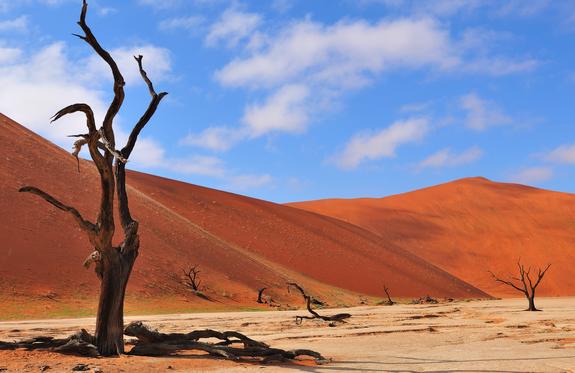
Sossusvlei in the Namib Desert rivals a visit to Etosha as the highlight of a Namibian safari. Surrounded by its distinctive dunes of red-orange sand, Sossusvlei is especially breath-taking in the early morning, when the dunes are transformed into explosions of colour by the first rays of the sun.
Typically you rise with the sun to see this exhilarating sight - some of the largest dunes in the world, rising more than 1000 feet above the desert. This is paradise for the photographer, as the shadows create a magnificent contrast of colours. Marvel at the gemsbok and other animals that manage to survive in these dry conditions. The energetic can climb one of the dunes such as Dune 45 or Big Daddy, for a panorama of the endless dune landscape and the changing play of light. Afterwards you may like to visit Sesriem Canyon. Unless you have your own 4x4 vehicle, you’ll need to join an organized excursion from your Sossusvlei lodge as the final approach is deep sand.
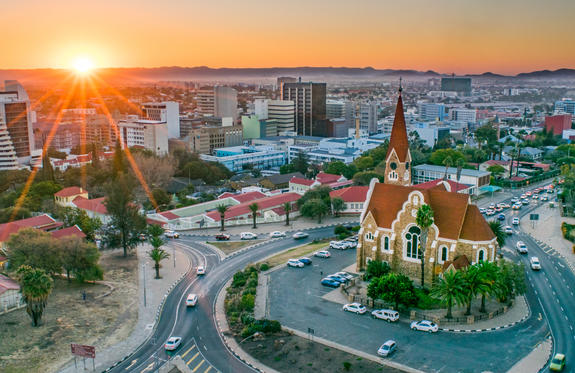
Windhoek is one of the most appealing of African capitals, surrounded by the Central Highlands with its rolling hills, acacia trees and dramatic ridges. The city is clean, safe and well-organised, with a colonial legacy that is reflected in its many German eateries and shops, and the widespread use of the German language.
You will almost certainly need one overnight stop here. It is a small city with a population of about 200,000 and thus the centre of the city can easily be explored on foot. A spare afternoon can be spent browsing the friendly street markets - perhaps buying jewellery, leather goods or African crafts. You also get to understand something of the cultural diversity of Namibia. As you walk the city streets, the different dress of passers-by gives a clue to the origins of each person.
Windhoek has an interesting mix of historical architecture and modern buildings, many of which are worth a look. Its Germanic roots are much in evidence with late 19th/early 20th century Germanic architecture such as the 1896 Christuskirche, the Tintenpalast, the Alte Fest (old fort) and the three castles of Schwerinburg, Sanderburg and Heinitzburg.

The Waterberg Region incorporates the Waterberg Plateau National Park and the farming districts from Outjo and Otjiwarongo in the west to Grootfontein and Tsumeb in the west.

The Etosha National Park is Namibia’s premier safari park and is one of the finest parks in Africa in season. It encloses a vast saltpan that becomes an immense, shallow lake in rainy periods, attracting great numbers of flamingos and other water birds. The surrounding open plains are home to tens of thousands of animals with large herds of springbok, gemsbok, zebra, wildebeest, elephant and, of course, the predators - particularly cheetah and lion. The diminutive Damara dik-dik is one of the more rare and delightful animals seen here. Raptors such as Bateleur, Pale Chanting Goshawk and Red-necked Falcon are fairly common.
Another attraction is the vast Etosha pan itself, once the inland delta of the Kunene River. The river’s course changed millions of years ago, leaving behind a salt encrusted barren, shallow depression. Dry and shimmering for most of the year, the pans fill up with water after good rains. In the dry season wildlife is attracted to perennial springs and waterholes that makes for excellent game viewing.
Within the park are three large rest camps catering for those on a modest budget, and a couple of eco-lodges. Other smarter options are situated just outside the park gates.
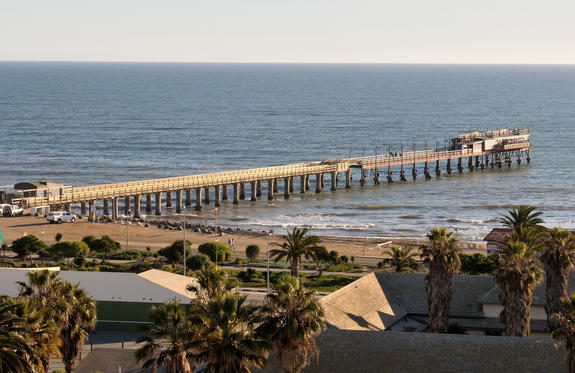
Swakopmund has a distinctive continental atmosphere and many picturesque reminders of the German colonial era, somewhat incongruous in the midst of the Namib Desert! (Founded in 1892 as the main harbour for Namibia, Swakopmund is often described as being more German than Germany.) Now this charming seaside town, with its palm-lined streets, provides a welcome resting place where you can stroll along the beach, enjoy superb seafood or marvel at the High German architecture. The quirky mix of German and Namibian influences, colonial-era buildings and the cool sea breeze contrast with the arid interior.
There's plenty to see in and around Swakopmund such as visiting the Seal Colony at Cape Cross, the flamingos at Walvis Bay and Sandwich Bay. Take a drive to the surreal landscape of the 'Moon Mountains', an area of deep chasms and interesting geological features, or perhaps try some sand-boarding, quad-biking or riding a camel into the desert. There are plenty of day excursions to choose from, even aerial flights over the Namib Desert.

Resting on Namibia's spectacular coastline just south of Swakopmund, Walvis Bay (Whale Bay) is a thriving town, Namibia’s principal harbour and one of the country’s most popular tourist centres. It is known for its natural lagoon, striking orange sand dunes and wealth of outdoor activities. Visitors can enjoy fishing, bird-watching, sailing, sandboarding, swimming, surfing and golf. Located just outside town is Dune 7, one of the largest sand dunes in the world, offering fantastic views from the crest for those with the energy to climb it. Other bucket list items include a trip to the expansive green and pink salt pans dotted with flocks of flamingos, and boat trips to see seals colonies, dolphins and friendly pelicans while enjoying champagne and oysters.


