Depart from Pretoria at 11h00
After departing from Rovos Rail Station, the train heads south across the goldfields of the Witwatersrand. Lunch is served on board, with tea in the afternoon.
19h30 – Dinner is served in the dining cars en route to Kimberley. Dress: Formal
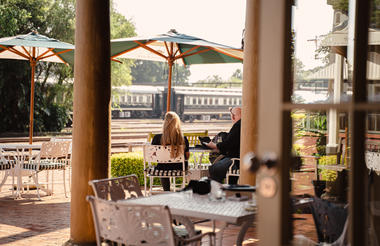
Kimberley & the Karoo
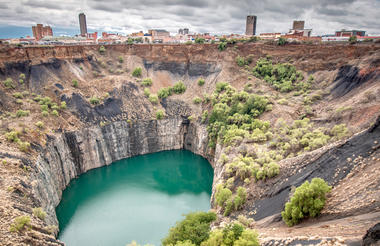
Enjoy a tour of Kimberley’s Diamond Mine Museum and the Big Hole. Capital of the Northern Cape, Kimberley is well-known for the discovery of diamonds that led to its establishment in 1871.
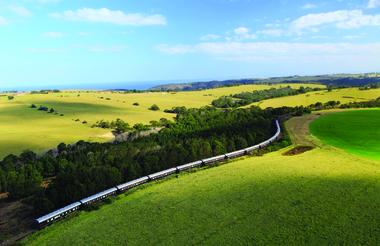
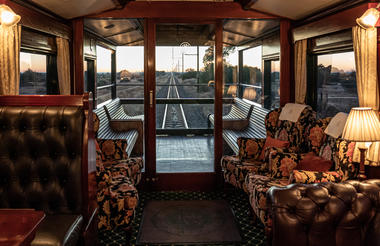
After lunch, the observation car will be leading the train until after tea – a different aspect that rail enthusiasts enjoy. Travel through the Karoo, a vast semi-desert region that was once an enormous inland sea. Over millions of years, volcanic matter was ground down and deposited as silt upon the seabed to form what geologists call the Karoo system.
19h30 – Dinner is served in the dining cars en route to De Aar, an important railway junction. Dress: Formal
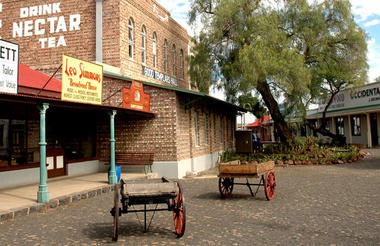
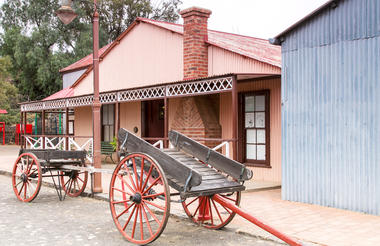
Upington & The Orange River
The Orange River is the longest river in South Africa (2432km/1511mi). It rises in the Drakensberg Mountains in Lesotho and flows westwards through South Africa to the Atlantic Ocean. It forms part of the borders between South Africa and Lesotho and South Africa and Namibia. Except for Upington, it does not pass through any major cities. Attorney General of the Cape, Sir Thomas Upington was principally responsible for liquidating the business activities of all the Orange River pirates and capturing their leader, Klaas Lucas. When the desperadoes were finally chased away in 1884, the town was founded on the banks of the Orange River and named in his honour.
16h00 – Enjoy a walking tour of Upington with a sundowner cruise on the Orange River.
19h30 – Dinner is served in the dining cars en route to Ariumsvlei for border formalities with Namibia. Dress: Formal

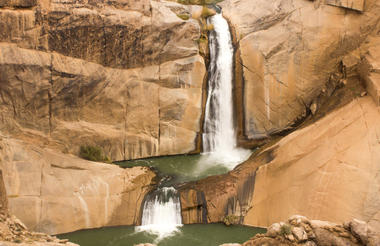

The Fish River Canyon
After breakfast, the train travels along the southern reaches of the Kalahari Basin towards the Fish River Canyon, where you'll stop for a day visit.
The Fish River rises in the centre of the country before flowing south into the Orange River on Namibia’s border with South Africa. It has formed the great Fish River Canyon – the largest canyon in the southern hemisphere and probably only second to Arizona’s Grand Canyon in terms of size. The vast rocky landscape breaks up into a series of spectacular cliffs. Its size is impressive: 161km long, up to 27km wide and almost 550m at its deepest.
19h30 – Dinner is served in the dining cars en route to Aus. Dress: Formal


Kolmanskop & Lüderitz
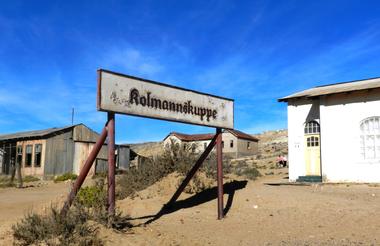
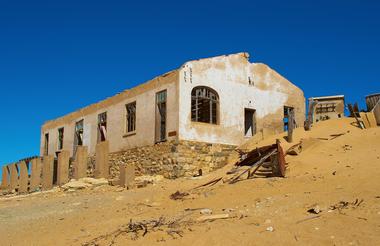
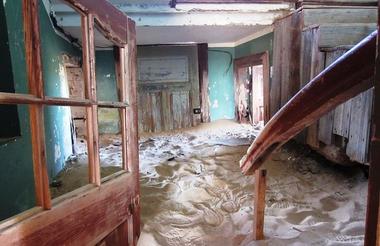
After breakfast, transfer (±60 min) to the ghost town of Kolmanskop followed by lunch in Lüderitz. Lüderitz is known for its museum, colonial architecture and wildlife including seals, penguins, flamingos and ostriches. Look out for the illusive legendary horses rumoured to roam the Namib.
In the early evening, return to the train and depart for Keetmanshoop. The observation car will be leading the train until after dinner.
19h30 – Dinner is served in the dining cars. Dress: Formal
Keetmanshoop & Garas Park
Visit Keetmanshoop and Garas Park (Quiver Trees), home to roughly 300 specimens of the Aloe dichotomy. The prehistoric trees have forked branches that reach up to 5m making for great photographic opportunities. Return to the train for lunch. Depart for Mariental.
Dinner is served in the dining cars en route to Rehoboth. Dress: Formal


Sossusvlei
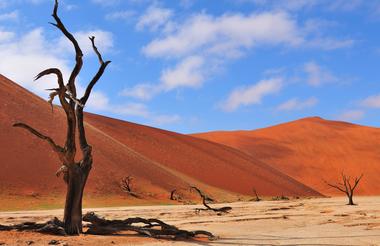
The dunes of the Namib Desert were created by sand carried by the wind from the coast of Namibia. The sand here is over five million years old and is red in colour due to its iron-oxide content. As the light changes during the day, so does the appearance of the dunes’ characteristic colour, allowing for interesting photographs at any time. The wind in the Sossusvlei area blows from all directions causing the sand to form a star shape with multiple arms, hence the name “star dunes”.
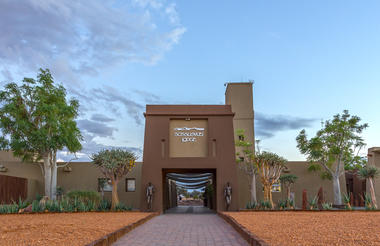
In the morning, transfer to the airstrip for departure in a light aircraft and a one-hour scenic flight to Sossusvlei Lodge. Enjoy an afternoon desert drive and a bush dinner after sunset.
Overnight at the lodge. Dress: Casual

Sossusvlei & Windhoek
After an early wake-up call with tea and coffee, enjoy a desert drive with breakfast in the vlei. Return to the lodge to use the facilities, check-out and transfer to the airstrip. Then, at 11h00, depart in a light aircraft for the one-hour flight to Windhoek.
Situated in Namibia’s central highlands, Windhoek is an attractive city surrounded by clusters of hills and the impressive Auas and Eros Mountains. The Trans-Namib Transport Museum outlines Namibian transport history, particularly that of the railway. The Independence Memorial Museum focuses on the anti-colonial resistance and the national liberation struggle of Namibia.
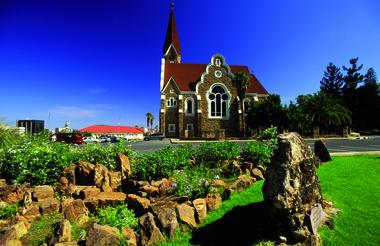
Have lunch at Windhoek Country Club followed by a city tour. Visit the Trans-Namib Transport Museum, the Independence Memorial Museum, the Evangelical Lutheran Church (a striking landmark) and the Namibia Craft Centre in the old Breweries Building. In the early evening, depart for Kranzberg.
19h30 – Dinner is served in the dining cars. Dress: Formal
Afternoon
Cheetah Conservation Project
In the afternoon, transfer (±60 min) to a cheetah conservation project in Otjiwarongo. Founded in Namibia in 1990, the Cheetah Conservation Fund (CCF) is dedicated to saving the cheetah in the wild.
In the early evening, depart for Otavi.
19h30 – Dinner is served in the dining cars. Dress: Formal


Etosha National Park
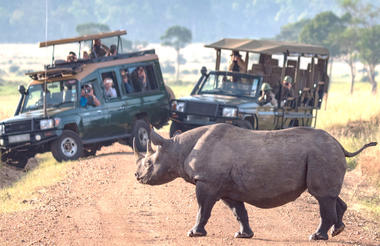
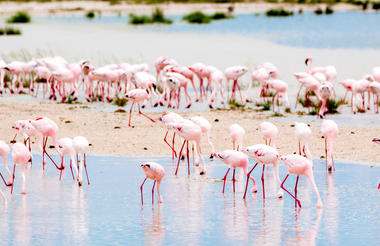
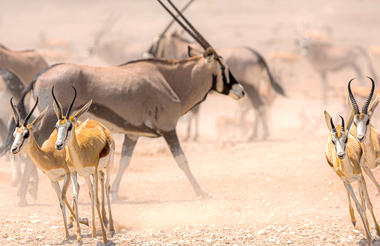
Etosha National Park (22 270km²) offers great game viewing with many species of mammals, birds and reptiles. It gets its name from the Etosha pan (4 760km²), which almost entirely lies within the park. Etosha is a large salt pan forming part of the Kalahari basin and means ‘Great White Place’.
After breakfast, transfer (±60 min) to an Etosha lodge for an overnight stay. Check-in and enjoy lunch.
15h00 – Afternoon game drive (approximately 3 hours).
19h30 – Dinner at the lodge and overnight. Dress: Casual
Etosha National Park
After an early wake-up call with tea and coffee, embark on an early-morning game drive in the Etosha National Park. Return to the lodge for a late breakfast and check-out. Then, transfer (±60 min) to the train at Tsumeb Station.
13h00 – Lunch is served in the dining cars. The observation car will be leading the train until tomorrow.
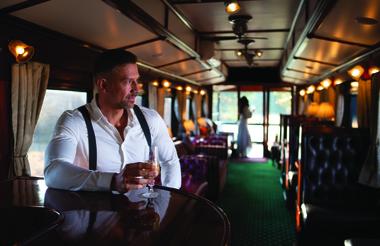
19h30 – Dinner is served in the dining cars. The train travels southwest towards the Atlantic Ocean. Dress: “1920s” Theme or Smart Casual
Morning
Early-morning game drive in Etosha National Park
Arrive in Walvis Bay via the Namib Desert
The Namib stretches for more than 2000km along the Atlantic coasts of Angola, Namibia and South Africa. The geology consists of sand seas near the coast while gravel plains and scattered mountain outcrops occur further inland. The name is of Khoekhoegowab origin and means “vast place”. Having endured arid or semi-arid conditions for roughly 55-80 million years, the Namib may be the oldest desert in the world.
Enjoy a final leisurely breakfast as you travel across the Namib Desert, arriving in Walvis Bay by 12 noon.