
AM: San Cristobal Island Airport: Arrival and Transfer to the boat
You will arrive at San Cristobal Island in the morning. After passing through immigration and baggage claim, you will be met by a Infinity staff member and transferred to the yacht. You will be shown to your cabin where you will have some time to settle in before lunch and a welcome briefing.
PM: San Cristobal Island: Puerto Chino or Breeding Center David Rodriguez
Puerto Chino is located 15,2 miles (24.5 km) away from Puerto Baquerizo Moreno and a few miles from the Breeding Center Cerro Colorado. This walk takes approximately 30 minutes to the beach. Puerto Chino, San Cristobal Island Possible Activities: Hiking, swimming, snorkeling Difficulty: Moderate/Difficult Type of Landing: Dry Landing Highlights & Animals: White sandy beach, sea birds, snorkeling Breeding Center David Rodriguez - “La Galapaguera”, in Cerro Colorado, is a new visitor site in the southeast part of San Cristobal Island and can now be reached in roughly one hour by road from Puerto Baquerizo Moreno. On the trees and shrubs surrounding the site, you may see land birds like warblers, finches and mockingbirds. Giant tortoises can be observed on the trails. They live there wild but in a protected area to ensure their survival by sealing them off from introduced predators like pigs and goats


PM: San Cristobal Island: Puerto Chino or Breeding Center David Rodriguez
- Possible Activities: Short hike (0,6 mi / 1 Km)
- Difficulty: Easy/Moderate
- Type of Landing: Dry Landing
- Highlights & Animals: Giant tortoises, finches, warblers, mockingbirds
AM: Santa Fé Island
Santa Fe Island (Barrington) is home to the small picturesque bay and anchorage on the island’s northeast coast. The bay has two visitor trails: one leading to a scenic viewpoint atop a cliff, and the other spanning from a small beach to a tall prickly pear cactus forest
PM: South Plaza Island
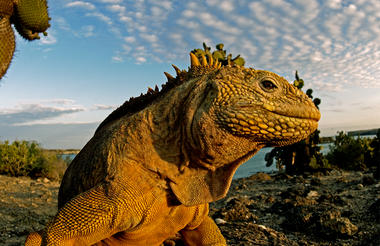
This small island with steep cliffs was formed by rising lava and is now covered by Opuntia cacti. It is also home to one of the largest sea lion colonies as well as colorful yellow and red land iguanas. The most characteristic plant is the Sesuvium. During the rainy season its color is a greenish to yellowish tone and in the dry season (end of June through January) a bright red.

Santa Fé Island
- Possible Activities: Hiking (5 miles / 8 km)
- Difficulty: Moderate
- Type of Landing: Dry Landing
- Highlights & Animals: Land iguanas, giant Opuntia cacti
South Plaza Island
- Possible Activities: Hike (1.5 miles / 2 ½ km)
- Difficulty: Moderate
- Type of Landing: Dry Landing
- Highlights & Animals: Land iguanas, sea lion colony, Audubon’s shearwaters, swallow-tailed gulls, Nazca boobies, amazing landscape with cliffs
AM: Fausto Llerena Breeding Center
You will visit “Fausto Llerena” Giant Tortoises Creeding Center in Puerto Ayora, Santa Cruz Island, where giant tortoises are bred in captivity; this is home to tortoises ranging from 3-inches (new hatchlings) to 4-feet long adults. Subspecies of the giant tortoises interact with one another, and many of the older tortoises are accustomed to humans stretching out their heads for a photo opportunity. The babies are kept until they are about four years-old and strong enough to survive on their own.
PM: Twin Craters
You will visit the Twin Craters located opposite to each other on both sides of the road leading from Puerto Ayora to Baltra. The name is only figurative; not real craters, these formations were created by the collapse of surface material in underground fissures and chambers. The view is breathtaking


Fausto Llerena Breeding Center, Santa Cruz Island
- Possible Activities: Walking
- Difficulty: Easy
- Type of Landing: Dry Landing
- Highlights & Animals: Giant tortoises, finches, Galapagos rails
Twin Craters, Santa Cruz Island
- Possible Activities: Walking and scape viewing
- Difficulty: Easy
- Type of Landing: Dry Landing
- Highlights & Animals: Pit craters, Scalesia Forest
AM: Moreno Point
Moreno Point is located southwest of Elizabeth Bay. Here a dry landing onto what was once owing lava is possible. The lava has left craters in its wake which formed crystal tide pools. By looking into the pools, you can peer into another world as the marine life drifts by your window. In the brackish pools of this area, you may see pink flamingos, white-cheeked pintails, and common gallinules. If you look carefully into the pools, you may see white-tip reef sharks and some sea turtles.
PM : Elizabeth Bay
Elizabeth Bay is located on the east coast of Isabela Island. The bay contains many islets, which can be visited by dinghy. Penguins and blue-footed boobies can be spotted on the rocky islets. With an abundance of marine life and clear water, the area is perfect for snorkeling and viewing schools of colorful fish, sea lions, and perhaps even sharks.


Moreno Point, Isabela Island
- Possible Activities: Snorkeling, panga ride & hike (1.2 miles / 2km)
- Difficulty: Moderate/Difficult
- Type of Landing: Dry Landing
- Highlights & Animals: Flamingos, gallinules, pintail ducks, turtles, white-tip reef sharks
Elizabeth Bay, Isabela Island
- Possible Activities: Hiking (1.5 miles / 2 km) and dinghy ride
- Difficulty: Easy/Moderate
- Type of Landing: Wet Landing
- Highlights & Animals: Mangrove forest (unique in Galapagos), sea turtles, penguins, rays, herons and sea lions
AM: Urbina Bay
Urbina Bay is located at the base of Alcedo Volcano on the west coast between Tagus Cove and Elizabeth Bay. This area experienced a major uplift in 1954 causing the land to rise over 16 feet. The coast expanded half a mile out leaving marine life stranded on the new shore. This area is also a great place for snorkeling.
PM: Tagus Cove
In the morning, you will visit Tagus Cove on Isabela Island which is located across from Fernandina Island, near the Bolivar Channel dividing the two islands. This spot has been frequented by ships since the 1800s, using the area as an anchorage site. Trails winding by Lake Darwin up to a ridge display wonderful views.


Urbina Bay, Isabela Island
- Possible Activities: Snorkeling, dinghy ride & hike, 2 trails: short (0.6mi/1 km), long (1.9mi/3km)
- Difficulty: Easy/Moderate
- Type of Landing: Wet Landing
- Highlights & Animals: Land iguanas (the biggest in the Galapagos), hawks, coral reef, giant tortoises; snorkeling: turtles, rays, tropical fish
Tagus Cove, Isabela Island
- Possible Activities: Long hike, snorkeling, panga ride, kayaking (depending on weather conditions and time availability).
- Difficulty: Moderate/Difficult
- Type of Landing: Dry Landing
- Highlights & Animals: Penguins, flightless cormorants, Darwin Volcano & Lake
AM: Espinoza Point
Crossing the Bolivar Channel that divides Isabela and Fernandina Islands, you will land at Espinoza Point, and after walking past a colony of marine iguanas and a group of sea lions, you will reach the island’s highlight: the flightless cormorant nesting site. This area also provides a great opportunity to see the Galapagos hawk
PM: Vicente Roca Point
Comprised of two separate coves, Vicente Roca Point is a large bay with spectacular sea life. Keep an eye out for seahorses, sea turtles, and the strange yet fascinating Mola mola (or sun fish) while you snorkel.


Espinoza Point, Fernandina Island
- Possible Activities: Hike (approximately 1.2 miles / 2 km)
- Difficulty: Moderate
- Type of Landing: Dry Landing
- Highlights & Animals: Flightless cormorant, marine iguanas, ‘a‘ā lava, sea lions, penguins, active volcano “La Cumbre”.
Vicente Roca Point, Isabela Island
- Possible Activities: Snorkeling & dinghy ride
- Difficulty: Easy/Moderate
- Type of Landing: No Landing
- Highlights & Animals: Penguins, blue-footed boobies, terns, Nazca boobies, two types of sea lions. Sea turtles, rays and puffer fish.
AM : Egas Port
Egas Port, also known as James Bay, on Santiago Island is home to the curious Galapagos hawks and quick-footed Galapagos lava lizards. The trail leads to the coastline with gorgeous tide pools and grottos full of fauna. Here the Galapagos furseals bathe in the sun. This is also a great snorkeling site.
PM: Pinnacle Rock
You will head to Bartholomew Island where the famous Pinnacle Rock is found. Bartholomew consists of an extinct volcano with a variety of red, orange, black and even green volcanic formations. We will take a trail of stairs to the summit of the volcano (about 30 or 40 minutes) where you will enjoy one of the best views of the islands! You will also visit a small, beautiful beach surrounded by the only vegetation found on this barren island. The beach is perfect for snorkeling where you may even see and swim with Galapagos penguins.


Egas Port, Santiago Island
- Possible Activities: Snorkeling, hiking (1.2 miles/2 km)
- Difficulty: Easy/Moderate
- Type of Landing: Wet Landing
- Highlights & Animals: Furseals, Galapagos sea lions, tidal pools and grottos, Galapagos hawks, oyster catchers, marine iguanas, finches; snorkeling: reef sharks, turtles, rays, nice underwater formations
Pinnacle Rock, Bartholomew Island
- Possible Activities: Dinghy ride, snorkeling & hiking (1.2 miles/ 2 km)
- Difficulty: Moderate/Difficult
- Type of Landing: Dry & Wet Landings
- Highlights & Animals: Pinnacle Rock, panoramic view, moonlike landscape, penguins, pioneer plants, lava cactus; snorkeling: penguins, reef sharks, rays, and great colorful fish
AM: North Seymour & Baltra Airport Departure
In North Seymour you may see Galapagos sea lions, blue-footed boobies, and magnificent frigate birds which are abundant on this island. North Seymour was formed by a series of submarine lava flows containing layers of sediment that were uplifted by tectonic activity. The island is characterized by its arid vegetation zone.
After this final visit, you will be transferred to the Baltra airport in time for your flight back to the mainland.
North Seymour Island
- Possible Activities: Dinghy ride & hiking (1.5 miles / 2.41 km)
- Difficulty: Moderate/Difficult
- Type of Landing: Dry Landing
- Highlights & Animals: Land & marine iguanas, frigate birds, blue-footed boobies, sea lions; snorkeling: rays, reef sharks, fish, garden eels


