PRELIMINARY ITINERARY
Departures from the U.S.
Independent departures on overnight flights to Santiago, Chile.
Reminder for packing for Domestic Flights within Patagonia:
Includes 1 Checked Bag up to 50 lb. | One Carry-on Bag for the overhead compartment up to 26 lb. | One personal item to be stored under the seat such as a handbag or backpack.
Arrive in Santiago & Explore the City
Arrive in Santiago this morning.
We’re met upon arrival by our Conservancy Travel representative. Walk directly across the street to the Holiday Inn Santiago Airport. Our rooms have been reserved from the night before, so that we can immediately check in, go to our rooms to shower, change, or take a short rest.
Late morning, we depart for the city to begin our introduction to Chile’s capital, set against the dramatic backdrop of the Andes.
Enjoy lunch at a local restaurant, then continue with a guided visit that takes in key neighborhoods and viewpoints that help orient you to Chile’s history and culture.
Return to the airport hotel for a casual dinner and an early night.



Travel Details:
- Flights from the USA to Santiago, Chile typically arrive between 5:30 – 9:30 a.m.
- Drive 15–30 minutes each way between the airport hotel and central Santiago (traffic dependent).
Activity:
- Short walks in the city, mostly on paved sidewalks and plazas, under 1 mile.
NOTES
- Have your daypack ready with sun protection (hat, sunscreen, sunglasses), a light sweater or jacket, and a refillable water bottle.
- Santiago can be warm in the sun but cool in the shade—layers are ideal.
Lunch, Dinner
Fly to Punta Arenas & Andean Condors
After an early breakfast, we check in for our domestic flight to Punta Arenas, gateway to Chilean Patagonia.
Schedule (Subject to change): LaTam Flight 83 Departs 08:51 AM / Arrives 12:16 PM
Includes 1 Checked Bag up to 50 lb. | One Carry-on Bag for the overhead compartment up to 26 lb. | One personal item to be stored under the seat such as a handbag or backpack.
Upon arrival, we drive north toward Río Verde and Palomares Hill, a conglomerate rock promontory overlooking the Fitz Roy Channel and Riesco Island, where large numbers of Andean condors typically roost.
A short, gradual walk brings us to excellent vantage points to watch condors soaring at eye level, sometimes just overhead, framed by the sweeping Patagonian landscape. An unforgettable start to our wildlife expedition.
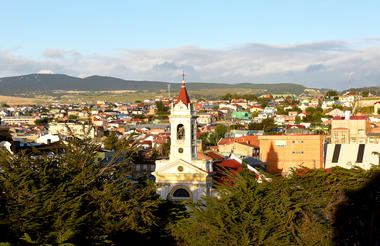
Later we return to Punta Arenas and check into our hotel.
This evening, enjoy a Welcome Dinner accompanied by Chilean wine.


Travel Details:
- Santiago - Punta Arenas flight: ~3.5–4 hours.
- Punta Arenas - Río Verde / Palomares Hill: approximately 1–1.5 hours each way by road on mostly paved and some gravel roads.
Activity:
Moderate: 1–1.5 miles of walking on uneven ground and mild uphill slopes to reach condor viewpoints; standing for periods while observing and photographing.
NOTES
- Bring binoculars and a camera with a telephoto lens; condors are large but distances can still be significant.
- Dress in windproof layers — even on sunny days, Patagonian wind can be strong and chilly.
- A thin pair of gloves and a warm hat are helpful while standing still in the wind during condor viewing.
- Baggage limitations on domestic flight: 1 Small bag or backpack personal item that fits under the seat in front of you, plus 1 Carry-on baggage up to 12 kg (26 lbs) and 1 Checked baggage up to 23 kg (50 lbs).
Breakfast, Lunch, Dinner
Magdalena Island’s Magellanic Penguins
We depart early for an exploration by sea and land, traveling by boat through the Strait of Magellan to Magdalena Island, home to more than 100,000 Magellanic penguins.
8:30 a.m.: As we approach the island, the cliffs and shoreline seem carpeted in birds.
We have an hour on the island to walk the designated trail up toward the lighthouse — now a ranger station — while penguins shuffle along their paths, call to mates, and tend burrows. Along the way, we watch for Imperial and Rock cormorants, terns, skuas and gulls. South American sea lions often patrol the coast looking for opportunities to catch a distracted penguin.
We return to Punta Arenas for lunch at a local restaurant.
The afternoon is at leisure to explore town or relax.
Dinner is on your own this evening, with many walkable options nearby.
Travel Details:
- Short transfer from hotel to pier.
- Boat ride to Magdalena Island: typically 1.5–2 hours each way, weather and sea conditions dependent.
- Walking on the island: well-marked dirt/gravel path, modest incline; up to 1–1.5 miles total.
Activity:
Moderate: walking on uneven, sometimes windy terrain; boarding/disembarking the boat via gangways or steps.
NOTES
- Pack a waterproof and windproof outer layer; conditions in the Strait can change quickly.
- Use a neck strap or wrist strap for cameras and binoculars on the boat.
- A buff or scarf is helpful against wind and penguin dust on the breeding colony paths.
- For the next two days, you’ll travel with your carry-on baggage only; your large checked suitcase will be held in Punta Arenas until you return from Porvenir.
Breakfast, Lunch
Dinner
Crossing the Strait of Magellan - Wildlife by Sea and Land
This morning, we check out of the hotel and transfer to the ferry terminal at the northern end of Punta Arenas.
9:00 a.m.: We begin our 2.5-hour ferry across the Strait of Magellan to Tierra del Fuego, following a route sailed by historic explorers such as Magellan, Darwin, and FitzRoy. From deck, we scan for Black-browed albatross, Southern giant petrel, Southern fulmar, cormorants, gulls, and terns. It is likely that we’ll see marine mammals including pods of Peale’s dolphins and South American sea lions.
On arrival in Tierra del Fuego, we meet our local guide and drive through windswept steppe and rolling hills to the tiny town of Porvenir, then continue along the shores of Bahía Inútil (Useless Bay). Along this coastal route, we may spot guanacos, Southern gray foxes, the ubiquitous Upland Goose, Chilean flamingos, a variety of waterfowl. We may see albatrosses, petrels, gulls and skuas patrolling the turbulent waters of the bay.
We return to Porvenir and settle into our family-run inn, known for its warm hospitality.
Enjoy dinner including Chilean wine.


Travel Details:
- Hotel - ferry terminal: ~15–20 minutes.
- Ferry crossing: approximately 2.5 hours.
- Post-ferry driving and wildlife stops along Useless Bay: 2–3 hours total with many stops.
Activity:
Light to moderate: short walks at viewpoints and along roadside pullouts; optional longer coastal walks of up to 1 mile at a time.
NOTES
- Have layers, windproof shell, and a warm hat handy for time on the ferry deck.
- Keep binoculars accessible as we’ll constantly be on the lookout for bird- and wildlife activity.
- Dust and wind are common; consider a lens cloth and zip-top bags for small gear.
Breakfast, Lunch, Dinner
King Penguins
We continue exploring along the coastal road skirting Bahía Inútil, again scanning for seabirds and marine life. Raptors such as Variable hawk, Aplomado falcon, and possibly Peregrine falcon patrol the skies, while Magellanic horned owls nest in some ravines.
Our main goal today is the King Penguin breeding colony at Reserva Parque Pingüino Rey, the only known continental colony for this species. The colony is present year-round, and February typically offers excellent viewing of adults and often their large, downy or molting chicks. From designated platforms, we observe the penguins’ stately posture, courtship calls, and social interactions surrounded by the dramatic sweep of Bahía Inútil.
On our return, we explore the shrubby slopes and moorlands of the Baquedano Hills, habitat for Rufous-chested dotterel, Austral canastero, and the striking White-bridled finch.
Return to Porvenir. Dinner this evening is on your own to discover the small local eateries featuring fresh, local products.


Travel Details:
Porvenir - Parque Pingüino Rey: approximately 2 hours each way, mostly gravel roads with scenic stops.
Additional driving and stops in Baquedano Hills: 1–2 hours.
Activity:
Light to moderate: walking on packed earth and gravel paths, mostly flat, with optional short hill walks in the Baquedano area.
NOTES
- Bring a spotting scope or high-magnification binoculars if you have them - the colony is viewed from a set distance for conservation reasons.
- Wear closed-toe shoes or light hiking boots; ground can be uneven or muddy.
- Have a light daypack with extra layers and snacks, as Patagonian weather can shift quickly between sun, wind, and drizzle in a single outing.
Breakfast, Lunch
Dinner
Scenic Flight, Mylodon Cave & Torres del Paine
We say farewell to Porvenir and transfer to the local airfield for a short, scenic flight back to Punta Arenas. From the air, we trace glacially carved channels and coastlines that record the last 12,000 years of ice and sea.
Landing in Punta Arenas, we continue by road north to Puerto Natales, where we stop for lunch.
This afternoon, we visit Mylodon Cave Nature Reserve, a massive natural cave complex where remains of the Giant ground sloth (Mylodon) and other Pleistocene mammals were found. We walk one of the reserve’s trails into the main cave and learn about the region’s glacial and paleontological past.
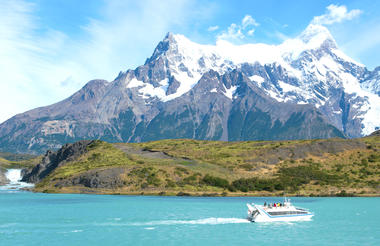
From here, we continue our drive, entering Torres del Paine National Park, where the jagged peaks of the Paine Massif rise higher with every mile. This vast protected area - more than 560,000 acres of lakes, steppe, forest, and mountains - is Patagonia’s premier wildlife destination, and the approach alone sets the stage for the days ahead. We stop at several viewpoints that offer sweeping, unforgettable vistas of the massif’s granite spires and banded sedimentary cliffs, a dramatic geologic story written in stone.
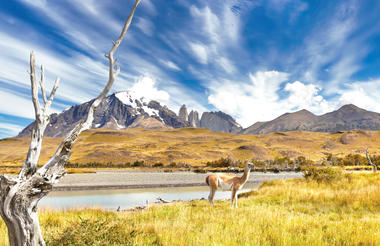
As we travel toward the park’s eastern entrance, wildlife begins to appear across the open steppe. Large herds of guanacos graze along the roadside, often unbothered by passing vehicles, while Darwin’s (lesser) rheas stride through the grasslands with their characteristic rolling gait. With luck, we may spot southern gray foxes weaving through the shrubs or even a Patagonian hog-nosed skunk foraging near the road.
We enjoy our first walk in the park between Lago Pehoé and Lago Nordenskjöld, a mild and scenic path that passes waterfalls, wind-sculpted shrubs, and the first pockets of southern beech (Nothofagus) forest. Throughout the walk, the iconic Cuernos del Paine (“Horns of Paine”) dominate the skyline, their contrasting bands of dark granite and lighter sedimentary layers revealing the park’s extraordinary geologic history. This is an ideal introduction to the landscapes that define Torres del Paine, and to the wild inhabitants we will spend the next several days tracking and observing.
We arrive at our base, Hotel Las Torres, in time to settle in and enjoy dinner.

Travel Details:
- Porvenir - Punta Arenas flight: ~15–20 minutes.
- Punta Arenas - Puerto Natales: approximately 3 hours by road with scenic stops.
- Puerto Natales - Hotel Las Torres: approximately 75–78 miles, taking 2–2.5 hours, with the final portion within Torres del Paine National Park on gravel roads.
Activity:
Moderate: cave walk on well-maintained paths with some steps and slight inclines; total walking up to 1.5–2 miles spread over the day.
NOTES
- Dress in layers as you’ll transition through a variety of climate conditions today.
- The cave can be cool and damp; a light fleece or jacket is useful even on a warm day.
- Keep camera batteries charged; this is where “classic Patagonia” landscapes begin in earnest.
Breakfast, Lunch, Dinner
Torres del Paine: Puma Country & Patagonia Landscapes
For three full days, we immerse ourselves in Torres del Paine National Park, an extraordinary backdrop for some of the best puma viewing on Earth.
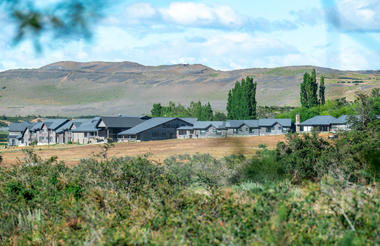
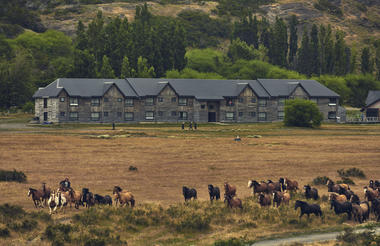
We devote our time to the eastern flank of the park, where the northern shores of Lago Sarmiento, Laguna Amarga, and Laguna Azul, together with Estancia Laguna Amarga, support one of the world’s highest concentrations of wild pumas. Through long-standing relationships with the estancia, we have privileged access to private lands rarely open to visitors. Using a combination of 4×4 routes and easy to moderate walks, we explore ridgelines, open steppe, and lake margins while scanning for fresh tracks, territorial scrapes, and the subtle movement of cats on the hunt.
Our schedule is built around the puma’s natural rhythm. Early mornings and late afternoons offer the greatest likelihood of activity, and each day includes two wildlife sessions of approximately four hours supported by highly experienced puma trackers (1 tracker per 6 guests). During these windows, cats may be patrolling their territories, stalking guanacos, shifting between hunting grounds and dens, or interacting with their young. Sightings are never guaranteed, but Torres del Paine is one of the few places in the world where multiple encounters are possible in a single trip.
Mid-day, when pumas retreat to rest and avoid disturbance, we explore the park’s broader landscapes. Short scenic walks and drives bring us to classic viewpoints such as Lago Pehoé, Lago Nordenskjöld, and waterfalls framed by the striking Cuernos del Paine. Wildlife remains abundant throughout the day: herds of guanacos, Darwin’s (lesser) rheas, Andean condors, caracaras, and waterfowl are frequent sightings, while more elusive species such as the huemul (Andean deer), Patagonian hog-nosed skunk, and both chilla and culpeo foxes - reward patient observers.
Terrain across the estancia and park is generally gentle, with occasional slopes and altitude differences of 160–1,000 ft, all approached at a slow, steady pace appropriate for wildlife viewing. The maximum elevation during this section of the journey is around 1,000 ft above sea level, making the walking accessible for most travelers with moderate fitness.
These days offer an authentic immersion into one of the world’s most vibrant predator-prey ecosystems. Whether watching condors spiral overhead, observing guanacos on alert, or scanning a windswept hillside for the silhouette of a puma, each moment deepens your connection to the extraordinary natural rhythms of Patagonia.

Reminders: Check in for your international flights home tomorrow
Travel Details:
- Morning and afternoon puma tracking outings involve travel of roughly 45 minutes to 1.5 hours each way, depending on wildlife activity and the specific area of Estancia Laguna Amarga being explored.
- Distances are covered in short, stop-and-scan segments, with frequent breaks for wildlife sightings, interpretation, and photography.
- Road surfaces are primarily gravel, and speeds are intentionally slow to maximize viewing opportunities and ensure safe travel in variable terrain.
Activity (Each Day):
- Moderate: multiple short walks totaling 0.5–2 miles at a time, often on uneven, rocky, or grassy terrain, with occasional short, steeper sections (altitude differences typically 160–1,000 ft).
- Guests may opt out of any walk or remain with the vehicle; daily plans are adjusted to comfort levels and current conditions.
NOTES
- Bring layered clothing, including a windproof shell, insulating mid-layer, hat, and gloves—Patagonian weather can shift rapidly between sun, wind, rain, and even sleet.
- A good daypack, sturdy hiking shoes or boots, and trekking poles (if you use them) add comfort and stability.
- Keep binoculars and camera ready at all times—puma or condor sightings often happen quickly and unexpectedly.
- Patagonia’s dry, windy climate can lead to dehydration; carry a refillable water bottle and top off at the hotel or during stops.
Breakfast, Lunch, Dinner
Return to Santiago Airport for Departure
We say goodbye to Torres del Paine and drive back to Puerto Natales, enjoying final views of the jagged tops of the Paine Massif. From Puerto Natales, we board our domestic flight to Santiago.
Schedule (Subject to change): LaTam Flight 250 departs at 1:00 PM / Arrives at 4:06 PM
Upon arrival in Santiago International Airport, a local representative is on hand to assist with your international check-in and connections for independent departures home.
Travel Details:
- Torres del Paine - Puerto Natales: roughly 2–2.5 hours by road.
- Puerto Natales - Santiago flight: typically 3–3.5 hours.
- Flights from Arturo Merino Benítez International Airport (SCL) to the USA typically depart after 11:00 p.m.
NOTES
- Keep travel documents, valuables, and medication organized and secure in your carry-on.
- Pack a light change of clothes or warm layer for the overnight flight home.
- This is a great time to jot down your favorite sightings and experiences while they’re fresh.
Breakfast
Lunch, Dinner