FLY TO TOKYO
Today you fly from Auckland to Tokyo Narita with Air New Zealand. It’s a daytime flight, so settle in with a film or two and you’ll land in Japan in the early evening.
After immigration and customs, head out into the arrivals hall, where your driver will be waiting with a name board. Your private car will take you straight to your hotel, so there’s no need to work out trains or carry bags through stations on your first night.
The drive into the city usually takes an hour to an hour and a half, depending on traffic. You’ll watch the countryside around Narita give way to the expressways and lights of Tokyo, a fitting first glimpse of one of the world’s great cities.


- Complete Visit Japan Web before you fly. It’s free and optional, and it gives you a single QR code for both immigration and customs. Finish it at least six hours before you land, and save a screenshot of the code on your phone. You can still use the paper cards handed out on the plane.
- Don’t worry if immigration is slow. Your driver knows your flight details and will wait for you in the arrivals hall. We’ll send you the meeting point and contact details before you travel.
- Sort out your Suica card early. If you have an iPhone, you can add a Suica card to Apple Wallet before you leave home and top it up with your credit card. Most phones bought outside Japan can’t use mobile Suica, so you’ll need a physical Welcome Suica. These are sold at the JR East Travel Service Centres and machines in the Narita Airport train stations.
- Get some yen on arrival. ATMs at the airport and in 7-Eleven stores accept New Zealand cards, and cash is still handy for smaller restaurants, market stalls and temples.
- Set up your eSIM or pocket Wi-Fi before you fly, so you can use maps and messages from the moment you land.
- Jet lag is gentle. Japan is only three to four hours behind New Zealand, depending on the time of year, so try to stay up until a normal bedtime and you’ll feel at home quickly.
- Tokyo accommodation tax is a small charge per person per night, paid at the hotel.
- Economy Class Airfare.
- All Airline Taxes.
- Check-in Baggage Allowance.
- Arrival Transfer by Private Car.
- Overnight Accommodation.
- Tokyo accommodation Tax (payable locally).
TOKYO - FULL DAY TOUR
Today you’ll explore Tokyo with an English-speaking, government-licensed guide, who will show you both the traditional and modern sides of the capital. The route below is a suggestion, and your guide is happy to tailor the day to your interests.
We’ll put you in touch with your guide well before you travel, so you can plan the day together by email.
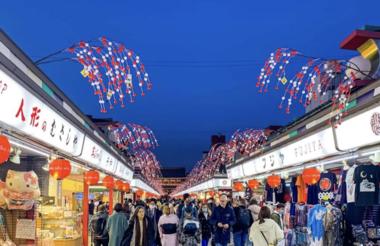
Meet your guide at 9 am at the Kaminarimon Gate in Asakusa, Tokyo’s most atmospheric old neighbourhood. Its giant red lantern marks the start of Nakamise Shopping Street, a lane of family-run stalls that has served pilgrims for centuries.
At the end of the street you’ll reach Senso-ji Temple, Tokyo’s oldest temple, founded in the 7th century. Your guide will explain the rituals you’ll see around you, from wafting incense smoke at the great burner to drawing an omikuji fortune.
Take some time to wander the quieter lanes behind the temple, where you’ll find traditional craft shops, sweet makers and small restaurants. It’s a good chance to try a freshly grilled rice cracker or a warm ningyo-yaki cake.
From Asakusa, take the Ginza Line straight through to Ginza, Tokyo’s most elegant shopping district. Stroll along Chuo-dori past landmark department stores such as Wako and Mitsukoshi, then continue past the Kabukiza Theatre towards the market.
Lunch is at Tsukiji Outer Market, where hundreds of small shops and counters sell some of the freshest seafood in the city. Graze on grilled scallops, tamagoyaki omelette and tuna skewers, or sit down at a counter for a bowl of sushi or a seafood rice bowl.
The wholesale auctions moved to Toyosu in 2018, but Tsukiji is still where Tokyo’s chefs shop. Your guide will help you find the best stalls and explain what’s on offer.
Finish with a short walk to Hamarikyu Gardens, a former shogun’s retreat beside Tokyo Bay, where your tour ends around 3 pm. Its tidal pond is fed by seawater, and the skyscrapers of Shiodome rise behind the pine trees in a striking contrast of old and new Tokyo.
Before you leave, cross the long wooden bridge to the Nakajima Teahouse on its island in the pond for a bowl of matcha and a Japanese sweet.
The rest of the afternoon is yours. Here are a few ideas:
- Odaiba and teamLab Planets: walk ten minutes to Shiodome Station and take the Yurikamome driverless train across the Rainbow Bridge, with superb views over Tokyo Bay. Stay on to Shin-Toyosu for teamLab Planets, an immersive digital art museum where you walk barefoot through water and light.
- Ginza at your own pace: head to Ginza for the food halls in the department store basements. If you’d like to see kabuki, single-act tickets at the Kabukiza Theatre are a great way to try it without committing to a whole performance.
- A quiet hour: stay on in Hamarikyu Gardens and enjoy a slower pace after a busy morning.



- Today's itinerary is just a suggestion. It's a busy day with a reasonable amount of ground covered on foot.
- What you decide to do on this day is entirely up to you however, so don't worry if you want to change things, or do something entirely different.
- We will put you in touch with your guide by email well in advance, so you can liase with the guide and plan your day to suit you.
- You can meet your guide at your hotel or at the starting point of your tour. If you can meet your guide at the starting point of the tour, it will give you more time with your guide. The Kaminarimon Gate is a good meeting point to start your day.
- English Speaking Guide for 6 hours.
- Overnight Accommodation.
- Entrance fees, lunch and public transport during the tour.
- Tokyo accommodation Tax (payable locally).
TOKYO - SELF GUIDED EXCURSION
Today is yours to explore, using the Yamanote Line, the JR loop line that circles central Tokyo and stops at many of the city’s best-known neighbourhoods. Trains run every few minutes, so it’s easy to hop on and off, but it’s a long day if you try to do everything, so pick the parts that appeal most.
Have your Suica card ready, wear comfortable shoes and off you go!
Start in Ueno, one of Tokyo’s older districts. Ueno Park is home to the Tokyo National Museum, Japan’s oldest and largest museum, with superb collections of samurai armour, swords, ceramics and Buddhist art.
Even if museums aren’t your thing, the park is lovely for a morning stroll around Shinobazu Pond and its little island temple. Afterwards, wander through Ameyoko, a lively market street running under the railway tracks, where stallholders call out their prices for dried fish, fruit, spices and street food.
Two stops down the line is Akihabara, Tokyo’s electric town and the centre of the city’s anime, manga and gaming culture. Even a quick walk along the main street, with its towering electronics stores and colourful arcades, gives you a glimpse of a very different side of Japan.
From Akihabara, stay on the Yamanote Line around to Harajuku. Just outside the station, a huge wooden torii gate marks the entrance to Meiji Jingu, one of Japan’s most important Shinto shrines, set in a forest of around 100,000 trees.
The gravel paths through the trees are wonderfully peaceful, and it’s hard to believe you’re in the middle of one of the world’s biggest cities. Next door, Yoyogi Park, once the athletes’ village for the 1964 Tokyo Olympics, is a favourite with locals for picnics, music and people-watching, especially at weekends.
Back in Harajuku, dive into Takeshita Street, the narrow lane at the heart of Tokyo’s youth fashion scene, and try one of its famous crepes. Then stroll down tree-lined Omotesando, with its striking designer architecture, and browse the independent boutiques and cafés along Cat Street, which leads you towards Shibuya.
Cat Street brings you out in Shibuya, one of Tokyo’s busiest hubs and a great place for lunch. Join the crowds at Shibuya Crossing, one of the busiest pedestrian crossings in the world, where hundreds of people surge across from every direction each time the lights change.
For a view from above, head up to the Starbucks on the second floor of Shibuya Tsutaya, or the rooftop of Magnet by Shibuya 109 across the road. Just outside the station, pay your respects at the statue of Hachiko, Tokyo’s famously loyal dog, a favourite meeting point for generations of locals.
For the finest view of all, ride up to Shibuya Sky, the open-air rooftop deck 229 metres above the crossing. On a clear day you can see right across Tokyo, and sometimes all the way to Mount Fuji.
Finish your day in Shinjuku, a few stops further round the line. If you’d like a little green space first, Shinjuku Gyoen is one of Tokyo’s loveliest gardens, combining a traditional Japanese garden with French formal and English landscape gardens.
On the west side of the station, the Tokyo Metropolitan Government Building has free observation decks on the 45th floor, 202 metres up, with sweeping night views across the city. After dark, the building’s facade becomes a giant screen for a free projection mapping show of light and music.
For dinner, squeeze into Omoide Yokocho, a smoky little alley of tiny yakitori bars dating back to the post-war years, where you can sit elbow to elbow with locals. Then wander the neon-lit streets of east Shinjuku, which come alive at night.


- This is a big day, so don’t try to do it all. If you love museums, give Ueno the whole morning and skip Akihabara. If you’d rather keep things relaxed, start at Harajuku and spend the day between Shibuya and Shinjuku.
- The Tokyo National Museum and Shinjuku Gyoen are both closed on Mondays, so check the day you plan to visit.
- Meiji Jingu is at its most peaceful early in the morning. If you’d like to see it before the crowds, swap the order and start at Harajuku.
- Book Shibuya Sky online before you travel. Tickets are released two weeks ahead, and the slots around sunset sell out very quickly. Arrive about half an hour before sunset to see the city in daylight, at golden hour and lit up after dark.
- Seats at the Starbucks window overlooking Shibuya Crossing are hard to get, so be patient or try the rooftop at Magnet by Shibuya 109 instead.
- The Tokyo Metropolitan Government Building has two observation decks, North and South. Each closes on a couple of weekdays a month, so if one is closed the other will usually be open.
- Omoide Yokocho’s bars are tiny, and many have a small seat charge. Go early in the evening for the best chance of a seat, and bring cash.
- Overnight Accommodation.
- Tokyo accommodation Tax (payable locally).
TRAVEL TO HAKONE
This morning, make your own way to Shinjuku Station to catch the Romance Car directly to Hakone-Yumoto, a journey of about 85 minutes. On a clear day, watch out of the right-hand side of the train as you get closer to Hakone for a glimpse of Mount Fuji.
Your Hakone Free Pass gives you a full day of travel by mountain railway, cable car, ropeway, bus and even pirate ship. It’s a wonderful way to explore this area of hot springs, pine-clad hills and lakes in the shadow of Mount Fuji.
Before you set off, it’s well worth using the luggage delivery counter inside Hakone-Yumoto Station. Drop your bags before midday and they’ll be waiting at your accommodation from 3pm, so you can enjoy the day without them.
Hakone-Yumoto deserves a short wander. Stroll the main street to try some local snacks, such as warm manju buns or fish cakes, then cross the bridge over the Hayakawa River for a look at the old hot spring town.
Next, board the Hakone Tozan Railway for the climb to Chokoku-no-Mori Station, which takes about 35 to 40 minutes. The little train zigzags up the mountain through a series of switchbacks, and the views get better as you go.
From the station, it’s only a couple of minutes’ walk to the Hakone Open-Air Museum, one of Japan’s best outdoor galleries. Allow an hour or so to explore the sculpture gardens and the Picasso Pavilion, and take a few minutes to soak your feet in the free footbath.
Hop back on the train for one stop to Gora, a good place to stop for lunch. From here, the retro Hakone Tozan Cable Car climbs steeply to Sounzan, where you change to the Hakone Ropeway.
The ropeway carries you high over the forest to Owakudani, a volcanic valley with steaming vents and a strong sulphurous smell. On a clear day, Mount Fuji comes into view as you crest the ridge, which is one of the most memorable moments of the day.
At Owakudani, it’s worth stepping off to explore before taking the second ropeway down to the lake. Try the famous kuro-tamago, eggs boiled in the hot springs until their shells turn black, which are said to add seven years to your life.
The second ropeway brings you down to Togendai on the shores of Lake Ashi. From here, board a pirate ship for a sightseeing cruise of about 30 to 40 minutes to Moto-Hakone, which is often a highlight of the day.
Near the end of the cruise, look out for the striking red torii gate of Hakone Shrine standing at the water’s edge. From Moto-Hakone it’s about a 10-minute walk along the lakeshore to the shrine, which sits among towering cedars.
If you have a little more time, the Old Tokaido Cedar Avenue runs along the lake from Moto-Hakone towards Hakone-machi. This historic road once linked Edo, as Tokyo was then known, with Kyoto.
Back at Moto-Hakone, catch the Hakone Tozan Bus to your accommodation, which is also covered by your Free Pass. We’ll give you clear directions to your ryokan before you travel.


- The ropeway and lake cruises stop running in the late afternoon, and earlier in winter, so try to reach Gora by early afternoon.
- The ropeway can close at short notice because of strong winds or volcanic gas levels. When this happens, replacement buses run instead.
- Mornings usually give the clearest views of Mount Fuji, as cloud often builds through the day.
- Romance Car from Shinjuku (Tokyo) to Hakone.
- 2-day Hakone Free Pass.
- Dinner.
- Overnight Accommodation.
- Hakone accommodation Tax (payable locally).
TRAVEL TO KYOTO
This morning, take the short bus ride from your ryokan to Hakone-Yumoto Station, then the train to Odawara. Your Hakone Free Pass covers this part of the journey.
From Odawara, board the Shinkansen to Kyoto, a journey of around two hours. Watch out of the right-hand side of the train after Mishima for a final view of Mount Fuji.
On arrival at Kyoto Station, make your own way to your hotel. A taxi is the easiest choice with luggage, and taxi ranks are clearly signed outside the station.
Once you’ve checked in, spend a relaxed afternoon exploring central Kyoto on foot. Everything below is within walking distance, and you can stop wherever you like.
Start at Nishiki Market, a narrow covered street of food stalls known as “Kyoto’s kitchen”. Graze your way along, trying tamagoyaki (sweet rolled omelette), soy-milk doughnuts, pickles and skewers of grilled seafood.
At the eastern end, wander through the Teramachi and Shinkyogoku covered arcades, where small temples are tucked between the shops. It’s a good place to pick up souvenirs, from incense to handmade paper.
From here, walk east to Shijo Bridge for a view along the Kamo River, where locals gather on the banks in the early evening. Across the bridge you’re on the edge of Gion, where you’ll meet your guide this evening.
If you have time, finish at Kennin-ji, Kyoto’s oldest Zen temple, just south of Gion’s main street. Look up at the dramatic twin dragons painted across the ceiling of the Dharma Hall, then sit for a while beside the raked gravel and moss gardens.
This evening, head to Gion to meet your guide outside the small Gion Omoide Museum, which shares a building with the Izutsu Yatsuhashi sweet shop near Shijo Bridge. If you have trouble finding it, ask a local for Izutsu Yatsuhashi, which is better known.
Over the next hour and 40 minutes, a licensed English-speaking guide will lead you through Kyoto’s most famous geisha district as the lanterns come on. Gion is still a working geisha district, and your guide will help you understand a world that’s usually closed to visitors.
You’ll walk the stone-paved lanes beside the Shirakawa Canal, lined with willows and old wooden teahouses, and cross the much-photographed Tatsumi Bridge. Along the way, your guide will explain the lives of the geiko and maiko, as geisha and apprentices are known in Kyoto, from their kimono and hairstyles to their training and strict traditions.
You may well see a geiko or maiko hurrying to an evening engagement, though this can never be guaranteed. If you do, please give them space and don’t stop them for photos, as they’re on their way to work.


- Some of the lanes in Gion are private, and photography there isn’t allowed. Your guide will point out where you can and can’t take photos.
- After the walk, cross the river to Pontocho, a narrow lantern-lit lane of restaurants. It’s a good spot for dinner, especially for yakitori or Kyoto-style tofu dishes.
- Breakfast included in Hakone.
- 2-day Hakone Free Pass.
- Rail Tickets Odawara - Kyoto.
- Evening Walking Tour in Gion.
- Overnight Accommodation.
- Kyoto accommodation Tax (payable locally).
KYOTO: FULL-DAY GUIDED EXCURSION
Today you’ll explore Kyoto with an English-speaking, government-licensed guide, who’ll bring the city’s temples, lanes and traditions to life. The route below is a suggestion, and we’ll put you in touch with your guide before you travel so you can shape the day around your interests.
Start early at Kiyomizu-dera, one of Kyoto’s most important temples, before the crowds arrive. Its great wooden stage stands 13 metres above the hillside, built without a single nail, and looks out over cherry and maple trees to the city beyond.
From the temple, wander down the old stone-paved lanes of Sannenzaka and Ninenzaka, lined with wooden shops selling pottery, pickles and sweets. Your guide will point out the best places to try matcha soft-serve or yatsuhashi, Kyoto’s cinnamon-scented rice-flour sweet.
Continue to Yasaka Shrine, which has stood at the top of Gion for more than 1,300 years. It has close links with the geiko community, and it’s home to the Gion Matsuri, one of Japan’s most famous festivals, held every July.
After lunch, head north to Nanzen-ji, a vast Zen temple with a towering Sanmon Gate and a red-brick aqueduct hidden among the trees. From here, the Philosopher’s Path follows a quiet canal north for about two kilometres, past small temples, cafés and gardens.
The path ends at Ginkaku-ji, the Silver Pavilion, with its sculpted sand garden and moss-covered hillside walk. It’s a peaceful end to the day and a lovely contrast to the busier sights of the morning.
Other places to discuss with your guide
- Nijo Castle: the shogun’s Kyoto residence, built in 1603 and famous for its “nightingale floors”, which chirp underfoot to warn of intruders.
- Sanjusangendo: a long wooden hall holding 1,001 golden statues of Kannon, the goddess of mercy, and an unforgettable sight.
- Nishiki Market: a narrow covered market known as “Kyoto’s kitchen”, and ideal for a grazing lunch.


- Visit Ginkaku-ji before it closes in the late afternoon, which is earlier in winter.
- Wear comfortable shoes, as much of today is spent on foot, with some hills and steps.
- Full Day Tour.
- English Speaking Guide for 6 hours.
- Overnight Accommodation.
- Kyoto accommodation Tax (payable locally).
- All entrance fees and public transportation fees as mentioned in the itinerary.
KYOTO: ARASHIYAMA AND KINKAKU-JI
Today you’ll explore the western edge of Kyoto, where the city gives way to forested hills and the Katsura River. Another early start is worth it, as the bamboo grove is at its most magical before the crowds arrive.
From Kyoto Station, take the JR Sagano Line to Saga-Arashiyama Station, which takes around 15 minutes. From here, it’s a short walk to the Arashiyama Bamboo Grove, where towering green stalks close overhead and creak gently in the breeze.
The grove leads to the north gate of Tenryu-ji, one of Kyoto’s great Zen temples. Its 14th-century Sogenchi Garden is a masterpiece of “borrowed scenery”, with the hills of Arashiyama forming part of the design.
At the far end of the bamboo grove, the Okochi Sanso Villa is one of Kyoto’s best-kept secrets. This hillside estate of a 20th-century film star has moss gardens, winding paths, views across the city and a cup of matcha included with entry.
Walk down to the river and the long wooden Togetsukyo Bridge, framed by the hills behind. Arashiyama is known for yudofu, simmered tofu, a gentle and very Kyoto lunch served in several restaurants near Tenryu-ji.
In the afternoon, take a taxi of about 20 minutes to Kinkaku-ji, the Golden Pavilion. Covered in gold leaf, it sits above a still pond, and on a calm day its reflection is almost perfect.
From Kinkaku-ji, it’s about a 20-minute walk to Ryoan-ji, home to Japan’s most famous rock garden. Fifteen stones sit in raked white gravel, and from any spot on the viewing platform one is always hidden from view.


- Aim to be in the bamboo grove by 8am, before the tour groups arrive.
- Between March and late December, the Sagano Romantic Train runs through the Hozu River gorge from Arashiyama, a lovely half-hour ride when the leaves are turning. It doesn’t run every day, so check before you go.
- Kinkaku-ji closes at 5pm, and Ryoan-ji closes at 4:30pm from December to February, so leave Arashiyama by early afternoon.
- Overnight Accommodation.
- Kyoto accommodation Tax (payable locally).
KYOTO: FUSHIMI INARI AND NARA
Today is a self-guided day to Fushimi Inari and the ancient capital of Nara, both on the same railway line south of Kyoto. An early start makes all the difference, as you’ll have the shrine almost to yourself.
From Kyoto Station, take the JR Nara Line to Inari Station, which takes about five minutes. The station sits right across the road from the entrance to Fushimi Inari Taisha, the head shrine of Inari, the god of rice and prosperity.
Behind the main shrine, thousands of vermilion torii gates wind up the forested slopes of Mount Inari, each one donated by a business or family. Fox statues, believed to be Inari’s messengers, guard the path with keys and scrolls held in their mouths.
You don’t need to climb to the summit, which takes two to three hours there and back. Walking up to the Yotsutsuji crossroads takes about 30 to 45 minutes, and the view over Kyoto there is a natural place to turn back.
Back at Inari Station, continue south on the JR Nara Line to Nara, Japan’s first permanent capital. Check the departure board for a train going all the way to Nara, as the rapid services are much quicker.
From the station, walk or take a short bus ride to Nara Park, where more than a thousand freely roaming deer are considered sacred messengers of the gods. You can buy shika senbei (deer crackers) from vendors, and many of the deer have learnt to bow for them.
At the heart of the park is Todai-ji, whose Great Buddha Hall is one of the largest wooden buildings in the world. Inside sits a bronze Buddha 15 metres tall, and behind it a wooden pillar with a hole at its base, said to be the size of the Buddha’s nostril. Squeeze through, and tradition says you’re assured of enlightenment.
For lunch, try kakinoha-zushi, a Nara speciality of pressed sushi wrapped in persimmon leaves. You’ll find it in the streets between the station and the park.
In the afternoon, walk through the woods to Kasuga Taisha, Nara’s most important shrine. Its paths are lined with around 3,000 moss-covered stone lanterns, and hundreds of bronze lanterns hang in the corridors around the main hall.
If time allows, finish with a wander through Naramachi, the old merchant quarter, with its narrow lanes, small cafés and traditional wooden townhouses. Return to Kyoto by train in the late afternoon.


- Aim to reach Fushimi Inari by 8am. The shrine is open around the clock, and by mid-morning the lower gates get very crowded.
- The deer are wild animals and can nip or butt when they spot food. Hold crackers out of sight until you’re ready to give them, and show your empty hands when you’ve finished.
- Todai-ji’s Great Buddha Hall closes at 5pm (5:30pm from April to October), so visit it before Kasuga Taisha.
- Overnight Accommodation.
- Kyoto accommodation Tax (payable locally).
FLY TO AUCKLAND
Enjoy a final relaxed morning in Kyoto before your journey home. Keep it simple and close to the station, so there’s no need to rush.
Just a short walk from Kyoto Station, Higashi Hongan-ji is one of the largest wooden temple buildings in the world, and it’s free to enter. Step inside the vast Founder’s Hall, where the tatami floor stretches out beneath a soaring ceiling.
Alternatively, walk around 15 minutes south-west of the station to To-ji, whose five-storey pagoda is the tallest in Japan and a symbol of the city. If you’re in Kyoto on the 21st of the month, the temple holds a big flea market, with stalls selling antiques, ceramics, old kimono and street food.
Before you leave, the food halls beneath Kyoto Station and the shops of Porta underground are perfect for last-minute gifts. Pick up some yatsuhashi, matcha sweets or a bento for the train.
Collect your luggage from your hotel and catch the Shinkansen to Shinagawa, which takes a little over two hours. Keep an eye out on the left side of the train for Mount Fuji, a fitting farewell if the skies are clear.
At Shinagawa, change to the Narita Express for the journey of a little over an hour to Narita Airport. Follow the red N’EX signs from the Shinkansen gates, and allow plenty of time for the connection.
This evening, fly from Tokyo Narita to Auckland with Air New Zealand.


- Allow around five hours from leaving your hotel to reaching the airport, so that you arrive at least three hours before your flight.
- Large suitcases on the Shinkansen need a seat with an oversized-luggage area reserved in advance. We’ll arrange this when we book your seats, so let us know if you’re travelling with big bags.
- If you’d rather travel light, your Kyoto hotel can send your main bags straight to Narita Airport for collection at the departure terminal. This needs to be arranged at least two days before your flight.
- Rail Tickets Kyoto - Tokyo - Narita.
- Economy Class Flights.
- Airline Taxes.
- Check-in Baggage Allowance.
ARRIVE AUCKLAND
Arrive back in Auckland.