


With its well-developed infrastructure, some of the best tourist facilities in Africa and an impressive list of breathtaking natural wonders, touring Namibia is truly a pleasure. Visit the capital of Windhoek and the lovely coastal town of Swakopmund to discover remnants of the country’s German influence, reflected in the architecture, culture, cuisine and the annual Oktoberfest celebrations. To properly appreciate this extraordinary country, you will have to venture out of the cities to explore the remarkable natural landscapes Namibia has to offer. These include: the impressive Fish River Canyon Park; the vast Etosha National Park teeming with local subspecies, such as desert lions, desert elephants and the Hartmann's Mountain Zebra; the hauntingly beautiful Kalahari Desert; and of course the Namib Desert stretching for nearly 1000 km along the magnificent Atlantic coastline. Namibia is an ideal destination for travellers seeking an unforgettable African experience in a uniquely beautiful untamed wilderness.
In most places in the park, the pans are devoid of vegetation with the exception of halophytic Sporobolus salsus, a protein-rich grass that is eaten by grazers like blue wildebeest and springbok. The areas around the Etosha pan also have other halophytic vegetation including grasses like Sporobolus spicatus and Odyssea paucinervis, as well as shrubs like Suaeda articulata. Most of the park is savanna woodlands except for areas close to the pan. Mopane is the most common tree, estimated to be around 80% of all trees in the park. The sandveld of north-eastern corner of Etosha is dominated by acacia and Terminalia trees. Tamboti trees characterize the woodlands south of the sandveld. Dwarf shrub savanna occurs areas close to the pan and is home to several small shrubs including a halophytic succulent Salsola etoshensis. Thorn bush savanna occurs close to the pan on limestone and alkaline soils and is dominated by acacia species such as Acacia nebrownii, Acacia luederitzii, Acacia melliferra, Acacia hebeclada and Acacia tortilis. Grasslands in the park are mainly around the Etosha pan where the soil is sandy. Depending on the soil and the effects of the pan, grasslands could be dominated by one of the Eragrostis, Sporobolus, Monelytrum, Odyssea or Enneapogon species.
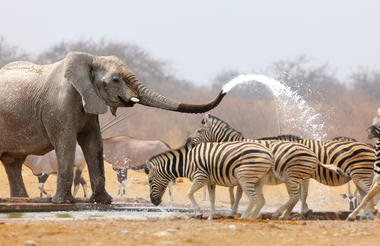
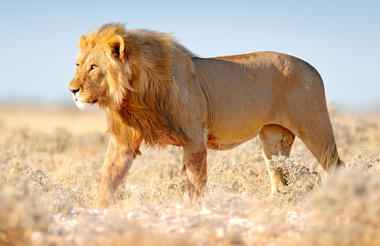
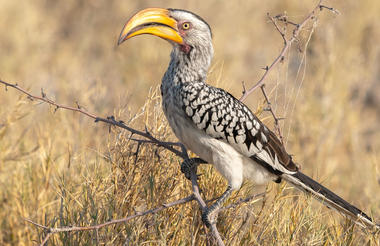
Situated along the southern boundary of Etosha National Park in northwestern Namibia, Etosha South encompasses the park's southern safari region and a collection of private game reserves and lodges. The park is accessed via Andersson Gate, placing visitors within easy reach of renowned waterholes and excellent wildlife viewing. Lions, elephants, giraffes, white and black rhinos, and a wide variety of antelope are among the species commonly seen. Guided 4×4 game drives are the main attraction, with half- and full-day safaris available, some including picnic lunches in the bush.


