


INFORMATION FOR THE VISITOR TO NAMIBIA
This information is provided by Namibia Tracks & Trails as a guideline for your upcoming visit to the country.
TRAVEL DOCUMENTS
Since the 1st of April 2025 a VISA must be applied to enter Namibia.
We recommend applying online before arrival (max. 30 days) - ONLINE VISA ON ARRIVAL -
This link will take you immediately to the website of the "Ministry of the Interior and Entry"
E-Services: Ministry of Home Affairs, Immigration, Safety and Security | E-Services Portal
https://eservices.mhaiss.gov.na/visaonarrival
- Log onto the website
- Register your email address
- Once you receive a response email from MHAISS to confirm your email address
- Ensure you have a scanned copy of your passport bio page and a passport photo
- Select VISA online on Arrival application
- Complete form and submit passport and photo
- Once submitted you will be notified via email if your VOA is approved
- On approval log back into the system and make your payment (
Per adults N$ 1600.00
Per child 6-11y N$ 800.00
Younger <6y free of charge
- Once payment is made you will be able to download your approved VOA
Please print out your approved VOA and provide it at the entry to Namibia with the following documents:
- proof of onward travel (if required)
- Health / Travel Insurance – Coverage for medical expenses.
- Details of 1st Accommodation / Itinerary / Invitation - Hotel booking, host invitation and copy of the itinerary (if applicable)
- Funds – Proof of financial means for your stay
You can also apply for the VISA upon entry directly at the border or airport, for this you need the following documents:
- completed visa application form (Provided on flight by airline before landing or at counters on arrival)
- proof of onward travel (if required)
- Health / Travel Insurance – Coverage for medical expenses.
- Details of 1st Accommodation / Itinerary / Invitation - Hotel booking, host invitation and copy of the itinerary (if applicable)
- Funds – Proof of financial means for your stay.
- Payment for Visa on Arrival must be made via credit card or cash Nam Dollar. The cost is N$1,600 per person, with an additional N$400 fee for applications submitted manually.
The Namibian Government mandates that all visitors to Namibia must have at least six fully blank pages in their passports upon arrival in the country. Additionally, passports should be valid for at least six months beyond the intended departure date from Namibia.
Namibia Tracks & Trails cannot be held responsible for the refusal of entry into a country for any reason whatsoever.
MINORS TRAVELLING TO NAMIBIA
Minors under the age of 18 traveling to Namibia must possess an unabridged birth certificate. Additionally, when traveling:
With an adult who is not their biological parent: An affidavit from both parents, providing consent for the minor to travel with the adult, is required.
With an adult other than a parent/legal guardian: Copies of the legal guardian's/parent's passports or identity documents are required, along with contact details of the parents/legal guardians.
With a parent: An affidavit from the other parent, granting consent for the minor to travel, is necessary. If one parent is deceased, a death certificate should be provided.
Unaccompanied: An affidavit from the parents/legal guardians, consenting to the minor's travel, is required. Additionally, a letter containing the contact details and residential information of the person receiving the minor passenger, a copy of the identity document, valid passport, or permanent residence permit of the receiving person, and the contact details of the minor's parents/legal guardians are necessary.
IMPORTANT CONTACT NUMBERS
Ambulance Emergency: +264 (61) 21-1111
AEMS +264 61 300 118 (international)
963 (National free)
EMed24 +264 83 924 (international)
924 (National free)
Police: +264 (61) 10111
Deutsche Botschaft Windhoek: + 264 (0) 61 273 100
SWAKOPMUND
Ambulance Emergency: +264 (64) 40-5731
EMed24 +264 83 924 (international)
924 (National free)
Police: +264 (64) 10111
NAMIBIA TRACKS & TRAILS +264 824 416 820 (8:00-17:00 Uhr) AH +264 (0) 81 269 7271


The best time to visit Sossusvlei is in the early morning. The park gates open at dawn and the golden light just after sunrise is perfect. Take along enough drinking water, sunscreen and a hat.
Situated in the largest conservation area in Africa (the Namib-Naukluft National Park), Sossusvlei is possibly Namibia’s most spectacular and best-known attraction. Characterized by the large red dunes that surround it, Sossusvlei is a large, white, salt and clay pan and is a great destination all year round. The dunes in this area are some of the highest in the world and provide photographic enthusiasts with wonderful images in the beautiful morning and evening light. Sossusvlei literally translates to “dead-end marsh”, as it is the place where the dunes come together preventing the Tsauchab River to flow any further, some 60km east of the Atlantic Ocean. However, due to the dry conditions in the Namib Desert the River seldom flows this far and the pan remains bone-dry most years.
Close to Sossusvlei, Deadvlei is a clay pan characterized by dark, dead camel thorn trees contrasted against the white pan floor. The pan was formed when the Tsauchab River flooded, and the abundance of water allowed camel thorn trees to grow. However, the climate changed, and the sand dunes encroached on the pan, blocking the river from reaching the area. The trees are estimated to be approximately 900 years old, however they have not decomposed due to the dry climate. Deadvlei is at least 1km walk from the parking lot so be sure to take drinking water with you.
Sesriem Canyon is located approximately 4.5km from the entrance gate of the Namib-Naukluft National Park. The Tsauchab River has shaped the Canyon over millions of years and it is one of the few places in the area that holds water all year round. The early Afrikaans explorers in the region named the canyon after the fact that they had to use six (“ses”) leather straps (“riem”) tied together to create a rope long enough to lower buckets into the canyon below, in order to fetch water.
Do not forget to carry enough water and protect yourself from the extreme sunlight.
Respect the delicate ecosystem of this region and be sure to stick to the path marked with stakes.
Since the dune area of Sossusvlei is only open during the day - from sunrise to sunset - you have to inquire about the exact opening hours.
The park entry fee can be paid at the NWR reception or at the 2x4 car park.
o Adults: N$ 280.00 per day
o Children under 16: N$ 180.00 per day
o Children under 8: free of charge
o Vehicles with fewer than 10 seats: N$ 60.00 per vehicle per day
A new, professionally guided hop-on / hop-off excursion service will operate daily from 07:00 to 17:00 from the 2x4 Parking area to Sossusvlei and Deadvlei.
• N$ 260 per adult
• N$ 130 per child under 12
Additional Visitor Services:
- A Ticket Sales Counter at the MEFT Gate Entrance
- A Refreshment Lounge at the 2x4 Parking Area
Set between the rolling dunes of the Namib Desert and the icy Atlantic coastline, Swakopmund is a relaxed seaside town in western Namibia known for its German colonial architecture, cool coastal climate, and adventurous spirit. Palm-lined streets, historic buildings, and ocean fog create an atmosphere unlike anywhere else in the country. Travellers visit for desert activities such as quad biking, sandboarding, and scenic flights over vast dunes and shipwreck-strewn shores. Cafés, bakeries, and small museums add to the town's laid-back charm, though the Atlantic waters are brisk rather than tropical. With its striking desert-meets-ocean setting and mix of adventure and history, Swakopmund is one of Namibia's most distinctive destinations.


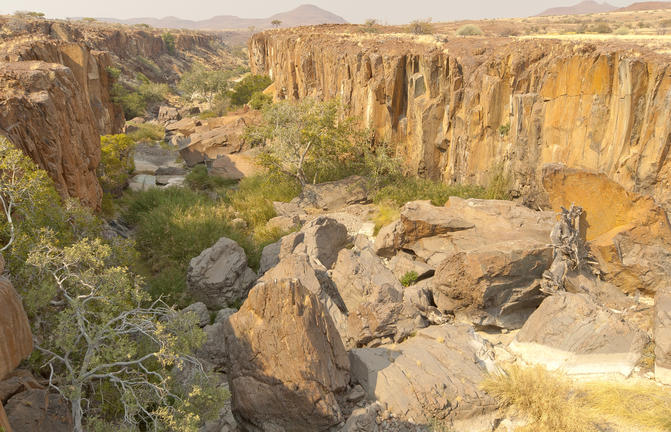

Situated in the rugged landscapes of northwestern Namibia's Kunene Region, Palmwag is a remote safari destination renowned for its dramatic desert scenery and remarkable wildlife. Set amid rocky hills, ephemeral riverbeds and iconic makalani palms, it lies within one of Namibia's largest wilderness conservation landscapes. Visitors can enjoy guided nature drives and walking safaris in search of desert-adapted elephants, black rhinos, giraffes, springbok and other wildlife adapted to this arid environment. Sweeping vistas, striking red-earth landscapes and peaceful starlit skies create a profound sense of solitude, making Palmwag an exceptional destination for travellers seeking wilderness, conservation experiences and the untamed beauty of Namibia.
Situated along the southern boundary of Etosha National Park in northwestern Namibia, Etosha South encompasses the park's southern safari region and a collection of private game reserves and lodges. The park is accessed via Andersson Gate, placing visitors within easy reach of renowned waterholes and excellent wildlife viewing. Lions, elephants, giraffes, white and black rhinos, and a wide variety of antelope are among the species commonly seen. Guided 4×4 game drives are the main attraction, with half- and full-day safaris available, some including picnic lunches in the bush.


Located along the eastern boundary of Etosha National Park in northern Namibia, Etosha East is a rewarding safari destination known for its excellent wildlife viewing and convenient access to the park through the Von Lindequist Gate near Namutoni. Characterised by open savannah, mopane woodland and seasonal waterholes, the region attracts an abundance of wildlife, including elephant, lion, giraffe, zebra and a variety of antelope species. Visitors can enjoy self-drive or guided game drives, with the waterholes offering some of the best opportunities to observe animals gathering to drink, particularly during the dry season. Golden grasslands, distant birdsong and expansive African skies create an immersive safari experience in one of Namibia's most celebrated conservation areas.
Bordering Angola, on the banks of the Okavango River in northern Namibia, the town of Rundu serves as the capital of the eastern Kavango region. Rundu is renowned for its local woodcarvers market and is filled with impressive woodcarvers' workshops. The town provides a great stopover to refuel for visitors heading to Katima Mulilo, enthralling Popa Falls, or Mahangu Game Reserve, home to the endangered wild dog and lion, leopard, elephant, cheetah, and hippo. Visitors to Rundu can also look forward to great game viewing, excellent bird watching as well as kayaking on the spectacular Kavango River.


Flowing through the Zambezi Region of northeastern Namibia, close to the borders of Botswana, Zambia and Angola, the Kwando River is a scenic waterway that forms part of the vast Kavango–Zambezi (KAZA) Transfrontier Conservation Area. Lined with riverine forests, floodplains and reed-fringed channels, it supports an exceptional diversity of wildlife and birdlife, making it one of Namibia's premier safari destinations. Visitors can enjoy game drives, boat cruises, canoeing and guided nature walks, with opportunities to spot elephants, hippos, crocodiles and an abundance of bird species. The river also borders Bwabwata National Park and provides access to nearby Mudumu and Nkasa Rupara national parks, where seasonal wetlands support a rich diversity of wildlife throughout the year.
Situated on the southern banks of the Zambezi River, the small town of Katima Mulilo is the capital of the Zambezi region. This riverside town is surrounded by lush vegetation and is home to an array of tropical bird species and cheeky monkeys. Katima Mulilo is the service centre for the Caprivi and serves as the commercial hub for the East Caprivi region. Visitors can enjoy a variety of interesting attractions including the vibrant street market, where arts and crafts, such as traditional grass-woven baskets, wood carvings, clothes and jewellery, can be found.


The Chobe River forms the northern boundary of Chobe National Park and is one of southern Africa’s most rewarding wildlife riverfronts, especially in the dry season when animals concentrate along its banks. Elephant herds gather in large numbers at the water’s edge, hippos crowd the channels, and buffalo move regularly through the floodplain grasslands, while lions range through the wider system and may hunt buffalo in the surrounding landscape. The river also supports exceptional birdlife across reeds, sandbanks, and woodland edges, and visitors typically explore it through guided game drives on designated park tracks as well as boat safaris that bring them level with elephants and hippos along the shoreline.


