
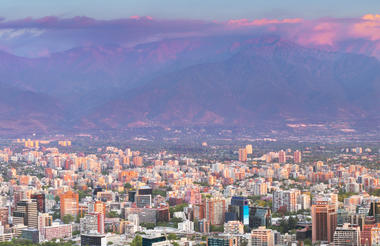
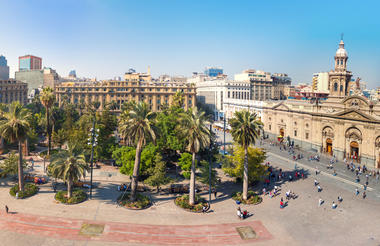
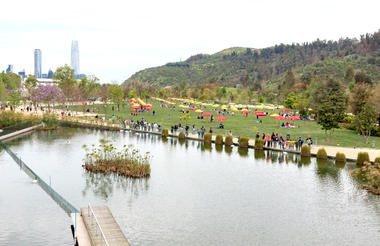
Resting in a valley surrounded by the snow-capped Andes and the Chilean Coast Range, Chile’s vibrant, cosmopolitan, the capital city of Santiago is famous for its beautiful parks, a wealth of historical attractions, and exciting arts and music scenes. The Cerro San Cristobal Park, the largest green space in the city, lies on a hill and is reached by a funicular ride. It offers visitors stunning sweeping views of the city, as well as a picturesque botanical garden and two huge swimming pools. The colonial Plaza de Armas, in the old town centre, is a delight to explore with its numerous Neoclassical buildings and museums, most notably the home-turned-museum of renowned poet Pablo Neruda. Visitors can also look forward to wonderful live shows, concerts and exhibitions.


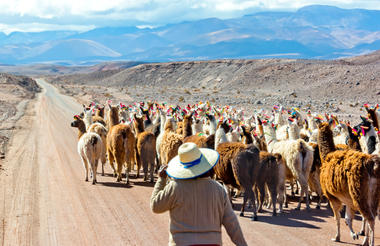
Centrally located in the north of Chile, Putre is a tiny, high-altitude village beautifully situated in the Precordillera (a range of smaller mountains which lead to the Andes). Putre’s chief drawcard is its access to Lauca National Park, one of Chile’s premier natural attractions. The centrepiece of this park is Lago Chugara, an enormous lake beneath Volcan Parinacota, which teems with an impressive array of exotic birdlife. The gorgeous landscape of Lauca National Park is dotted with quaint villages and adobe (mudbrick) buildings, such as the photogenic church of Iglesia de Parinacota. Although the village of Putre is short on sights and attractions, it is an excellent place to buy traditional items made from alpaca wool. It is a highly recommended stopover en route to touring the national park, helping visitors to adjust gently to the high-altitude environment.


Colchane is located in the extreme north of Chile. This remote village of the Andean Altiplano borders Bolivia, and makes a convenient stopover point for travellers passing between the two countries. The village also serves as an ideal departure-point for the 240-kilometre road trip to Putre, a journey which takes you through three of the country’s best national parks. The closest of these protected areas (just 40 kilometres from Colchane) is Parque Nacional Volcan Isluga, home to the scenic peak of Isluga Volcano, several unique species of cacti and Iglesia de Isluga, one of the most photogenic churches in the country. Also inside the park, near the village of Enquelga, you will find natural hot springs where the water rises to temperatures in excess of 30 degrees celsius.


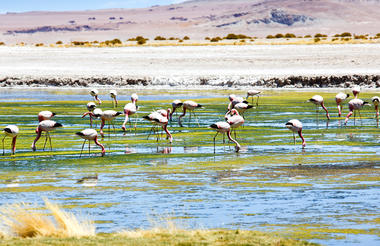
Situated in the Bolivian province of Daniel Campos, the town of Tahua and the surrounding eponymous municipality is home to some of the most spectacular landscapes in South America. The area is dotted with tiny Bolivian villages, blanketed with an endless white salt plain and covered with mountains rising from a lunar-like landscape. Resting at the foot of the sacred Tunupa Volcano, the little village of Tahua sits on the edge of the world’s largest high altitude salt flat, the Salar de Uyuni, which is undoubtedly the main highlight in the province. This vast salt desert is one of the most awe-inspiring spectacles in the country. Visitors will find a variety of wildlife living in and around this area including flamingos, rheas, vicunas, and foxes. Don’t miss the fascinating Fish Island, featuring a rocky island outcrop comprised entirely of fossilized coral and scattered with giant prehistoric cacti.


Located high in the Bolivian Andes close to the Chilean border, the tiny town of San Pedro de Quemes is one of the access points to the striking Uyuni salt pan. Visitors who reach this remote outpost will be rewarded with spectacular scenery and an authentic experience of rural Bolivian life. The village is composed mainly of traditional earth-and-stone houses and the community survives primarily on farming quinoa, potatoes and grains. Tours from San Pedro de Quemes take in striking vistas of rust and ochre-coloured desert desert plains, shallow lagoons rich in bird life, snow-capped volcanoes and the vast white expanse of the Uyuni salar.


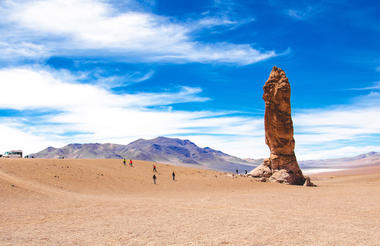
The Siloli Desert is the world’s highest desert, resting at an altitude of 4550 metres above sea level. It is located close to Bolivia’s border with Chile and considered to be an extension of the neighbouring Atacama Desert. Visitors to this remote part of the world can look forward to dramatic views of geometrically cracked salt pans and rust-coloured hills. The desert’s most iconic feature is the Árbol de Piedra, a seven-metre high sandstone formation that resembles a gnarled tree and was shaped by the region’s harsh winds over thousands of years. The tiny settlement of Ojo de Perdiz has a spattering of guesthouses and a fascinating community, while the nearby Pastos Grandes Lagoon is a shallow salt lake set below a volcanic mountain where you can see flocks of flamingos and revel in the breathtaking scenery.


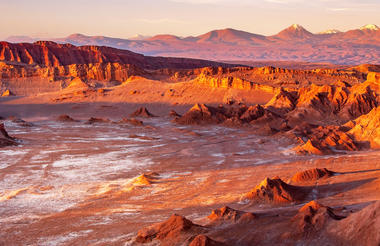
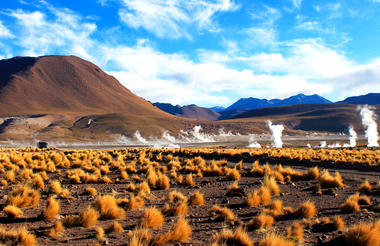
The small town of San Pedro de Atacama is a scenic oasis in the Atacama Desert, surrounded by the imposing volcanic peaks of the Chilean altiplano and located close to several major archaeological and natural attractions. The fascinating ancient sites of Tulor and Quitor, the enthralling Atacama Salt Flat, the jaw-dropping turquoise Altiplanic Lagoons, and the other-worldly Tatio Geysers all lie nearby, and as a result, the village has become a significant tourist destination. Despite its small size it encompasses a wide range of restaurants; however, it is also known for its ‘western feel’ and retains an old-world charm. History enthusiasts will enjoy a visit to the atmospheric 17th-century Iglesia San Pedro. However, it is really the breathtaking surroundings that make this destination special.
As previously described


