


For many years, Myanmar (formerly known as Burma) has long borne the brunt of a brutal regime that kept it strictly out-of-bounds to most visitors. But in the last decade, the country has seen significant advancement and, as a result, has become a popular tourist destination. Ironically, the nation’s former oppression has largely contributed to its current-day charm, as its isolation prevented the rampant development and commercialism that has affected many of its Southeast Asian counterparts. Highlights of the country include the mesmerising city of Mandalay; the ancient, sprawling temple complex of Bagan; the unique allure of Inle Lake; and the serene hill station of Kalaw.
With a population of over 5 million, Yangon, also known as Rangoon, was the capital of Myanmar up until the end of 2005. It remains the largest city, and is still the pivotal commercial hub of the country today. A visit to this magnificent city will allow you to take in the interesting mix of British, Burmese, Chinese and Indian cultures that mingle there. The skyline is an interesting contrast of decaying colonial architecture and modern high-rises, dominated by the golden glow of the Shwedagon Pagoda, an exquisite Buddhist temple that draws pilgrims from across the globe. Your time here would be well spent visiting the impressive array of temples, museums, and markets that the city has to offer.


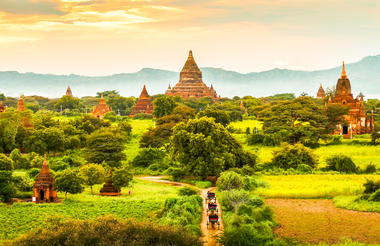
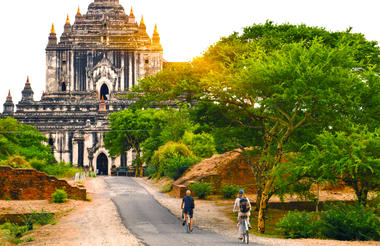
Bagan is an ancient archaeological and cultural destination in central Myanmar's dry zone, on the eastern bank of the Ayeyarwady River. A former capital of the Bagan Kingdom, it is a UNESCO World Heritage Site, with thousands of Buddhist temples, stupas and monasteries spread across an expansive plain. Travellers can explore the temple-studded plain by bicycle, horse cart or car, discovering architectural highlights such as Ananda Temple and Shwezigon Pagoda. Hot-air balloon flights, when conditions permit, provide a memorable perspective on the ancient monuments, river and surrounding countryside, while local lacquerware workshops offer insight into Bagan's living craft traditions. The combination of monumental Buddhist heritage, open landscapes and traditional culture gives Bagan a distinctive sense of place.

Situated high up in the western Shan State, Kalaw is a former hill station founded by British civil servants. It is something of a high-altitude resort – cool, calm, and leafy – but is also widely known as a trekking Mecca in Myanmar, as those wishing to explore the surroundings can do so without prior permission. Its population is diverse, as Nepali Gurkhas, Indian Hindus, Sikhs, and Muslims came here to build the roads and railway line during the British period. A wide variety of exploring options are available, including three-day treks to Inle Lake or Pindaya. At the town’s heart is an exciting market, where villagers from the wider area come to sell their produce and an eclectic range of foods. Make sure to visit the atmospheric Aung Chang stupa, or take a taxi ride to the captivating Green Hill Valley elephant camp.


Resting in the Shan Hills’ Nyaungshwe Township, beautiful Inle Lake is a world unto itself and one of Myanmar’s most alluring destinations. The local people have integrated their lives fully with their watery surrounds, building entire villages on stilts, buoying up their crop fields with floating devices, and even learning an ingenious method of fishing from their long-tail boats – balancing on one leg and using the other to clasp the paddle and row, which leaves their hands free to cast a net. Here visitors can enjoy delicious Myanmar cuisine and exquisite sunsets from alfresco decks, or take a boat trip to the floating markets and the handicrafts centres, watch silver makers, silk-weavers, and lacquer artists at work, and purchase exquisitely made gifts and souvenirs.


