


Since reopening to tourists in the early 1990s, Cambodia has captivated visitors from around the globe with its rich cultural heritage, warm and welcoming people, and extraordinary natural wonders. Phnom Penh, the nation’s vibrant capital, pulses with energy, offering world-class dining, lively markets, and a spirited nightlife. Yet the country’s true treasures lie beyond the city: the sleepy, French-influenced town of Kampot enchants with its riverside promenade, colonial villas, and charming cafés; the lush, jungle-clad Cardamom Mountains reveal spectacular waterfalls and pristine wilderness; and, of course, the majestic Angkor Wat complex stands as the world’s largest and most breathtaking religious monument. Cambodia seamlessly caters to every traveller, whether seeking exhilarating jungle adventures, serene golden-sand beaches, luxurious resorts, or a journey through its tantalising local cuisine. With its blend of history, nature, and culture, Cambodia remains a destination of endless discovery and wonder.
Situated at the confluence of the Mekong and Tonle Sap rivers, Phnom Penh, Cambodia’s vibrant capital, captivates with its rich history, welcoming locals, and thriving culinary scene. The city’s heritage is immediately evident: the National Museum of Cambodia showcases over a millennium of Khmer art and design, while the monumental Royal Palace—home to King Sihamoni—features the iconic Throne Hall and the dazzling Silver Pagoda, whose floor gleams with five tons of silver. Along the Tonle Sap riverfront, visitors can enjoy refined dining and French-inspired wines, a legacy of the city’s colonial past, while the evenings come alive with lively nightclubs, karaoke performances, and stage shows. Combining culture, history, and cosmopolitan energy, Phnom Penh offers a dynamic and immersive Cambodian experience.


Nestled in Cambodia’s expansive Mondulkiri Province, Sen Monorom is the region’s largest town and provincial capital, offering a gateway to the area’s lush, rolling landscapes. The town itself is home to the indigenous Pnong community and is graced by two serene lakes at its heart, adding to its tranquil charm. Beyond Sen Monorom, thick jungle, spectacular waterfalls, and traditional hill tribe villages await exploration. Visitors can savour authentic Cambodian cuisine at local restaurants, unwind at lively bars, or stay in comfortable hotels that blend convenience with character. Popular activities include trekking through verdant hills, eco-tours, motorbike adventures, and immersive cultural experiences with the Bunong people, making Sen Monorom a compelling base for both nature lovers and cultural explorers.


Crumbling colonial mansions stand proudly alongside bustling shopfronts and apartment blocks in Kratié, while the riverfront offers spectacular sunsets over the Mekong. Just beyond the town, traditional Cambodian villages unfold, with stilted wooden houses set against emerald rice paddies, coconut palms, and lush jungle. A highlight for most visitors is a boat trip to Kampi, where the critically endangered freshwater Irrawaddy dolphin can still be glimpsed in its natural habitat. Equally enchanting is Koh Trong, a serene riverine islet where travellers can experience traditional rural life and explore a nearby Vietnamese floating village, offering an immersive glimpse into the region’s riverine culture.


Named for the Cham Muslim residents who immigrated here centuries ago, Kampong Cham is one of eastern Cambodia’s largest urban centres and a key transit point for onward travel connections. It is nevertheless a laid-back city with a picturesque riverside setting and an evocative mish-mash of historical architecture – which includes traditional Chinese shophouses, elegantly weathered French colonial buildings, and the so-called ‘New Khmer Architecture’ that was developed in Cambodia’s 1960s heyday. Several ancient temples and shrines are dotted across the town’s surrounds, adding to the town’s timeless, mystical allure.


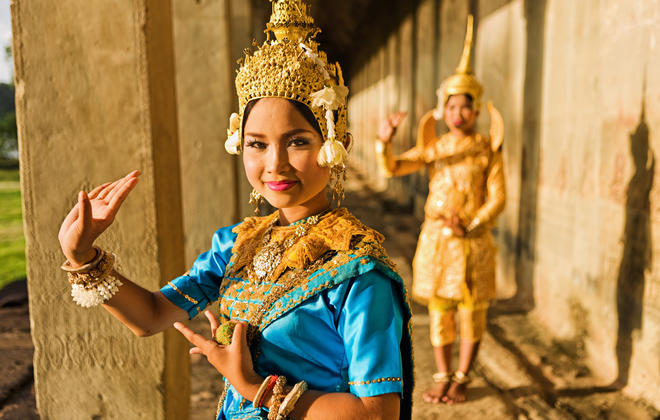
Best known as the gateway to the awe-inspiring Angkor Wat temple complex, Siem Reap is a charming town blending French colonial and Chinese architectural influences with a relaxed, welcoming atmosphere. Its crown jewel, the Angkor complex, spans an area larger than Paris and is a labyrinth of intricately carved temples adorned with dancing apsaras, lotus motifs, and five-headed naga (serpent deities). Abandoned for centuries and rediscovered in 1860 by French explorer Henri Mahout, it has since become Cambodia’s cultural and historical highlight. Beyond the temples, Siem Reap offers a vibrant arts and crafts scene, immersive cultural villages that showcase traditional rural life, and a bird sanctuary on the town’s outskirts, providing visitors with a rich mix of heritage, nature, and local culture.


