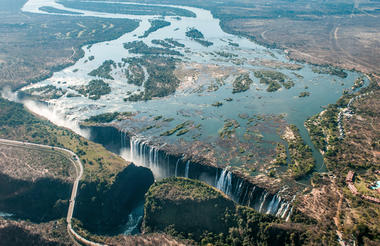
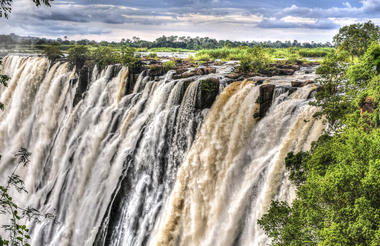
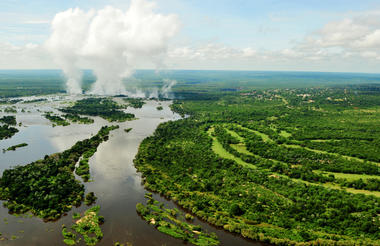
Situated on the Zambia–Zimbabwe border along the Zambezi River, Victoria Falls is experienced from the Zambian side within Mosi-oa-Tunya National Park, where walkways trace the cliff edge above a vast basalt gorge. Knife Edge Bridge pushes visitors into the spray line for a close view of the Main Falls, a continuous curtain of water, and the Eastern Cataract, where the flow breaks into narrower channels across the far side. Rainbow Falls, the highest section of the cascade, often reveals shifting arcs of colour in fine mist when light breaks through the spray. The Boiling Pot viewpoint looks directly into a deep whirlpool where the river is forced into the Batoka Gorge. Upstream, boat access reaches Livingstone Island, a rocky outcrop on the lip of the falls, and the seasonal Devil’s Pool, a natural rock pool at the edge of Victoria Falls that becomes safely accessible during low water when river levels drop and currents weaken. Activities extend beyond the rim, including white-water rafting through gorge rapids, kayaking, ziplining across the chasm, bungee jumping from the bridge, bridge swings, sunset cruises, game viewing along the riverbanks, and visits to the local market.
The Linyanti River forms the Northern border of Botswana with Namibia. The entire frontage comprises Wildlife Management Areas, and includes a small portion of the Chobe National Park. The Chobe Park and the Linyanti WMAs are renowned wildlife areas and are home to what is probably the highest density of elephants in Africa. Chobe Park alone is estimated to host over 50,000 of these great pachyderms.
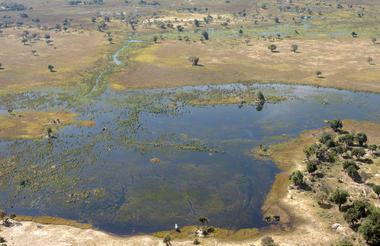
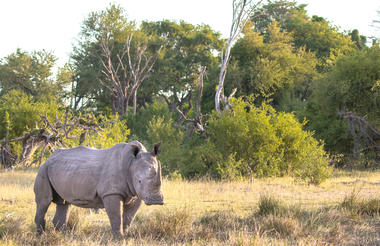
Situated on the eastern reaches of the Linyanti river, the secluded Linyanti reserve comprises a 20 km section of river frontage reminiscent of the Okavango Deltaʼs permanent swamp with reed fringed lagoons, small islands and a fringe of towering riverine trees. This is backed by Mopane and Acacia sandveld that hosts elephant, kudu, impala and bushbuck as well as occasional roan and sable antelope.
Lion, leopard, wild dogs, hyena and all the smaller predators also occur. Herds of buffalo, zebra and sometimes eland migrate into the Reserve in the late winter to spring dry season from the far south of the Chobe National Park, seeking the cool permanent water and lush marsh vegetation of the river.