Namibia posesses some of the most stunning landscapes in Africa, and a trip through the country is one of the great road adventures. Natural wonders such as that mighty gash in the earth at Fish River Canyon and the wildlife utopia of Etosha National Park enthrall, but it’s the lonely desert roads where mighty slabs of granite rise out of swirling desert sands that will sear themselves in your mind. It’s like a coffee-table book come to life as sand dunes in the world’s oldest desert meet the crashing rollers along the wild Atlantic coast. Among all this is a German legacy evident in the cuisine and art nouveau architecture, and in festivals such as Windhoek’s legendary Oktoberfest. Namibia is also the headquarters of adventure activities in the region, so whether you’re a dreamer or love hearing the crunch of earth under your boots, travel in Namibia will stay with you long after the desert vistas fade.
Windhoek is Namibia’s capital, home to an international airport and a plethora of restaurants, shops, entertainment venues and accommodation options. The city is clean, safe and well-organised, with a colonial legacy that is reflected in its many German eateries and shops, and the widespread use of the German language. Windhoek has an interesting mix of historical architecture and modern buildings, many of which are worth a look, including the Alte Feste (Old Fort), the 1896 Christuskirche (Christ Church), and the more contemporary Supreme Court.


Sossusvlei is where you will find the iconic red sand dunes of the Namib. The clear blue skies contrast with the giant red sand dunes to make this one of the natural wonders of Africa and a photographers heaven. Aside from the attractions at Sossusvlei - Dune 45, Hiddenvlei, Big Daddy and Deadvlei - other attractions in the area include the Sesriem Canyon and Namib-Naukluft National Park, where the mountains of the Namib meet its plains.


The only rocky part of the 1,500km Namib coastline and poised between sand and sea, Lüderitz is a remote frontier at the very end of everything - or the beginning depending on which way you look at history.
The only rocky part of the 1,500km Namib coastline and poised between sand and sea, Lüderitz is a remote frontier at the very end of everything - or the beginning depending on which way you look at history.
Lüderitz is trapped at the end of a long tarred road that squeezes through the Koichab Pan of the Great Sand Sea to the north, and the forbidden territory of the diamond fields in the south; the Antarctic-fed Benguela current effectively seals off any hope of eastward salvation.
And yet, against all odds and a fits and starts upbringing, Lüderitz is a thriving town with little to keep it there but for its isolation and the charm of its incongruous location. This German town of about 25,000 inhabitants was born out of necessity in 1487 when Bartholemu Dias sailed his little flotilla into the natural bay created by the rocky peninsula. Centuries later the the bay was no more than an obscure anchorage on the spice route when whales and guano attracted fierce commercial interest in the 19th century.
The region fell into German hands one year after a merchant named Adolf Lüderitz bought the bay and the coastline down to Orange River in 1883. The subsequent discovery of diamonds transformed this German enclave into a thriving port, which was promptly forgotten when richer bounty was discovered way down south in Oranjemund.
The fascinating and the bizarre mix like sand and sea in this twisted land that requires a two-night visit if not more.
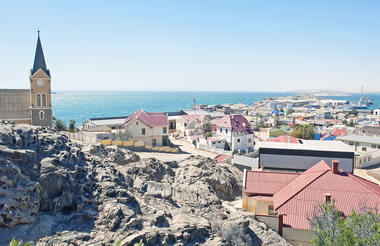
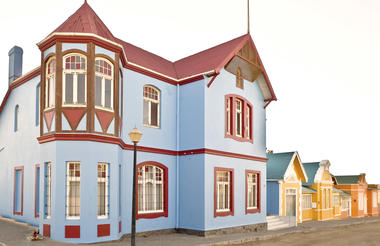
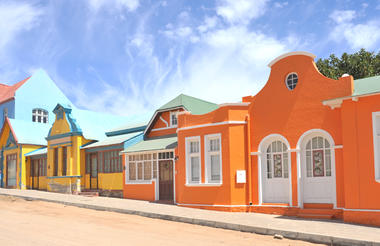
Lüderitz is an anachronism of 19th century Germany. Its older buildings have towers, turrets, oriel windows, bay windows, gables and steep roofs and the town is locked in a sleepy microcosm that defies modern notions of time.
Attractions in the town include Goerke Haus - a grand restored palace; Felsenkirche - a fine Victorian-Gothic church; the Lüderitz Museum, which has historical, ethnic, flora and fauna displays; Nautilus Hill on a clear afternoon for a taste of the desolation that surrounds the town; and the carpet factory, which is reviving demand for karakul wool.
Lüderitz Bay is dotted with islands and lined with rugged inlets. Daily boat cruises take you along the wild coastline with a good chance of encountering endemic Benguela dolphins, Cape fur seals and a rare breeding colony of African penguins. Birders should look out for Damara terns and greater flamingos.
The Lüderitz Peninsula is a scenic round trip with picnic spots and good photo-ops at Griffith Bay, Sturmvoglebucht, Diaz Point, Halifax Island, Essy Bay, Eberlanz Höhle, Kleiner Fjord and Grosse Bucht.
The ghost town of Kolmanskop is an eerie remnant of the diamond era at the beginning of the 20th century. This sand-filled skeleton of a town about 10km from Lüderitz was once a prospering community with a clubhouse, restaurant, bars, saloons, a concert hall and a free block of ice per household every day. You can buy diamonds here and join a guided tour for a detailed look at the history of the diamond boom.
The alluring Sperrgebiet, or forbidden zone, requires advanced booking, special permits and personal guides - all worth it. Agate Beach is about 5km north of Lüderitz and its black sand sparkles with mica and the occasional agate; Elizabeth Bay, 40km south of Lüderitz, had a 3 x 5km band of diamond-bearing coarse grits and sands; Bogenfels is a signature rock arch rising 55m above the sea and a day trip there goes by way of more ghost towns and abandoned diamond mines.
Leading out from Lüderitz, the road to Keetmanshoop is paved with a few attractions along the way, not least of which is the dramatic emptiness of the Koichab Pan.
Near Aus is the site of freak flower explosions after the erratic Cape-influenced winter rains. The timing and frequency is less predictable than the Namaqualand phenomenon in South Africa, making the experience all the more exciting. A similar phenomenon occurs in the lilyveld valley near Maltahöhe. The lilies are endemic to the valley and they bloom for about a week after good rains. February and March are the best times to catch this rare - and undiscovered - sight.
Another peculiarity inland of Lüderitz is the feral horses that have settled near the man-made waterhole at Garub Pan. Numbering about 150, these horses have adapted to the harsh conditions and roam at will across the Sperrgebiet.
Yet another oddity - and likely explanation as to the origin of the desert horses - is a sandstone fortress called Duwisib Castle. Complete with turrets, battlements, jacaranda trees and a lush lawn, this strange sight perches among the rugged hills as if it were dropped intact by a castle-bearing spaceship.
The intermittent Fish River has created Africa’s largest and the world’s second largest canyon. Hot, dry and stony the 160 km long, at times 27 km wide and 550m deep canyon is awe inspiring. At the southern end are the renowned hot springs of Ai-Ais.


This vast country is undoubtedly one of the most culturally and geographically diverse places on earth. Fondly known by locals as the 'Rainbow Nation', South Africa has 11 official languages and its multicultural inhabitants are influenced by a fascinating mix of African, Asian and European cultures. Spend your days: discovering the gourmet restaurants, impressive art and nightlife scenes and fine beaches of Cape Town; enjoying a typical local braai (barbecue) in the Soweto township; browsing the bustling Indian markets in Durban; or sampling some of the world’s finest wines at the myriad wine estates dotted around the picturesque Cape Winelands. Due to its rich and turbulent history there are plenty of historical attractions to explore including the Zululand battlefields of KwaZulu-Natal, the Apartheid Museum in Johannesburg and Robben Island, just off the coast of Cape Town. Above all else, South Africa’s attraction lies in its remarkably untamed wilderness with its astonishing range of wildlife roaming freely across massive unfenced game reserves such as the world famous Kruger National Park. With all of this variety on offer, it is little wonder that South Africa has fast become Africa’s most popular tourist destination.
Stretching for over 1000 kilometres along South Africa’s scenic West Coast, the Namaqualand is known for its stark, arid beauty. Once a year in early Spring, the Namaqualand landscape explodes into a kaleidoscope of colour. The dusty plains are transformed into a blanket of thousands of flowering wildflowers. International and local visitors flock here to see this seasonal natural splendour. Aside from the endless photogenic landscapes, visitors can look forward to viewing a wide variety of wildlife and exploring the quaint seaside towns dotting the coast as well as the various historic towns scattered in the hinterland.


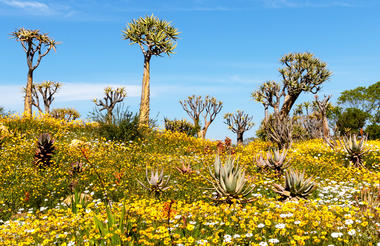
Located in South Africa’s Northern Cape Province, the Augrabies Falls National Park encircles the mighty Augrabies Falls. The Orange River plunges down 60 metres in absolute splendour, through the 18-kilometre ravine of the Orange River Gorge. The landscapes are characterised by rocky outcrops, scrub-dotted plains, and clusters of 'kokerboom', also known as quiver trees. This sanctuary provides a home for an array of animals including springbok, gemsbok, klipspringer, various bird species and the endangered black rhino. Other commonly spotted species include giraffe, steenbok, kudu, eland, leopard, African wild cat, jackal, and caracal.


Combining the former Kalahari Gemsbok National Park of South Africa and the Gemsbok National Park in Botswana, the enthralling Kgalagadi Transfrontier Park is a wonderland of bright orange dunes, spectacular wildlife and fascinating flora. This hauntingly beautiful desert land is part of Africa’s first transfrontier park, ensuring that conservation is the top priority for this vast ecosystem and its inhabitants - it also supports and protects the indigenous people here, the ‡Khomani San and Mier communities. Visitors can look forward to spotting lions, leopards, hyenas, cheetahs, blue wildebeest, springbok, eland, and more than 200 bird species, including migrating flamingos and pelicans, and numerous raptors. Some of the activities on offer include game drives, 4x4 excursions, hiking, swimming, eco trails, star-spotting and nature photography.


Namibia posesses some of the most stunning landscapes in Africa, and a trip through the country is one of the great road adventures. Natural wonders such as that mighty gash in the earth at Fish River Canyon and the wildlife utopia of Etosha National Park enthrall, but it’s the lonely desert roads where mighty slabs of granite rise out of swirling desert sands that will sear themselves in your mind. It’s like a coffee-table book come to life as sand dunes in the world’s oldest desert meet the crashing rollers along the wild Atlantic coast. Among all this is a German legacy evident in the cuisine and art nouveau architecture, and in festivals such as Windhoek’s legendary Oktoberfest. Namibia is also the headquarters of adventure activities in the region, so whether you’re a dreamer or love hearing the crunch of earth under your boots, travel in Namibia will stay with you long after the desert vistas fade.
The Kalahari is an exceptionally beautiful living desert a large semi-arid sandy savannah draped over a gently rolling inland sea of sand covering most of Botswana and large parts of Namibia and South Africa. It is also the last bastion of the San people with the modern world having enveloped all the other areas they once roamed. Here in Namibia it is typically red sands covered in thin, wispy, mostly golden grass and dotted with acacia trees and wide ranging wildlife including gemsbok, impala, jackals and cheetah.