


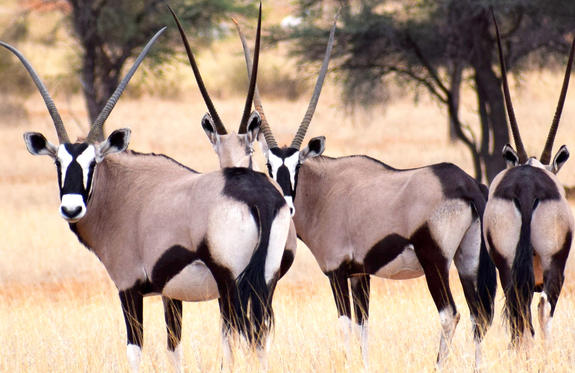
Spreading across Botswana, South Africa and Namibia, the Kalahari, meaning 'the great thirst', is an exceptionally beautiful living desert. The landscape is characterised by a large semi-arid sandy savannah, draped over a gently rolling inland sea of sand that covers most of Botswana and large parts of Namibia and South Africa. It is inhabited by the indigenous San people, with the modern world having enveloped all the other areas they once roamed. The Namibian portion is made up of red sands covered in thin, wispy, mostly golden grass and dotted with acacia trees and wide-ranging wildlife, including gemsbok, impala, jackals and cheetah.

Set amidst the arid terrain near Keetmanshoop are the ancient quiver trees, a striking Southern African phenomenon with twisted branches reaching towards the sky. These tall and photo-friendly trees, reaching up to eight metres, exhibit a unique dichotomous branching pattern, creating a distinctive candelabra-like silhouette. Slow-growing, some specimens in the forest are estimated to be 200-300 years old, thriving in the harsh climate by storing water in their thick trunks and fleshy leaves. Protected as a national monument in Namibia, the Quiver Tree Forest holds both ecological and cultural significance, with its smooth grey bark and fibrous wood once used by the San people for quivers. Nearby, the Giant's Playground, a geological wonder of large dolerite boulders, boasts a unique feature of appearing haphazardly stacked, as if by a giant child. A nearby rest camp provides a comfortable base for travellers keen to experience Namibia's surreal natural landscapes firsthand.

Sandwiched between the rugged and stark Atlantic Coast and the arid desert of Namibia, the town of Luderitz is located in an incredible unique geographical setting. This seaside town is something of an anomaly frozen in time – a piece of 19th-century Bavaria bordering the pinkish sand dunes of the Namib Desert. Lutheran churches, German bakeries, and colonial buildings boasting German art nouveau architecture are dotted about the settlement, while its windswept beaches are home to flamingos, ostriches, seals, and penguins. The nearby ghost town of Kolmanskop, which has been taken over by the desert dunes, is another fascinating must-see attraction, located approximately 10 kilometres from Luderitz central, along with the herd of wild desert-adapted horses near the small town of Aus.

Deep within Namibia’s Namib Desert, Sossusvlei is a striking landscape of towering red sand dunes, among the highest in the world, pale salt pans and immense open skies. Part of the Namib-Naukluft National Park, it has a remote, almost otherworldly atmosphere shaped by silence, shifting light and extreme desert conditions. Visitors can climb famous dunes such as Big Daddy or Dune 45 at sunrise, when the sand glows orange and shadows stretch dramatically across the valley floor. Nearby Deadvlei, with its blackened camel thorn trees standing against white clay and rust-coloured dunes, offers one of southern Africa’s most distinctive desert scenes. The dry heat, the soft crunch of sand underfoot and the vast sense of space create a powerful atmosphere, though early starts and challenging temperatures are part of exploring this remarkable region.

Resting on Namibia's spectacular coastline just south of Swakopmund, Walvis Bay (Whale Bay) is a thriving town, Namibia’s principal harbour and one of the country’s most popular tourist centres. It is known for its natural lagoon, striking orange sand dunes and wealth of outdoor activities. Visitors can enjoy fishing, bird-watching, sailing, sandboarding, swimming, surfing and golf. Located just outside town is Dune 7, one of the largest sand dunes in the world, offering fantastic views from the crest for those with the energy to climb it. Other bucket list items include a trip to the expansive green and pink salt pans dotted with flocks of flamingos, and boat trips to see seals colonies, dolphins and friendly pelicans while enjoying champagne and oysters.

Situated in Namibia’s desolate, awe-inspiring Namib Desert, between Usakos and Swakopmund and about two hours’ drive from Swakopmund, the Spitzkoppe are a group of bald granite peaks forming one of Namibia’s most recognizable and dramatic landmarks. These enormous towering domes are a mecca for hikers and mountaineers, from beginners interested in guided historic walks to professional climbers seeking an adrenaline boost. Numerous ancient rock paintings can be visited as part of a guided walking tour. The extreme, barren landscapes and striking rock formations create an excellent setting for photography.

Situated in northwestern Namibia, the Etosha National Park offers a premier game viewing experience. The park’s diverse vegetation ranges from dense bush to open plains attracting a variety of wildlife. Located in the heart of the park is the Etosha Pan - a shallow depression that covers an area of 5000 square kilometres. Dry and shimmering for most of the year, the pans fill up with water after seasonal rains, making it the perfect habitat for wildlife. In the dry season, the wildlife is attracted to the perennial springs and waterholes that makes for excellent game viewing. Visitors can look forward to world-class game viewing including a variety of large mammals such as lion, elephant, leopard, rhino, zebra, giraffe, a diversity of birdlife such as flamingoes and pelicans.


