


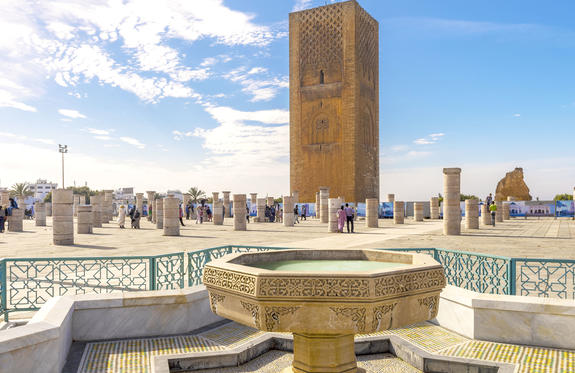
Rabat and its twin city, Sale, overlook the Atlantic Ocean from their location at the mouth of the Bouregreg River. This enchanting city serves as Morocco’s capital and features fascinating Islamic and French-colonial architecture. With a rich historical and cultural heritage, a long coastline with beautiful rocky and sandy beaches, an ecologically diverse countryside, wonderful hiking trails and a vibrant city centre with lush, green parks, the city is a popular destination for travellers. Explore the city on foot, relax on the unspoilt beaches and visit the captivating 12th-century seaside kasbah of Udayas.

Morocco’s second-largest city and the country’s former capital, Fes (Fez) is an exotic mix of Arabic architecture, ancient alleyways calls to prayer and colourful markets; all mixed in with a good dose of modern culture. Home to the venerated Karaouine Mosque, which dates back to 859 AD and incorporates an Islamic university, and to the country’s most hallowed shrine, the Zaouia Moulay Idriss II; Fes is regarded as the spiritual seat of Morocco. Music lovers should try to synchronise their trips with the annual Festival of Sacred Music, one of the highlights of the city’s cultural calendar showcasing diverse performances of spiritual and religious music; while those with a penchant for shopping can browse the mesmerizing colourful markets selling an exquisite array of silver, leather and other handicrafts up for grabs.

Situated in the vast desert region of Saharan Morocco, dividing Morocco and Algeria, Erg Chebbi is one of two Moroccan ‘ergs’, which are a sea of dunes. What it lacks in size - compared to the deserts of Algeria, Libya and Namibia - it makes up for in its extraordinarily scenic golden landscape, which changes colours dramatically at sunset. The dunes of Erg Chebbi span over 30 kilometres and rise up to 160 metres. From Merzouga, the tourist centre, take a camel trip into the wild; enjoy quad biking; or stay overnight in a desert oasis called a Moroccan bivouac.

Set along the former caravan route between Marrakech and the Sahara, Ait Benhaddou is a popular tourist destination in the Ouarzazate province. This ancient Moroccan village is a traditional mud-brick city edging the High Atlas Mountains. It has featured in many Hollywood movies, including Lawrence of Arabia, Jesus of Nazareth, Jewel of the Nile, and Gladiator. Thanks to the Hollywood touch-ups through the years, this UNESCO World Heritage Site is well preserved. It is a ‘ksar’ which means fortified village and served as a convenient stopover for hundreds of caravans of camels following the renowned trans-Saharan trade route. Travellers can wander the ancient alleyways, view the traditional architecture, and visit the Granary perched at the top of the hill. Don’t miss the opportunity to explore the Mausoleum of Ben-Haddon at the foot of the hill on the opposite side of town, and soak up the breathtaking views.

Situated to the north of the foothills of the snow-capped Atlas Mountains and fringing the famed Sahara, the bustling UNESCO-listed city of Marrakesh is an enchanting travel destination. Marrakesh is also home to the largest traditional Berber market in Morocco and one of the busiest squares in the world, known as Djemaa el Fna. Don’t miss the opportunity to visit this square in the evening as it transforms into an enormous, open-air restaurant, and browse through exquisite carpets, spices and a myriad of other items. Art, design and architecture enthusiasts flock to the city to see its incredible artisan achievements, so beautifully expressed at the glorious Bahia Palace, Dar Si Said and Saadian Tombs, as well as at several museums. The other-worldly Jardin Majorelle is also unmissable.

Taking up most of Africa’s north-western corner, the Atlas Mountains extend for roughly 2400 kilometres across Morocco, Algeria and Tunisia, reaching to over 4000 kilometres above sea level at their zenith, Toubkal Mountain. The Atlas range is exceptionally scenic and known for the many rare and endangered plants and animals occurring there, some of which are found nowhere else on earth. Visitors can explore some of North Africa’s most remote villages tucked away in the deep valleys of the rugged range, hike and bike through the spectacular scenery or visit the impressive kasbahs of Ouarzazate, Tifoultoute, Telouet and the magnificent Ait Ben Haddou, one of Morocco's most photogenic buildings.

Favourably situated on a vast sweeping bay on the southwest coast of Morocco, featuring long stretches of glorious, golden-sand beaches, the historical town of Essaouira is one of the country’s premier tourist attractions. The town is set against a picturesque backdrop of lush, wooded hills and a patchwork of small fields, spread with a kaleidoscope of colourful wildflowers in springtime. Known for its bustling fishing harbour, quaint white and blue houses, and its lovely, souk-filled medina, there is plenty to keep you blissfully engaged in this popular seaside town. The strong Atlantic wind provides perfect conditions for kitesurfing and windsurfing. Despite its popularity, the town has managed to retain its old-world charm and is an ideal place to embrace the laid-back lifestyle of the locals and escape the hustle and bustle of city life.

Casablanca lies on the Atlantic coast, in central-western Morocco. Fondly known by locals simply as ‘Casa', the capital is the industrial, economic and cultural heart of this remarkable country, as well as its most cosmopolitan, liberal, and progressive city. While most visitors overlook Casablanca in favour of Morocco’s more popular and exotic tourist areas, this sprawling metropolis has plenty to offer the discerning traveller and has many hidden historical and cultural gems just waiting to be discovered. The city is famous for its spectacular Art Deco and Moorish Revival architecture, constructed during the Colonial Period. Explore the Old Medina, a tiny, ancient, walled village; visit the impressive King Hassan II Mosque; discover the ornate rooms, masterfully tiled floors, and intricately carved wooden ceilings of the Hispanic-Moorish Mahkama du Pacha; or simply watch the world go by at one of the many ocean-view cafes along the waterfront boulevard.


