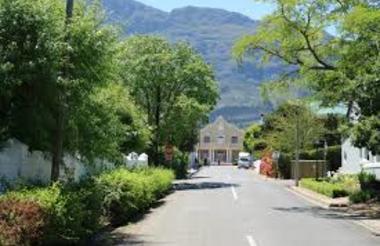
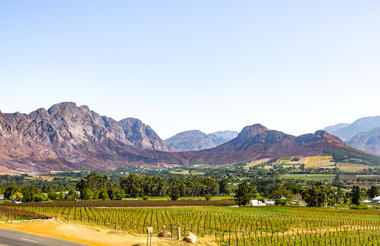
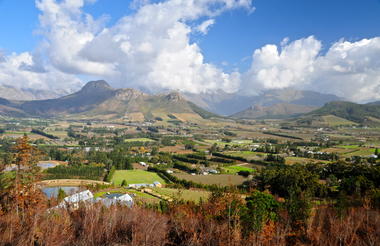
Idyllically situated in the Cape Winelands, this peaceful country retreat is one of the oldest towns in South Africa. The once sleepy little village was named Franschhoek, meaning 'French Corner' as it was founded by French Huguenots in 1688 alongside the original inhabitants, the Khoisan, who still live here. To the French Huguenots, fleeing violent religious persecution, the fertile valley must have seemed like heaven. The Huguenots named their farms after places in their old homelands, many of which continue to this day.
The original Cape Dutch architecture in much of the village is remarkably well preserved. Renovation and building restrictions are in place to preserve the spirit of the original settlers.
Completely closed off from the rest of the world on its eastern flank by the Franschhoek Mountains, the town can only be accessed from two routes. One of which Franschhoek Pass, is, in terms of valleys, gorges, and mountain peaks covered in snow in winter hard to beat for natural beauty.
World-class wine estates, quaint, upmarket boutiques, museums such as the Huguenot Memorial Museum where the signature of every 1685 Huguenot settler is on display, the Franschhoek Motor Museum with its unique and exciting collection of vehicles, motorcycles, bicycles and memorabilia from over 100 years of motoring history (by appointment only), and South Africa’s first Perfume Museum with an extensive and comprehensive permanent collection including antique masterpieces as well as workshops are just some of the unique delights of Franschhoek. Exploring the charming town’s centuries-old tree-lined streets, art galleries, world-class restaurants, Illustrious wine estates and secluded countryside retreats, delicious delis and spectacular scenery, all adds up to an unforgettable experience.



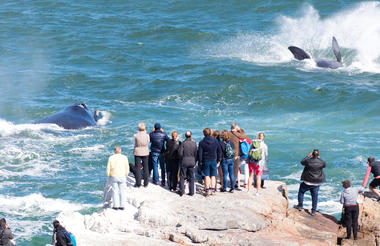
You’ll be relieved to know that the South African Post Office was responsible for the name of the town Hermanuspietersfontein being changed to Hermanus. Much more pronounceable and fits better on a signpost. Which is a good thing as this ‘village’, as the locals call it, is one of the most famous places in the world to watch whales from land.
Although the Southern Right whale is the most prolific species, it’s not the only one that visits these shores. Once hunted, the whales are now protected ensuring the survival of the species. Perhaps that, as well as the warm-summer Mediterranean climate, is why they return year after year. A Kalfiefees, or Calf Festival, is held, usually in August, to welcome the first whales. At the end of September, the annual Hermanus Whale Festival celebrates the calving and mating season. The whales can be seen from the cliffs all along the coast from June to early-December. The cliff path is wheelchair friendly. The Old Harbour Museum comprising the charming fisherman’s village, the old harbour, and the Whale Museum tells the story of whales, whaling and Hermanus.
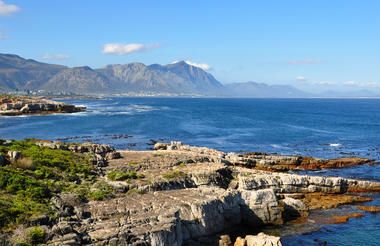
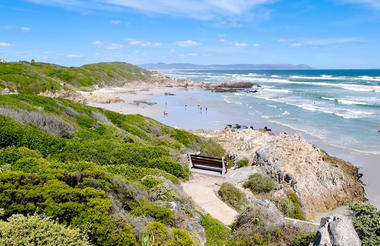
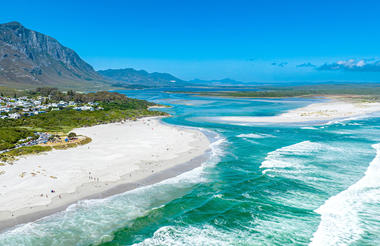
Walker Bay where Hermanus lies is stunningly beautiful. Long pristine sandy beaches, the protective arms of the Cape Fold Mountains that surround it, and one of the highest plant diversity levels in the world make this quaint town a memorable destination. A hike through the nearby Fernkloof Nature Reserve, and sampling prestigious wines on the famed Hermanus Wine Route add to the charm of the town.
Among the excellent restaurants and cafes, the town’s rather eccentric nature is also evident - the historic railway station, which has no railway line. Then, there’s the fact that Hermanus has the World’s only Whale Crier. Dressed in eye-catching attire, his job is to patrol the cliff paths during the whale season, alerting the population to the presence of whales by blowing on a kelp horn. Today, Eric Davalala, is the town’s Whale Crier. From keeping an eye on the whales to keeping one on variations of the earth's magnetic field - the National Research Foundation facility in Hermanus forms part of the worldwide network monitoring the earth's magnetic field.
Lunch at Stettyn Family Vineyard, including sparkling wine tasting
Lunch Platters and Wine Tasting at Benguela Cove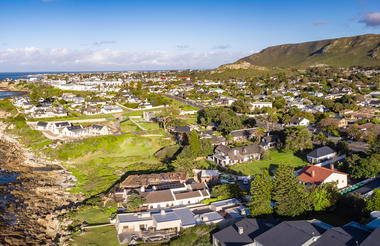

Over the centuries, French, Dutch, English, Malay and African influences have moulded a city replete with natural beauty, an eclectic culinary smorgasbord, and a rich history. This is Cape Town, the Mother City, the oldest city in South Africa. And it’s where modern South Africa began. The seat of the South African parliament is here making Cape town the legislative capital of South Africa.
Cape Town has been called Table Bay, the Cape of Storms, the Cape of Good Hope, The Cape, and directors of the English East India Company described it as ‘the Gibraltar of India’. It finally became known as Cape Town in 1773. The Dutch East India Company had sent Jan van Riebeeck to build a fort, as well as The Company Garden - a vegetable garden and fruit orchard to supply ships on their way to the East and Australia with fresh food. A remnant of the garden still exists in the city today, including one of the original Saffron pear trees which is still bearing fruit. It’s the oldest cultivated fruit tree in the country.
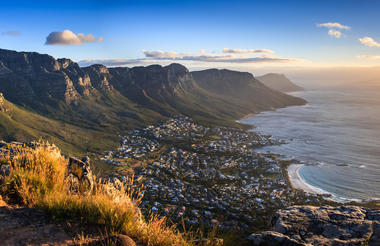
The most prominent and iconic feature of Cape Town is Table Mountain. One of the New Seven Wonders of the world, and part of the Cape Floral Kingdom World Heritage Site, Table Mountain is one of the most popular visitor destinations in Cape Town. From the top, you can see the whole of the city laid out before you, as well the Pacific Ocean lapping at the foot of the African continent, and further along the coast is the Atlantic Ocean.
The mix of ethnic influences have, over the years, created a city with a unique, creative and cosmopolitan flavour unlike any other city in South Africa. All of which can be experienced in the museums, art galleries, spectacular seafood, the Victoria and Albert Waterfront, the Two Oceans Aquarium, the historic and important Robben Island. Wildlife such as great white sharks, penguins, seals, and iconic African wildlife in the nearby national parks. Cape Town also has one of the most colourful and photographed suburbs in all of South Africa – the Bo-Kaap. The narrow cobble streets and brightly painted homes on the slopes of Signal Hill form what was historically called the Malay Quarter. It was where free slaves and Muslims settled in Cape Town and the only place where they were allowed to freely practice their religion.
Combined with architecture that is both historically important and beautiful, vibrant nightlife, world-class beaches and the weather to go with them, as well as the city’s proximity to internationally renowned vineyards, and cheese farms makes Cape Town the city with it all, and more.


Stretching across 13 000 hectares and part of the Greater Kruger National Park (GKNP) in South Africa, Kapama Private Game Reserve provides an authentic African safari experience. The reserve offers a range of stylish accommodation options across four refined lodges and bush camps from a traditional African safari camp to top-notch luxury suites. Kapama is home to the Big Five and is known for its diverse wildlife experiences which can be enjoyed on one of many game drives offering fascinating encounters with plentiful wildlife. Visitors can look forward to a variety of wonderful activities including: excellent game viewing, enjoying a relaxing spa experience and stargazing after a lamp-lit dinner under the African night sky.