
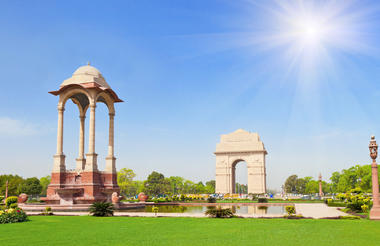
India’s largest city, Delhi, has been one of the country’s commercial and economic hubs for centuries and, as a result, is incredibly rich in culture and history. Comprising the ancient walled city of Old Delhi and the more modern entity, New Delhi, the city encompasses a staggering array of stunning architecture, notable monuments, and age-old temples, including three UNESCO World Heritage Sites – the Red Fort complex, Qutab Minar and its attendant monuments, and Humayun's Tomb. Other key attractions include the 17th century Chandni Chowk marketplace – still one of the city’s most tradtional wholesale and popular retail centers today, particularly for jewelry and traditional Indian saris; the iconic Bahà’i Lotus Temple – an award-winning architectural gem; and the Jama Masjid, India’s largest mosque.


Fringed by the rugged Aravali Hills, Jaipur is the capital and largest city in India’s northern state of Rajasthan. This city is famed for being India’s first planned city featuring a multitude of pink terracotta buildings within the walled historic center, earning it the nickname,’ The Pink City. Jaipur falls within the Golden Triangle, a popular tourist circuit, which includes Delhi, Jaipur, and Agra, and serves as a gateway to the neighboring desert cities of Jaisalmer and Jodhpur. This colorful city is a combination of tradition and modernity and offers visitors vibrant bazaars, lavish palaces, and ancient temples. The salmon-hued old city is home to the opulent City Palace, encompassing an impressive assortment of palatial structures, sprawling gardens, courtyards, and buildings. Don’t miss the fairy-tale splendor of the Amber Fort, set against the backdrop of the arid landscape.


Home of the world-famous Taj Mahal, Agra is one of India’s prime tourist destinations for specifically this reason, though its attractions also extend to an array of other impressive historical sights. These include the red-hued Agra Fort, the sacred Jama Masjid mosque, and Itmad-ud-Daulah’s tomb, with its white marble facade embellished with intricate inlaid designs and semi-precious gems. The Taj, however, is in a league of its own and needless to say is a must-see for any visitor to the city. Commissioned by the Mughal emperor Shah Jahan in the 15th century as a memorial to his beloved wife Mumtaz Mahal, it is an architectural masterpiece of exquisite craftsmanship and perfect proportions.


Tucked away in the Shivalik foothills, Narendra Nagar is a charming hamlet offering panoramic views of the Ganga River and the exceptionally scenic Doon Valley below. The town lies only 20 km from the popular city of Rishikesh and is situated on a popular trek route which runs between Gangotri and Yamunotri. Aside from the spectacular panoramic views, the main attraction here is ‘The Narendra Nagar Palace’ which is perched high on a ridge of Himalayan ranges offering a glimpse of the remarkable grandeur of the past. Original relief work still adorns the palace walls and two magnificent World War I cannons flank the royal gateway. The palace is now home to ‘Ananda in the Himalayas’, an internationally renowned luxury spa and holistic healing retreat.


As previously described


