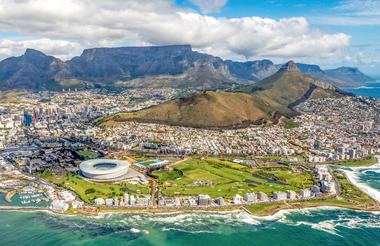
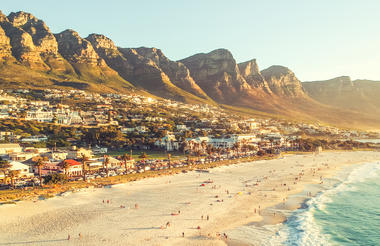
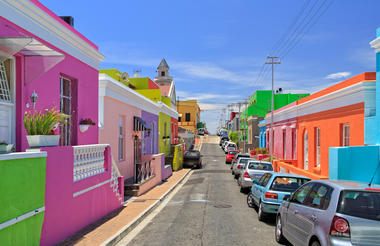
Against the majestic Table Mountain backdrop, the vibrant and cosmopolitan city of Cape Town is home to grand hotels, restaurants, and nightlife. It has long been a popular destination for film and modelling shoots. With rich historical and cultural heritage, tours through the township and trips to Robben Island allow guests to learn about the history. Cooking classes and wine and gin tastings are only the start of this captivating city. Narrow, cobblestone streets and the Islamic ambience of the Bo-Kaap enhance the atmosphere. Guided hikes and aquariums show off the wildlife of Cape Town, leaving guests wanting more.
The Western Cape's town of Stellenbosch is South Africa's second-oldest and most inspiring wine, food and cultural destination. The scenic wine route was the first in the country and one of the most popular destinations for local and international visitors. For the nature lover, several excellent hiking trails are found in the Jonkershoek Nature Reserve. A full-day hike starts on the slopes of the Stellenbosch Mountains and winds its way through vineyards, forests and olive groves. Stellenbosch is an ideal getaway year-round, and the historic town's centre is a living museum with unique, vibrant street culture.


Clanwilliam is a town on the Olifants River valley in the Western Cape. It is one of the ten oldest towns in the country and is regarded as the only town in the world where rooibos is planted and cultivated. The annual Wild Flower show is a highlight during the spring season. A visit to the Cederberg Wine Cellar and the Clanwilliam and Bulshoek Dams offers several water sporting opportunities. The Clanwilliam Living Landscape Project, a local empowerment programme, offers rock art trails of the paintings of the Bushmen, in which trained guides facilitate exploration of the art as a journey across the landscape.


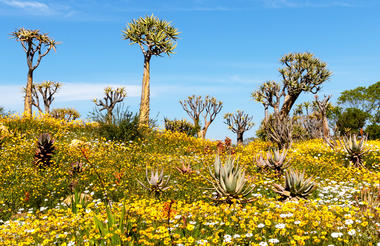
Namaqualand is a dry, hot and uninviting semi-desert that covers the northern part of Western and the Northern Cape up to the border with Namibia. Its natural boundaries lie to the south of the Olifants River, to the west of the Atlantic, to the east communities such as Pofadder or Clavinia in the Great Karoo and to the north the spectacular Orange River. Namakwa (Namaqualand) is considered part of the Succulent Karoo and, with its biodiversity and has the richest succulent flora on earth. During flower season months of July to September, this fast-paced area is transformed into an exquisite floral display. Every year thousands of visitors travel to the semi-desert to see the desert come to life and the dry gray scrub of the Karoo suddenly burst with color. For visitors, the transformation into wildflowers along the Flower Route from Springbok Goegap Nature Reserve to Kamieskroon Skilpad Wild Flower Reserve is a must-see phenomenon.


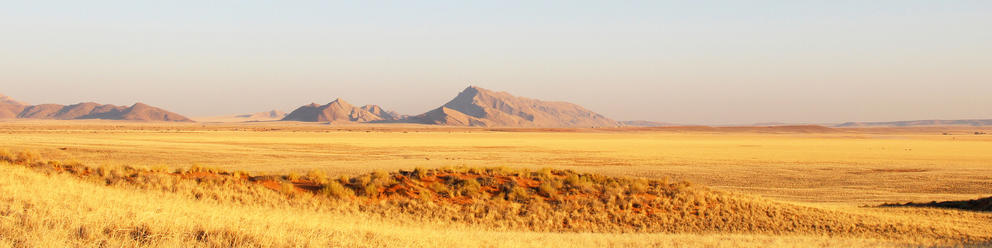
There is something mesmerizingly thrilling about exploring Namibia. Wind-swept desert dunes, polished white plains and abundant wildlife create an alluring atmosphere throughout the land. Namibia boasts remarkable natural attractions such as the Namib Desert, the Skeleton Coast and the Fish River Canyon. The wildlife offerings are second to none, and the country holds an average of 300 sunny days per year, making it an ideal destination all year round. Its diverse landscapes offer reliable game viewings regardless of the season and is undoubtedly one of the most exciting and rewarding experiences. The country inhabits more than 20 species of antelope, along with the famous Big 5 and many other magnificent creatures - some found nowhere else in the world. The country is often referred to as "one big desert" and described as a place where nature governs the land. With Namibia being one of the least populated nation on earth, it really is one of the best spots to spend a social distancing holiday.
Southern Namibia is home to the second-largest canyon globally and is one of Namibia's most remarkable geological wonders - Fish River Canyon. Plunging ravines and looming rock faces dominate the landscape, with natural hot springs dotted throughout the area. Dramatic sunrises cast heavy shadows while light plays on the rocks; various breath-taking views unfold one after another throughout the day. Yet, gazing at the starry night sky after dark is undoubtedly one of the most sought-after experiences. With the ever-changing crevasses and the raw magnitude of nature’s creation, this canyon is not to be forgotten.


Situated in the heart of Namibia's southern interior, the small town of Aus is an ideal scenic and tranquil base to explore the country. Located east of Keetmanshoop and north of the Orange River, a 2-night stay here will grant enough time to explore the towns of Lüderitz and Kolmanskop. The landscape is characterized by granite mountains, dry riverbeds and arid plains; however, the winter rains make this harsh terrain come to life. The ample hiking and climbing opportunities, along with the famous wild horses that roam free throughout the area, are what really make this town stand out among the rest.
If you only have time to see one thing in Namibia, make it the soaring sand dunes of Sossusvlei. Few words can describe the towering red dunes spread across the landscape or walking amongst the fossilized Acacia trees in the vast white clay pan of Deadvlei. The ever-changing dunes are the arid lands most iconic feature, and hiking to the tops will allow you to view the Martian-like landscape below. Sossusvlei shows off its beauty by housing many plants and animals that have adapted to life in the dry, yet dreamy terrain. This natural wonder is a perfect example of Namibia's unspoiled desert landscape.

Swakopmund, known simply as ‘Swakop’ to Namibians, is the capital of the Erongo Region. It was founded in 1892 and was regarded at the time as Germany’s main port in South-West Africa. The townscape of this small town is characterised by numerous historic buildings from the German colonial era: wide streets, German street names, German pubs, cafés and bakeries. During the colonial era, ‘Swakop’ was described as ‘Germany’s southernmost coastal town’. Even today, German is still spoken everywhere. Swakop offers many tourist attractions, such as charming pubs, a beautiful seafront promenade, an aquarium and much more. You can go on lovely day trips to the surrounding area, such as south to Walvis Bay or north to Cape Cross to visit the largest seal colony on the African mainland. In and around Swakop, there are plenty of activities on offer, such as boat trips to see seals, exciting desert tours, quad bike safaris, kayaking trips and helicopter flights. You’ll be spoilt for choice.


Featuring breath-taking panoramas, unforgettable sunsets, and abundant wildlife, Etosha National Park is Namibia's premier wilderness conservation area. The Etosha Pan - a shallow salt pan covering an area of 5.000 Square kilometres lies in the heart of the park. Natural springs are found in this dry terrain, making for excellent game viewing. Throughout the Park, the landscape is generally flat, with various habitats ranging from mopane woodland to wide, open, virtually treeless plains. Etosha is home to one of the world's most stable black rhino populations, along with lion, elephant, leopard, cheetah, and hyena.
Etosha's southernmost section is known for its rich population of both white and black rhino. Etosha South is home to the Okaukuejo Rest Camp, which is famous for its floodlit waterhole. The many viewpoints overlook picturesque bush-scapes and abundant wildlife. Getting into the South is accessible by Andersson's Gate. Here, visitors can expect to see many animals, including lion and the rare, black-faced impala. However, the most notable of animals found here are elephants. Enjoy guided nature walks, game drives, or simply watching the sunset from this breath-taking location.


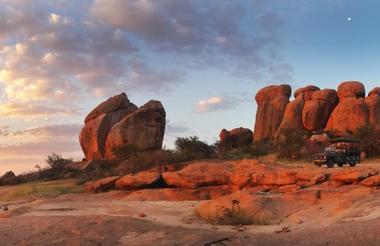
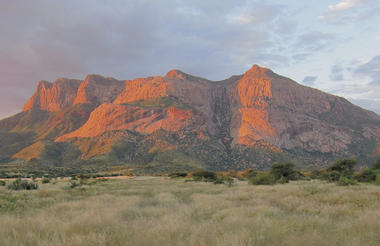
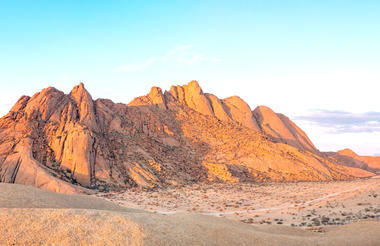
Known for its rugged mountain range, diverse plant and wildlife population, along with the famous Spitzkoppe, Erongo is a place that houses so much of Africa's natural magnificence. Surrounded by volcanic ruins and breath-taking rock formations, the Erongo Mountain range holds dramatic scenic landscapes and indescribable natural beauty. The peaks are best known for their caves and rock art, particularly the 50m-deep Phillips Cave, and home a vast array of reptiles and mammals. The rich biodiversity - with black rhinos and the rare black-nosed impala native to the area - leaves people wanting more.