


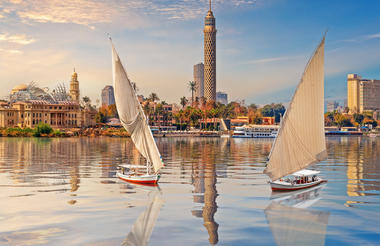
Resting on the banks of the River Nile, Cairo is the mythical Egyptian capital that has been inhabited for over 6000 years. The dynamic metropolis is an exciting commingling of historical and contemporary offerings, vibrant streets and diverse neighbourhoods. The numerous heritage sites offer a glimpse into its Islamic and Coptic histories, including the renowned Al-Muiz street, Amr Ibn Al-As Mosque, the Hanging Church, and the Saint Samaan Monastery. The bustling tourist hub of Tahrir Square features the world-renowned Egyptian Museum displaying an array of antiquities, including mummies and King Tutankhamun artefacts. After that immersive foray into the past, pull yourself to the present and experience modern Cairo. Visit the baladi bars of downtown Cairo, shop at the Khan al-Khalili Bazaar, watch the sunset from the impressive Cairo Tower, or be entertained at the stately Cairo Opera House. The city's diverse nightlife options range from the traditional bars and coffee houses of downtown Cairo to the upscale Western clubs and bars of the affluent neighbourhood of Zamalek.

Resting on the east bank of the infamous Nile River in southern Egypt, the city of Luxor is renowned for its many well-preserved monuments, so much so that it has been described as the world’s greatest open-air museum. Luxor is often divided into three different areas; the city of Luxor on the east side of the Nile, the town of Karnak further north and Thebes on the west side of the Nile, across from Luxor. Visitors can look forward to a variety of accommodation and an abundance of exciting activities – Luxor knows how to accommodate tourists as it has been doing since ancient times. Don’t miss the Karnak and Luxor Temples, as well as the Valley of the Kings and the Valley of the Queens.


Resting on the west bank of the Nile River between Esna and Aswan, the historic town of Edfu is the location of the famous Temple of Horus. Considered the best-reserved temple in Egypt and dating back to the Ptolemaic times (237 - 57 BC), the temple has played a dramatic role in today’s understanding of ancient Egypt, including our knowledge of its religion, lifestyle, and language. The temple is decorated with intricate and varied scenes depicting marriages, deities, and the birth of its namesake god, and exhibits a combination of both Egyptian and Greek architectural elements. Other highlights include the ruins of one of seven small provincial step pyramids, and two temples considered second only in importance to the Temple of Dendera. Modern Edfu is a bustling hub producing renowned pottery.


Situated north of Aswan, on the eastern bank of the Nile River in Egypt, the ancient city of Kom Ombo is famous for its unusual riverside double-temple honouring Horus the Elder (Haroeris) and Sobek (the crocodile god), and its attached crocodile museum. The building is especially distinctive in its dual, mirror image structures and even features a double altar. At the crocodile museum, visitors can see crocodile mummies and other artefacts which give insight into the sacred place the animals had in ancient times. The town is also notable for being home to an original community of peasant farmers as well as a large population of Nubian people and is surrounded by beautiful sugar-cane fields. Kom Ombo makes for a fantastic day trip from both Luxor and Aswan and is a popular stop on river cruises.


Located just 40 kilometres north of the Sudanese border in southern Egypt, the laidback town of Abu Simbel is renowned for its ancient temple complex, the temples of Ramses ll. The town serves as a convenient stopover for visitors wanting to spend more than a few hours exploring the temples and surrounding area. These famous 3200-year-old Egyptian temples are part of the UNESCO World Heritage Site of Nubian Monuments stretching from Abu Simbel to Philae. It is also Egypt’s second most visited attraction. The temples are comprised of two structures featuring four massive seated figures representing the pharaoh. Visit on February 22 and October 22 to catch the magnificent solar alignment which illuminates these colossal statues and its 56-metre-long inner chamber that leads to a series of hidden rooms and halls.


Situated on the east bank of the Nile in the south of Egypt, Aswan is an arid, modern and popular city with a relaxing atmosphere. The city is home to a number of significant archaeological sites and also makes an excellent base for exploring the many world-class attractions in the surrounding area. Visitors can enjoy the beautiful views by way of slow walks along the wide corniche, or while dining on fresh seafood at one of the town’s charming floating restaurants. In the evenings, dancers, musicians, and folklore troupes perform at the Cultural Centre, providing memorable entertainment. City highlights include a large, lively market, and the Nubian Museum, which showcases some of Southern Egypt’s most important historical artefacts.


As previously described


