AM - Arrival at Baltra airport Upon arrival at Baltra airport, you will pass through an airport inspection point to insure that no foreign plants or animals are introduced to the islands, as well as to pay the park entrance fee of $100 (unless it has been prepaid). A guide will meet you, help you collect your luggage, and escort you on a short bus ride to the harbour.
PM - Fausto Llerena Breeding Centre (Santa Cruz) At this site, you can observe tortoises that come from various islands of the archipelago. They comply with the captive breeding programme and then return to repopulate the areas where their population has been affected. The land iguanas of Santa Cruz, Isabela and North Seymour are also in a captive breeding programme, as the populations in these areas suffered from feral dogs. One of the main attractions is the famous embalmed Lonesome George. Estimated to have died between 93 and 109 years of age, it is recognised as the last of its kind and a symbol of the efforts invested to conserve endangered species. The captive tortoises are used to the presence of visitors, so it's a great place to take photos with them.


AM - Moreno Point (Isabela) Moreno Point is located on the north coast of Isabela Island, between the volcanos Sierra Negra and Cerro Azul. The trail runs along a solidified pahoehoe lava flow into a complex of coastal lagoons. Its main attractions are several species of birds, which are found around the lakes and mangroves.
PM - Urbina Bay (Isabela) Urbina Bay is located along the west coast of Isabela, between Elizabeth Bay and Tagus Cove. It is close to the base of the Alcedo Volcano. The coastline has undergone a major uplift in 1954, which caused the shore to expand three quar ters of a mile out. Here you will be able to find corals, shells, and many other calcareous organisms exposed above water. Urbina Bay is home to large and colorful land iguanas and giant tor toises of the Alcedo Volcano population. A lot of Darwin finches can be seen as well.


AM - Espinoza Point (Fernandina) Fernandina is the third-largest island in the archipelago and has a single visitor site: Punta Espinoza, located at the northeastern tip of the island. Marine iguanas conglomerate in larger groups than on any other island. They bask around in the sand, swim near the shore and sometimes block the way at the landing dock. Among the unique species found here, is the flightless cormorant. This bird had to adjust its way of survival and perfection its skills of finding food in the ocean. Their wings, tails and feet progressively adapted for swimming. To see these birds is to witness evolution happening right in front of you.
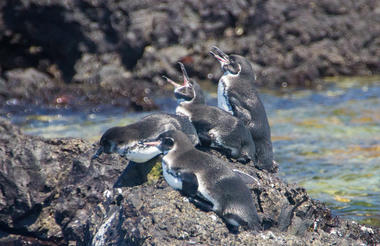
PM - Vicente Roca Point (Isabela) Whilst having lunch we will cross the Bolivar Channel for the last time to Vicente Roca Point, just at the mouth of Isabela’s seahorse-shape. While entering a dark cave below a spectacular arch, roaring echoes of the waves will accompany you. Just around the corner the collapsed amphitheatre of Volcan Ecuador offers another impressive view. The calmer waters of the coves are well-protected against the ocean swell and are a fairly cold, but great place for snorkelling amongst various species of shark, penguins, puffer fish and even seahorses!


AM - Egas Port (Santiago) Egas Port is a black beach located on the west side of Santiago Island. Volcanic tuff deposits have favoured the formation of this special black sand beach and this is the main attraction of the Island. This site is called Puerto Egas because there was an attempt of Hector Egas to start the exploitation of salt, which failed. After all, the price of salt on the continent was very cheap and did not justify its exploitation in the Galapagos. The project was abandoned and they left their infrastructure.
PM - Rabida Rabida Island is unique because of the red colour of the rocks and sand. The volcanic material in this island is very porous and external factors such as rain, saltwater and sea breeze have acted as an oxidizing agent. A short walk along a trail will lead you to a coastal lagoon behind the beach that allows for the observation of land birds as finches, doves, yellow warblers and mockingbirds. There is also a colony of flamingos at the lagoon


AM - Black Turtle Cove (Santa Cruz) After breakfast, you will check out and disembark the cruise for the last time at 08:30 am. Your last adventure is brief but enchanting, and will take place enroute to the airport. You will explore onboard the dinghy the green landscape of Black Turtle Cove, which is mostly composed of mangrove trees that host innumerable aerial and aquatic species. Observe how the quiet emerald lagoon and surrounding shallow bays enables the easy observation of sea turtles and as well as groups of sharks.
PM – Bachas Beach (Santa Cruz) Around noon you will embark from Baltra airport on the Archipel cruise. Your cabins will be assigned, and lunch will be promptly served. Your first excursion will take place this afternoon after 14:00 PM, at Bachas beach. This is a lovely bay with soft, white coral sand that is frequently visited by sea turtles to lay their eggs, so please, watch your step! After enjoying some leisure time at the beach, you could explore a small lagoon hidden behind some bushes, where occasionally it is possible to observe flamingos, black-necked stilts, and whimbrels. You might also observe some rusty barges, which were abandoned here after WWII when the USA rented this island as a strategic point to protect the Panama Channel from Japan. After two hours on this visit, you will return onboard


AM - Prince Philip’s Steps (Genovesa) Before landing, you will take a dinghy ride along the eastern arm of the caldera. As you approach, the soaring 25 m/80 ft high walls become overwhelming. Sometimes, a Galapagos fur seal is resting or a seabird is nesting on one of the ledges at the base. You will then have to hike and overcome the steep stairs from the landing dock to a bush of palo santo shrubs on top. Red-footed boobies gratefully use these scarce nesting places; so that they don’t have to nest on the rocky ground. Upon arriving at the edge of the rim, the bushes open up and you can enjoy panoramic views, a strong sea breeze and the amazing flying skills of countless seabirds. Following the exposed rim, you will first pass the Nazca boobies and finally reach the extensive storm petrel nesting places, where, if you’re lucky, you can spot the well-camouflaged short-eared owl hunting for food!
PM - Darwin Bay (Genovesa) Inside the submerged caldera of Genovesa lies Darwin Bay, with a diameter of more than 1.5 km/1 mi and it is almost 200 m/650 ft deep. The small area will surprise you repeatedly, walking along a coral sand beach, crossing barren lava formations and creeks, passing tidal pools, shrubs and further ahead following the top of some cliffs. With this peaceful surroundings, every single species has occupied its own ecological niche (or habitat) without disturbing others.


AM - Bartholomew The beautiful volcanic islet of Bartholomew is among the youngest of the islands and, on a geological scale, was just recently born out of the fire. Although it looks lifeless at first sight, Bartholomew offers some of the wildest landscapes and best panoramas of the entire archipelago. To enjoy the postcard view of the idyllic “Pinnacle Bay” you will have to climb the stairs to the viewpoint on top of the island (114 m/375 ft). Enter a dramatic world of threatening (though extinguished) nearby spatter cones, craters, and lightweight lava droplets that have been spewed out by fiery fountains. The summit trail is also ideal for witnessing how scanty pioneer vegetation, such as lava cactus, struggles to take root in the bare virgin lava fields.
PM - Sullivan Bay (Santiago) The arrival in Sullivan Bay is like a moon landing. The desolate, sprawling fields seem to be mostly lifeless, but this island, which is particularly popular among photographers, still offers a lot to see. There is even some life! Green sea turtles burrow in the small white sand beach, where you can also find crabs, blue herons and oystercatchers.


Breakfast
Lunch
Dinner
AM - Twin Craters and El Chato Reserve (Santa Cruz) The native scalesia forest of El Chato Tortoise Reserve is the best place to search for Galapagos giant tortoises in their most authentic setting! Despite the interesting breeding centres – where you are guaranteed to find tortoises in their corrals – there is nothing better than to observe them in their wild environment. Though it can be quite moist and muddy, your visit may turn into an adventurous quest when they have left their favourite pond silently.
The Twin Craters are found on either side of the road leading to Puerto Ayora. These impressive formations are not really volcanic craters and were formed by magma domes, which hardened on the outside while the lava continued flowing inside, leaving huge and empty magma chambers that eventually collapsed, leaving two large holes. The craters lie within a lush scalesia cloud forest, a high-altitude plant species that are endemic to the Galapagos. This area is also home to the carpenter finch, which uses tools to search for food. There may also be opportunities to see the vermillion flycatcher, a small red-breasted bird. After this, assisted by the naturalist guide and some crew members, you will be taken to Baltra airport. It has been a pleasure accompanying you on this unique trip and we hope to see you again very soon!


Breakfast

