


On arrival at Windhoek's Hosea Kutako International Airport proceed through immigration and customs, collect your luggage and enter the arrivals hall. A representative of your car rental supplier will be waiting for you in the arrival’s halls. Please look for a signboard with your name on it. Our airport is small, but should you not be able to see the transfer driver please go to the information desk and ask them to page the rental company. Please stay at the information desk until the driver finds you. It can take some time to get through immigration if the flight is full. Do not worry if it is slow, your driver will wait for you. Our airport is located 45 kilometres east of the city.


Travel north towards Otjiwarongo and the Okonjima Nature Reserve, a protected area known for its conservation programmes and diverse wildlife. The reserve provides opportunities to encounter species such as leopard, brown hyena and various antelope, with the surrounding bushveld offering a beautiful introduction to Namibia’s wildlife.


Continue north to Etosha National Park, entering the park from the eastern side. Spend the rest of the day exploring the extensive plains and numerous waterholes, which attract large concentrations of wildlife, particularly during the dry season, or have the afternoon at leisure to explore a full day tomorrow. Expect opportunities to see elephants, giraffes, zebra, wildebeest, antelope and predators. One of Namibia’s premier wildlife destinations. Game drives through the park offer excellent opportunities for photography and wildlife sightings, while the contrasting landscapes around the vast Etosha salt pan create a unique safari environment.

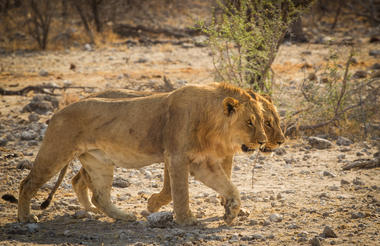

Travel east towards Rundu, located along the banks of the Kavango River. The landscape changes dramatically from the dry interior to a greener environment characterised by riverine vegetation, woodland and traditional villages. Enjoy the relaxed atmosphere of the Kavango region and the beautiful river setting.


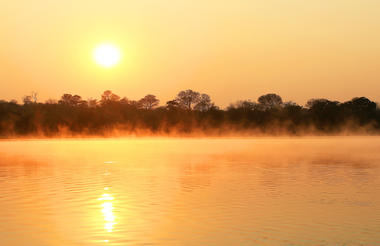
Continue into the lush Zambezi Region, travelling towards Kongola. This area is characterised by dense woodland, floodplains and seasonal waterways and forms part of one of Namibia’s most wildlife-rich regions. The area provides a transition from Namibia's dry landscapes into a greener, more tropical environment.
Spend the following day exploring the Nkasa Rupara National Park, Namibia’s largest wetland area and an important wildlife refuge in the Zambezi Region. The park is made up of channels, floodplains, islands and woodland, creating excellent habitat for elephants, buffalo, hippos, crocodiles and a wide variety of birdlife.


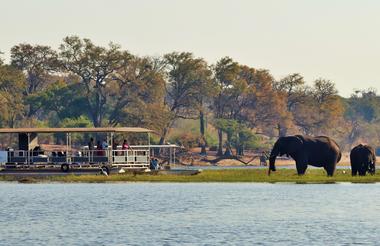
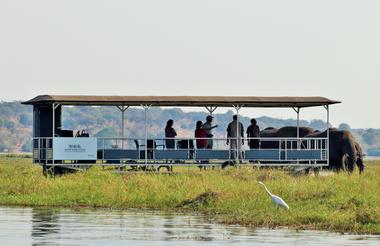
Cross into Botswana and continue to Kasane, situated alongside the Chobe River and close to Chobe National Park. In the afternoon, enjoy a sunset cruise on the Chobe River, offering excellent opportunities to observe elephants, hippos, crocodiles and other wildlife gathering along the waterways.
You will need your cross border authorization document for the border crossing. This will have the engine & chassis number of the vehicle on it which you will require to take the vehicle into Botswana. Keep a pen or two handy as you will have to complete some paperwork and they seldom have pens. On the Botswana side you will need to purchase some temporary insurance and pay road taxes. Below is an indication of the current rates (subject to change without notice):
- Road fund: 50 Pula – valid for 1 year
- Insurance: 50 – 100 Pula – valid for 90 days and will depend on vehicle mass
- Road permit: 40 Pula – single entry OR
- Road permit: 90 Pula – return trip
Additional charges can be paid by credit card (not always working) or in cash (ZAR is best if you are not able to find BWP, have small denominations, you will not get change).
On the Botswana side of the border you may be required to drive your vehicle through a dip filled with a disinfecting solution. You may also be asked to exit the vehicle and walk on a mat impregnated with the solution to disinfect your shoes. Botswana is very protective of its meat export industry. An outbreak of foot-and-mouth disease can bring the whole meat industry of a region to its knees. As soon as foot-and-mouth disease is detected, all exports are suspended, and that includes shipments to the EU which is a massive market for Namibia and Botswana.
From the border the road runs through Chobe National Park to Kasane. There are entrance and exit gates (or booms) for the park, the driver will need to fill in the vehicle registration and destination. As long as you stay on the main road you are not required to pay park fees. While the game tends to stay closer to the river be sure to keep to the speed limit and watch out for game like elephant and buffalo crossing the road.
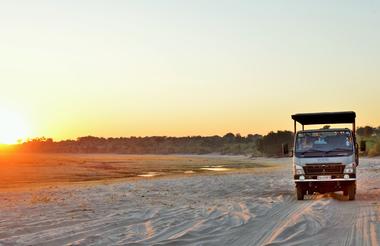
Spend the following morning on a game drive in Chobe National Park, famous for its exceptional wildlife concentrations and particularly its large elephant population. The park's diverse habitats support buffalo, giraffe, zebra, antelope and numerous predators, while the Chobe River provides an important source of water for wildlife.
Afternoon
Take a day trip from Kasane to Victoria Falls in Zimbabwe, one of Africa’s most remarkable natural attractions. Explore the viewpoints along the falls and enjoy the included excursions before returning to the Kasane area for the evening.


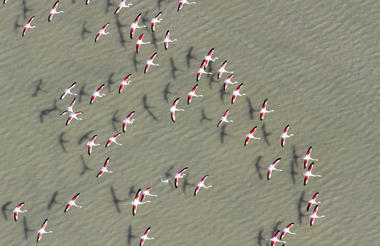
Travel south towards Nata, entering the vast landscapes of the Makgadikgadi region. This area is characterised by open salt pans, grasslands and ancient baobab trees and forms part of one of Botswana’s most distinctive landscapes. The area is particularly impressive for its sense of space and changing seasonal wildlife.


Continue to Maun, widely regarded as the gateway to the Okavango Delta. This bustling safari town provides access to the extensive network of waterways, floodplains and islands that make up the Delta. Spend the remainder of the day relaxing or preparing for your wilderness experience.


Travel into the Khwai region of the Okavango Delta, an exceptional wildlife area where permanent water channels meet open floodplains and woodland. The region is renowned for its abundant wildlife and offers opportunities to encounter elephants, hippos, buffalo, lions, leopards, wild dogs and numerous bird species. Enjoy the first of your included safari excursions.
Spend a full day exploring the Khwai wilderness, with two included excursions allowing you to experience the area from different perspectives. The combination of waterways, floodplains and surrounding woodland creates a particularly diverse safari environment and excellent opportunities for wildlife viewing and photography.


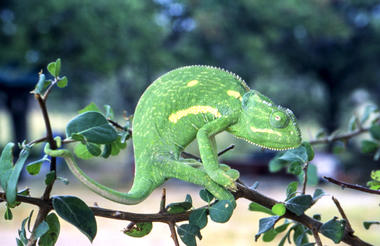
Leave the Okavango region and travel west towards Ghanzi, entering the vast Kalahari landscape. The area is characterised by open grasslands, scrub and sandy terrain and provides a completely different environment from the wetlands of the Okavango. It is also an important region for experiencing aspects of traditional San culture.


Cross back into Namibia and travel towards Windhoek, passing through the changing landscapes of central Namibia. The journey provides a final opportunity to appreciate the country's wide-open spaces before returning to the capital for your final evening.


Sadly, your time in Namibia has come to an end. Allow some time to refuel your vehicle before dropping it off and the drive to the airport roughly 45min away to check in, in time for your outbound flight. We know you will have many wonderful memories to keep you company on your journey home. And maybe we can welcome you back in the future. Thank you for travelling with Great Explorations Namibia. We wish you a safe journey home.


