


You will arrive at Kilimanjaro airport today where you will be met by your driver guide and driven to your overnight accommodation in Arusha National Park, Ngare Sero Mountain Lodge.
The park is small but varied with spectacular landscapes in three distinct areas. In the west, the Meru Crater funnels the Jekukumia River; the peak of Mount Meru lies on its rim. Ngurdoto Crater in the south-east is grassland. The shallow alkaline Momella Lakes in the north-east have varying algal colours and are known for their wading birds.
Mount Meru is the second highest peak in Tanzania after Mount Kilimanjaro, which is just 60 km away and forms a backdrop to views from the park to the east.


You will head off with your guide today to Tarangire National Park stopping for a pack lunch along the way
The Park covers an area of approximately 2,850 square kilometers (1,100 square miles.) The landscape is composed of granitic ridges, river valley, and swamps. Vegetation is a mix of Acacia woodland, Combretum woodland, seasonally flooded grassland, and baobab trees.
The park is famous for its high density of elephants and baobab trees. Visitors to the park in the June to November dry season can expect to see large herds of thousands of zebra, wildebeest and cape buffalo. Other common resident animals include waterbuck, giraffe, dik dik, impala, eland, Grant's gazelle, vervet monkey, banded mongoose, and olive baboon. Predators in Tarangire include lion, leopard, cheetah, caracal, honey badger, and African wild dog.
Tarangire is also home to more than 550 bird species, the park is a haven for bird enthusiasts.
You will stay at Kirurumu Tarangire Tented Camp right on the edge of the park and with no fences the wildlife can roam freely through camp.
Each tented chalet has its own deck and all are en suite
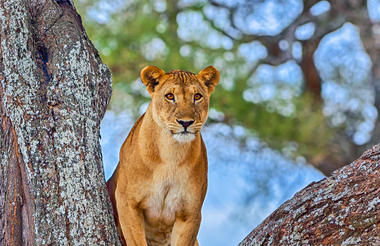
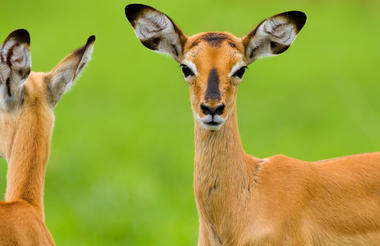
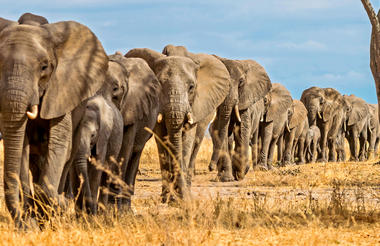
You leave Tarangire today and head for Ngorongoro stopping at Lake Manyara on the way which is famous for its flamingos that feed in the rich waters in their thousands but it is also home to many of Africa's iconic wildlife species including elephants, leopard, giraffe and tree climbing lions.
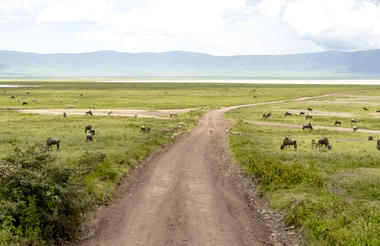
You are heading for Pakulala Safari Camp which is located above the ring of the Ngorongoro crater. An exclusive campsite offering a unique experience and spectacular views of the crater caldera. The Ngorongoro Conservation Area is considered as the 8th wonder of the world. Inside the volcano´s crater lives the largest stable population of wild animals in Africa. The chances of sighting the Big Five are as real as the air you breath, offering you the fullest and most comprehensive safari experience and you have the next day to explore this wildlife haven
The Pakulala Safari Camp common areas are accented by the vast beauty of the surrounding scenery. The campfire, with views of the crater, is undoubtedly a turning point for travelers. An unforgettable place for a drink under the stars in the Tanzanian sky.
Our camp it is made up of eleven under canvas tents decorated in an elegant style reminiscing the late 19th century safaris. A small accommodation in an exceptional place with fine materials, such as wood and leather to imitate the feel of the earliest expeditions.
All tents are equipped with original butterfly chairs blended with handcrafted elements such as handmade carpets woven by Mbulu women´s mammas.
Comfort and luxury are paramount for us, our tents are equipped with two comfortable queen beds, private bathroom with bucket shower, eco- toilet, original local handmade washbasin and mirror.
Every tent is supplied with feather duvet, pillows, 100% percale cotton sheets & towels, luggage racks and safari chairs to enjoy the starry Tanzanian night from while you relax over your day in your terrace after a long safari day.

You leave Ngorongoro today and head for the Serengeti stopping at Olduvai Gorge en route which is one of the most important archaeological sites on earth. The geological strata exposed in the gorge reveal a remarkable record of animal and human evolution from about two million until fifteen thousand years ago. Among the significant finds from Olduvai is the range of stone tool types, the thousands of animal fossils – both extinct and extant species – and the fossil bones of hominids (pre-Homo Sapiens) and early Homo sapiens. The different kinds of hominids found here show a gradual increase in brain size and in the complexity of their stone tools
Your last 4 nights will be spent in the heart of the Serengeti at Kirurumu's central camp where you can spend your days in search of Africa's iconic wildlife in this world famous wildlife sanctuary.
Kirurumu Serengeti Central Camp is a lovely mobile camp which is moved seasonally to take best advantage of the vast Serengeti. The camp is used as a base, a spring board for an early morning game drive, a break for a sumptuous lunch, a respite from the heat of the day and the finale to a days adventure where stories can be swapped around a fire. As a small and intimate camp the staff are on hand just to look after a very limited number of guests and so the level of attention and service is always excellent.
The camp is situated at the outstandingly beautiful Moru Kopjes .. Moru is the unique location for the Serengeti Rhino project and also by virtue of permanent water in the area boasts a large population of Lion, the area is not congested and it is much more remote and private. The resident game is plentiful and is the reason the Lion population is high. The migration may or may not move through the area but is always reachable from the camp. Generally the guides avoid the most congested areas and use their superior knowledge and many years of experience to be located in areas that are less busy but excellent for wildlife.
This small, intimate camp has a central dining and relaxing area and just 7 tented chalets with en suite facilities, solar lighting and comfortable beds so you are sure to be well looked after during your stay


You leave your camp today for your final game drive across the Serengeti to Seronera airstrip where you will catch your flight back to Arusha to connect with your onward flight


