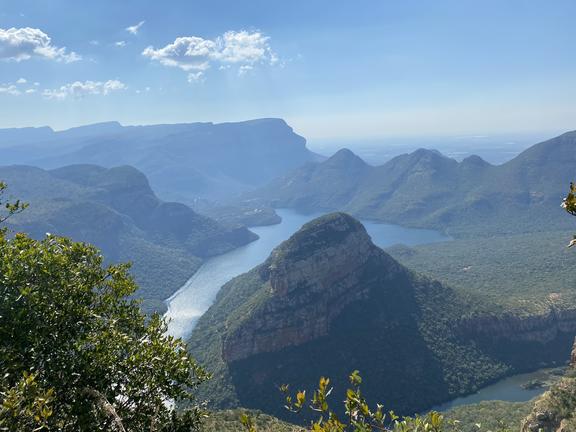
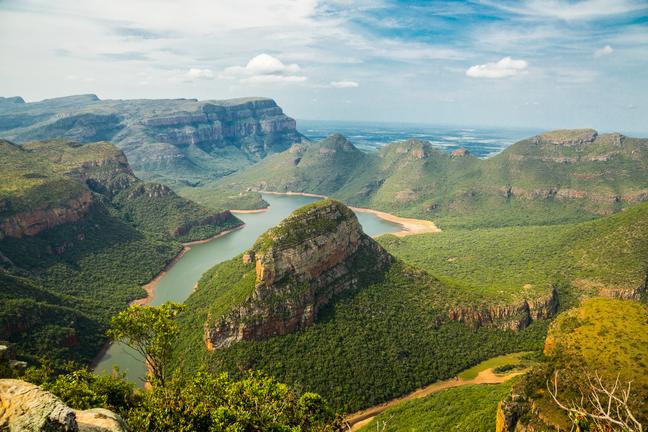
The northern section of the Drakensberg Mountains stretches through the province of Mpumalanga. The road that joins the towns of Sabie and Graskop constitutes the spectacular Panoramic Route through the Blyde River Canyon section of the Drakensberg.
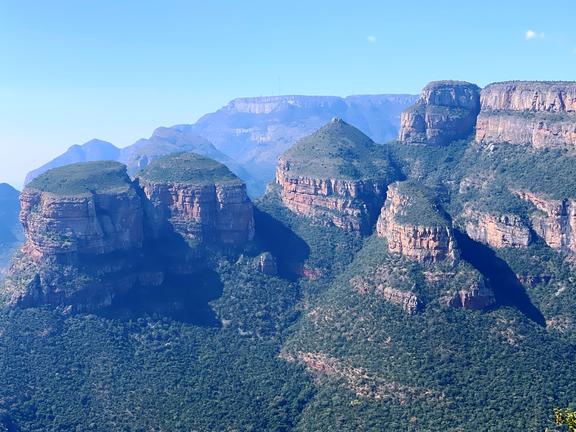
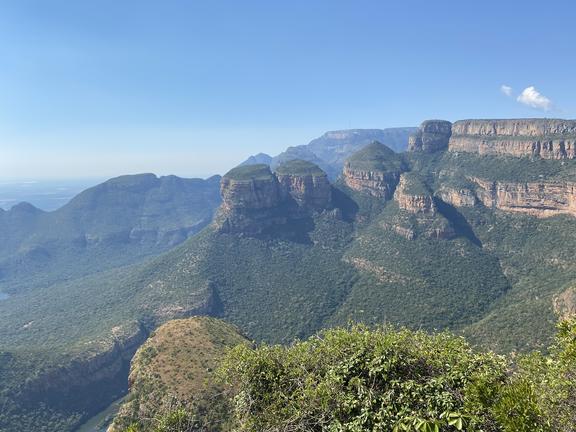
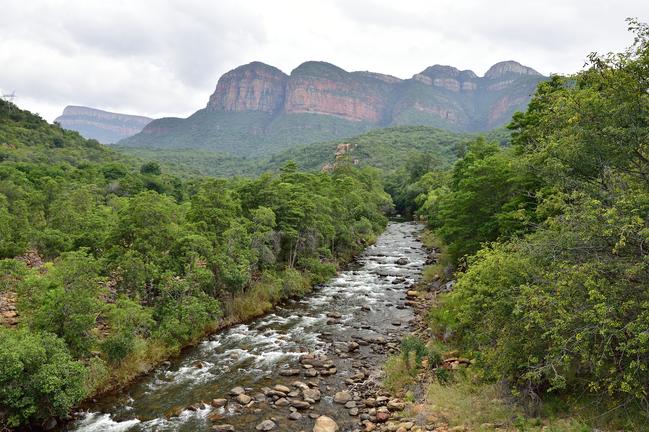
After the Grand Canyon in the United States and the Fish River Canyon in Namibia, the 30 kilometre long Blyde River Canyon occupies third place on the world’s list of canyons and is one of the most impressive natural phenomena in South Africa. The canyon is dominated by three similarly shaped peaks (the Three Rondavels) and by Mariepskop (the highest point of this section of the Drakensberg Mountain Range). The road continues through a rugged landscape where fruit, vegetables and tobacco are grown in reddish soil before entering Pilgrim’s Rest.
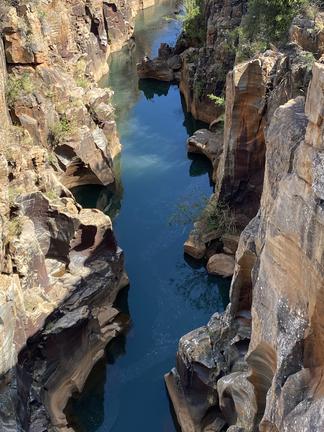
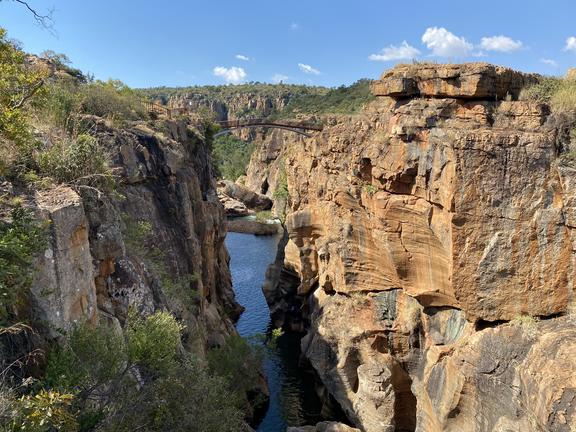
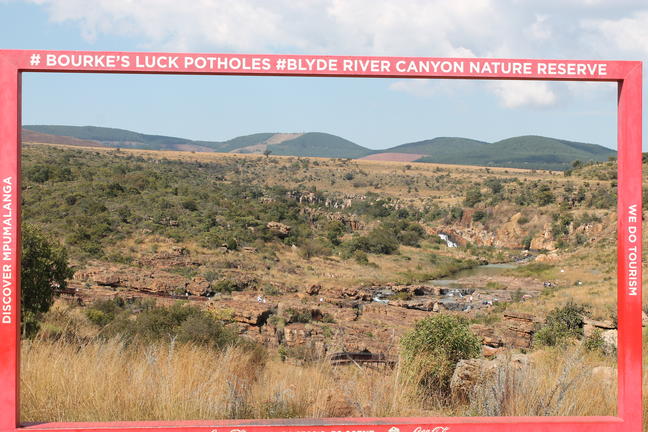
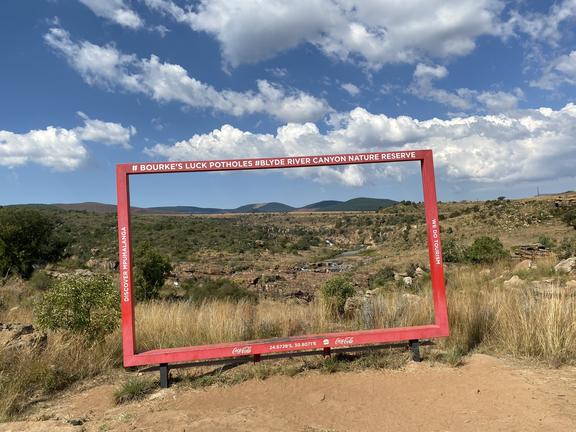
The Pinnacle, Jock’s View, God’s Window and Wonderview are some of the most famous scenic lookouts where a stop is highly recommended. These stops offer lookouts over sheer cliffs and unique geologic features over the expanse of the Lowveld. Further north are Lisbon Falls and the Berlin Falls, just before reaching Bourke’s Luck Potholes. Here, paths and footbridges take visitors to viewing sites overlooking extraordinary samples of river erosion. Northwards, the Blyde River has carved a magnificent gorge through the mountains.
God’s Window
God’s Window is a popular vantage point along the Drakensberg escarpment in Mpumalanga, South Africa. It is situated at the southern extremity of the Blyde River Canyon Nature Reserve.
At God’s Window, majestic cliffs plunge over 700 meters to the Lowveld and the game reserves which have made the area one of Africa’s prime wildlife destinations. From this Escarpment—a 250 km long rampart of sheer cliffs—opens a vista into a lush forest, the Eden-like aesthetic appearance of which prompted the name. On a clear day it is possible to see over the Kruger National Park towards the Lebombo Mountains on the border with Mozambique.
Mac Mac Falls
The Mac Mac Falls are one of the most photographed and unusual sites in the lowveld area. The Mac Mac River plummets down 65 metres. The Mac Mac pools to the south of the falls consist of a series of rocky basins filled with water.
Blyde River Canyon
The Blyde River Canyon is a significant natural feature of South Africa, located in Mpumalanga, and forming the northern part of the Drakensberg escarpment. It is 16 miles (26 kilometers) in length and is, on average, around 2500 feet (800m) deep. The Dam itself, when full, is at an altitude of 665m (2182 feet). The Canyon consists mostly of red sandstone. The highest point of the canyon, Mariepskop, is 6378 feet above sea level (1944m) whilst its lowest point where the river leaves the canyon is slightly less than 1840 feet (+- 560m) above sea level. This means that by some measure the Canyon is over 4500 feet (about 1400m) deep.
By some measures it is the third largest canyon in the world, after the Grand Canyon in the United States and the Fish River Canyon in Namibia but this depends heavily on one's definition of a canyon (see canyon.) By any definition it is one of the largest canyons on earth, unquestionably being the largest 'green canyon' due to its lush subtropical foliage, and it has some of the deepest precipitious cliffs of any canyon on the planet. It is the second largest canyon in Africa, after the Fish River Canyon, and is known as one of the great wonders of nature on the continent.
Possibly the best view in the whole of the Blyde River Canyon is of the "Three Rondavels", huge, round rocks, thought to be reminiscent of the houses or huts of the indigenous people, known as rondavels. This canyon is part of the famous Panorama route. This route starts at the town Graskop and includes God's Window, the Pinnacle and Bourke's Luck Potholes.