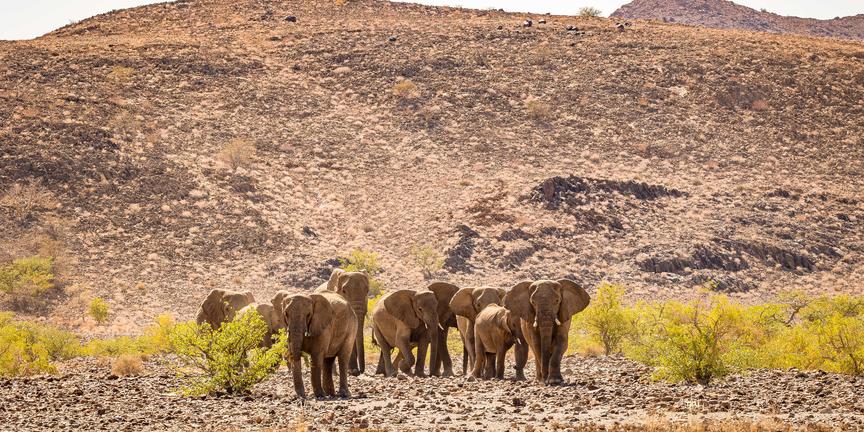
Although not a separate species, and not much different from other savannah elephants (Loxodonta africana africana), Namibia's desert-dwelling elephants are nonetheless special.
They are of high national and international conservation priority and have been designated as a top priority for protection by the IUCN (International Union for the Conservation of Nature).
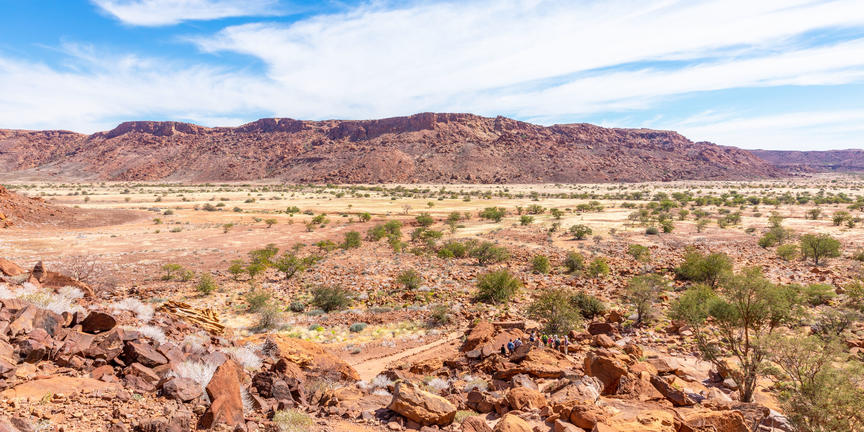
They live in the Kunene Region, which encompasses 115,154 km² of mostly sandy desert, Rocky Mountains, and arid gravel plains in Namibia's northwest. These elephants have adapted to their dry, semi-desert environment by having a smaller body mass with proportionally longer legs and seemingly larger feet than other elephants. Their physical attributes allow them to cross miles of sand dunes to reach water. They have even been filmed sliding down a dune face to drink at a pool in a desert oasis.
They survive by eating moisture-laden vegetation growing in ephemeral riverbeds, and through their ability to go several days without drinking water. Sometimes, they must travel long distances to reach a water source.
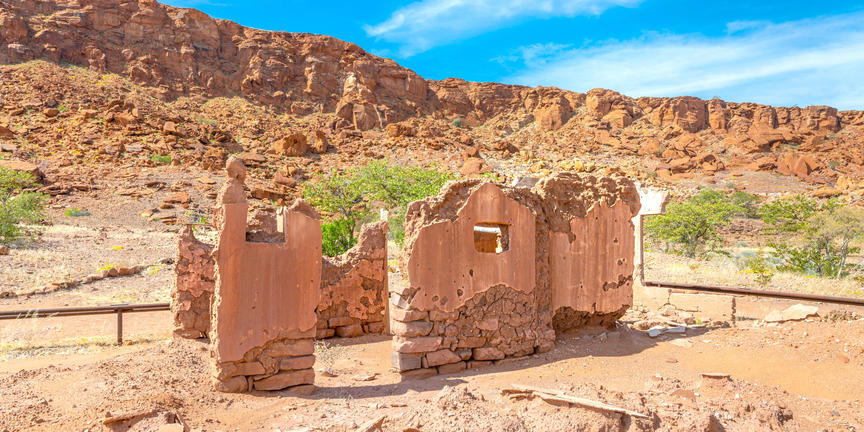
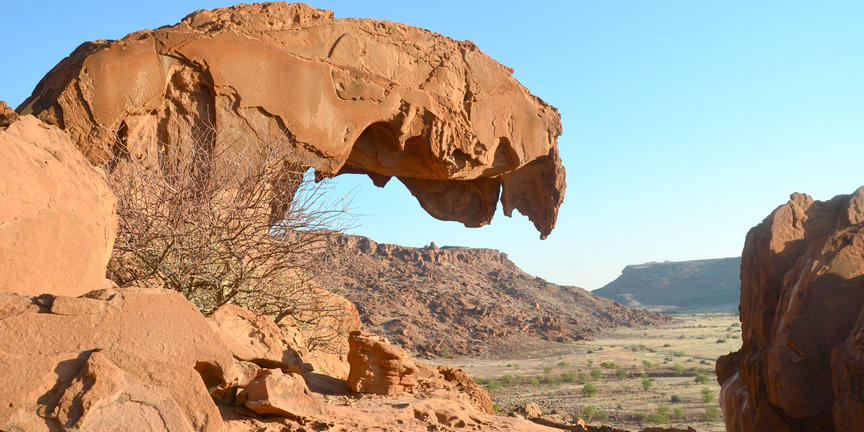
Twyfelfontein (“Doubtful Spring”) has one of the most extensive galleries of rock engravings in the world.
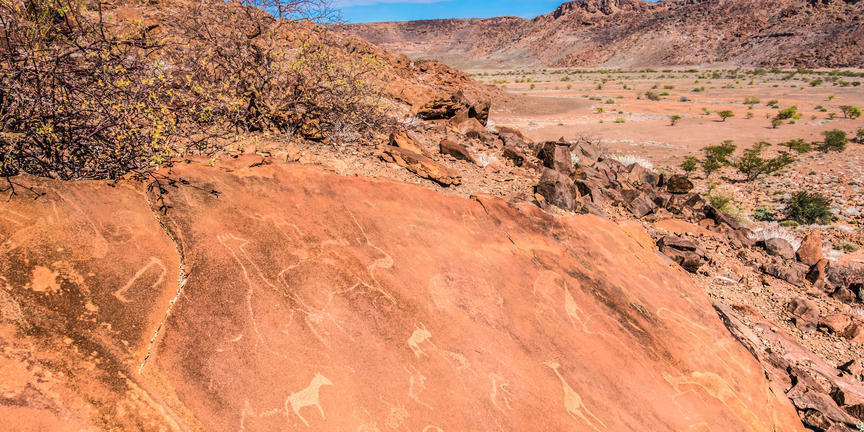
These are not paintings, but carvings made by cutting through the hard surface layer of sandstone. More than 2,000 petroglyphs have been recorded here. In 1952, the valley of Twyfelfontein was proclaimed a National Monument.
The rock engravings are found on a number of smooth rock surfaces, most of which depict animals and their tracks. Scientists have estimated their age to range between 1,000 and 10,000 years, with most agreeing on an age of about 6,000 years. In 2007, Twyfelfontein was declared a UNESCO World Heritage Site.
The Organ Pipes are a fascinating geological formation located near Twyfelfontein.
Strikingly rich, rusty colors are displayed in long columns resembling those of a church organ, some rising up to 5 meters high. Thought to be the result of the Gondwanaland breakup, fractures and cracks were formed as the dolerite columns cooled through the process of columnar jointing approximately 120 million years ago.
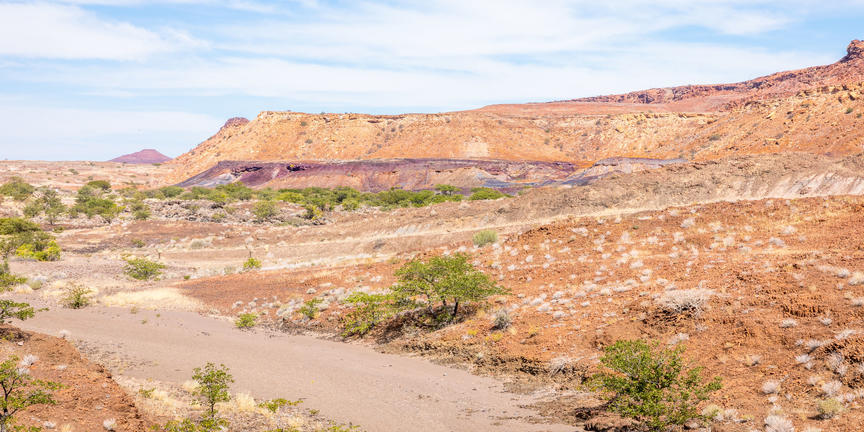
Just a short walk from the Organ Pipes is a small inselberg named Burnt Mountain, proclaimed a National Monument on 15 September 1956.
The reason for its name is most evident in the early mornings and late evenings, when the rays of the sun seem to set the mountain ablaze. Rich red colors, mixed with shades of black and purple, are caused by manganese-coated clay molecules.
Twyfelfontein important Information:
Once having entered the National Heritage Council of Namibia sights fees are as follows:
open from 8am-5pm – cash only!
Organ Pipes & Burnt Mountain:
- N$ 250.00 per adult
- N$ 200.00 per child 8-17 years
- Children younger than 8, free of charge.
Twyfelfontein Main Site:
- N$ 270.00 per adult
- N$ 200.00 per child 8-17 years
- Children younger than 8, free of charge.
The center also sells lots of trinkets and tribal jewelers along with the usual fridge magnets, shot glasses, t-shirts and coffee mugs.
The Damara Living Museum, near Twyfelfontein, offers the opportunity to learn about the traditional culture of the Damara people.
A Living Museum brings together three key goals:
- The preservation and transmission of traditional culture
- The creation of a source of income in rural areas of Namibia
- The development of a cultural and intercultural educational institution
Entry fees:
- Adults: N$110.00 – N$190.00 (cash only)
- Children (3–12 years): Half price