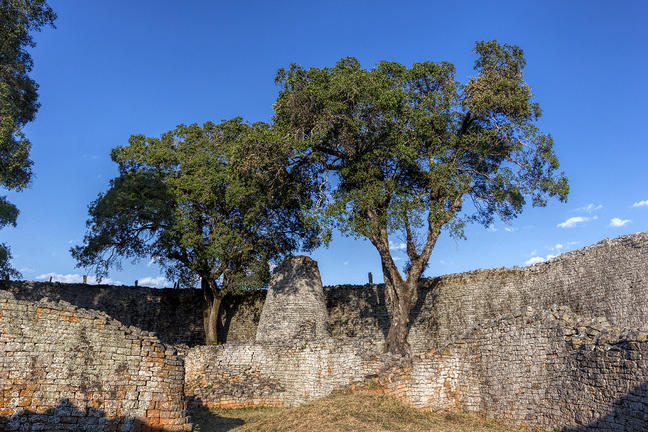
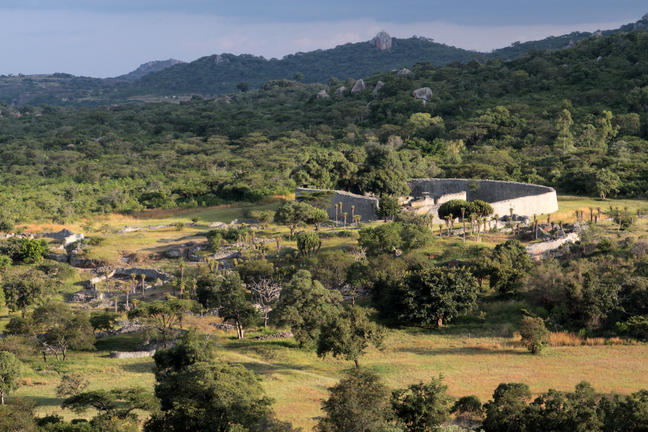
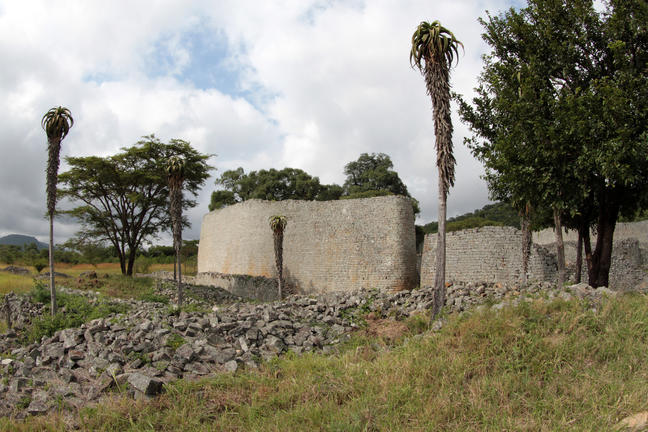
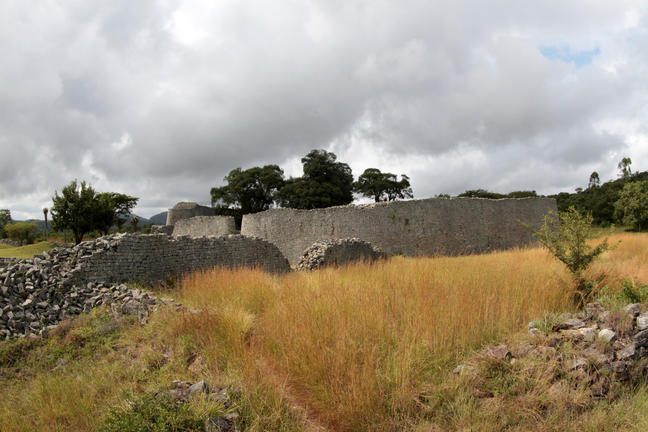
The Ancient City of Great Zimbabwe is one of the well-preserved stone cities in sub-Saharan Africa and situated 28 km southeast of Masvingo town. Zimbabwe means 'large houses of stones' in a Shona dialect and is the name of the ruins spread over a 722-ha area. The construction was done by the Bantu civilization of the Shona between the 11th and the 15th centuries. It is one of the oldest and largest structures in southern Africa and was renowned from the Middle Ages onwards. It was recognised as a UNESCO World Heritage Site in 1986 because of the spectacular effort it took to assembling the stones in almost geometrical pattern with simple tools and technology.
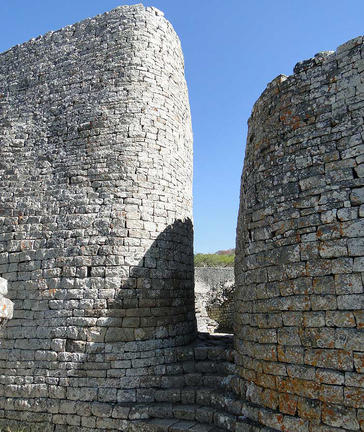
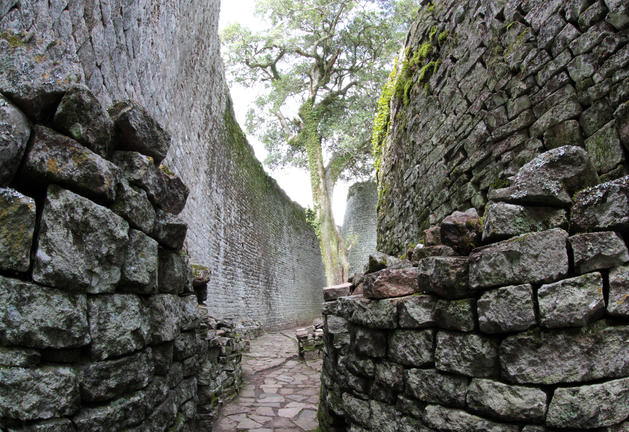
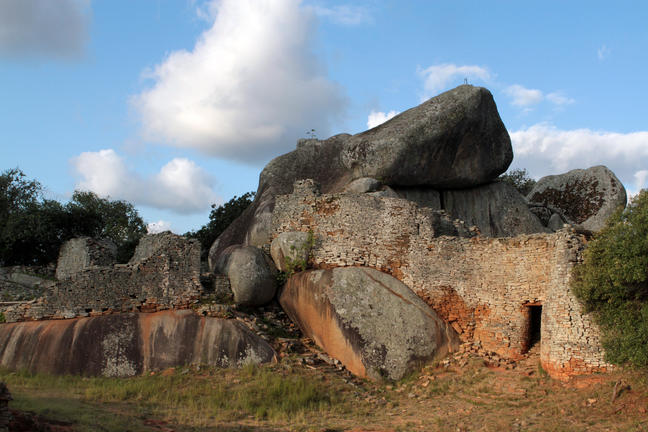
The ruins are divided into three groups: the Hill Ruins, the Great Enclosure and the Valley Ruins. They were used as a temple complex, by the king and by the citizens respectively. The Great Enclosure has 11m high walls extending for 250m and is built out of granite using dry-stone masonry. The Valley ruins are a series of living ensembles scattered throughout the valley and they are mostly constructed with bricks. You can observe chevron and chequered wall decorations in a display of high standard of craftsmanship.
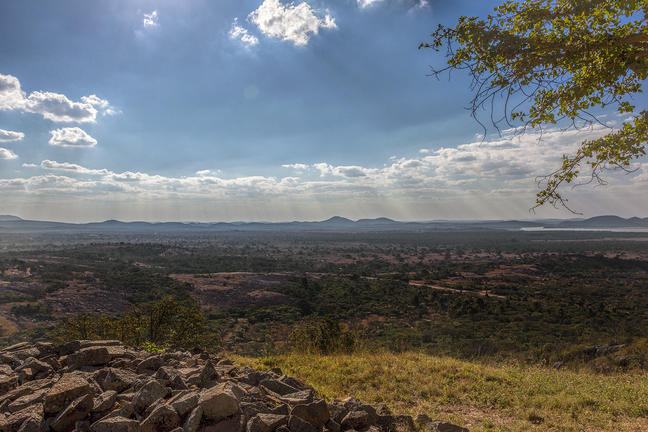
The Hill ruins, some believe, were a royal city as opposed to the Great Enclosure. It has views of the whole complex and of Lake Mutirikwe. The west side might have been the residence of the chiefs and the east side might have served a ritual purpose. They make up a large granite mass atop a spur. According to research carried out, the city was a center of trade. It is believed that the Shona traded with traders from East Africa in cloth, beads and ceramics from Arabia and China exchanging via barter for gold, ivory and copper. It was also one of the main cities of the state extending over a gold-rich area. The population is estimated to be around 25000 at its peak. But around 1500 the city lost its power and the migration slowly proceeded towards the Ancient City of Khami, which became the next seat of power.
The origin of the ruins was debated for a long length of time, with the Europeans , especially the colonists declaring that the it was not possible for the Africans to have built the grand structures. Many British archeologists who were sent to investigate came back with the assertion that the site was non-African in origin, even with the discovery of artefacts like bronze ans copper spearheads, axes and tools that indicated tgehe presence of the Shona. The ones who tried to support the theory of African origin were disbelieved and Cecil Rhodes banned the independent study of the area for about 25 years!
To the anti-colonists Zimbabweans, the site was a monument of pride and a symbol of great achievement. Hence, when the country became independent, it was named after the Ancient City.
The museum displays a few unearthed items like metal tools, fragments of Chinese and Persin crockery and most importantly the soapstone birds. The birds, eight in total, carved out of soapstone were found at the ruins. The mix of human and avian characteristics suggest that the birds are mythical figures. Six came from the Hill Complex. Cecil Rhodes took 5 of them to South Africa but they were returned to Zimbabwe in 1981, an act that symbolised independence for the Zimbabwean people.
Archeologically, a very important site , not only in Zimbabwe but in Southern Africa, The Ancient City of Zimbabwe is a must-see to gain a historical perspective.