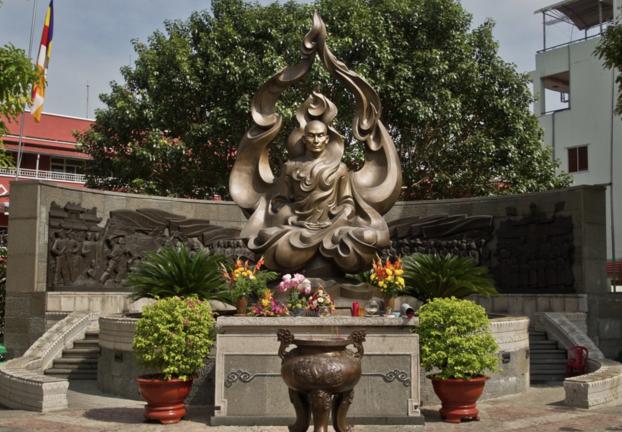
Thich Quang Duc Monument is a small but deeply significant memorial in central Saigon, marking one of the most powerful moments in Vietnam’s modern history. It commemorates Thich Quang Duc, the Buddhist monk who set himself alight in 1963 in protest against the treatment of Buddhists under the South Vietnamese government.
The monument stands near the junction where the event took place, and although the surrounding streets are busy with traffic, the site itself has a quiet, reflective quality. The bronze sculpture shows Thich Quang Duc seated in the lotus position, with a stylised flame rising behind him. It’s a striking and sobering memorial, and one that helps connect visitors with the political and religious tensions that shaped Saigon in the years before the wider escalation of the Vietnam War.
A visit here doesn’t take long, but it adds useful context to other wartime sites in the city, particularly the War Remnants Museum and Independence Palace. It also offers a reminder that Vietnam’s modern history wasn’t shaped only by battles and foreign intervention, but also by internal struggles, public protest and acts of extraordinary personal sacrifice.
The monument is best included as part of a wider exploration of Saigon’s historic sites rather than as a standalone visit. It’s a meaningful stop for travellers with an interest in history, photography, religion or Vietnam’s 20th-century story.
Expert Tips: Allow around 10 to 15 minutes for a visit. The monument sits by a busy road junction, so take care when crossing nearby streets. It’s a place for quiet reflection rather than a conventional sightseeing stop, and it combines well with a guided tour for a clearer understanding of the background and significance.