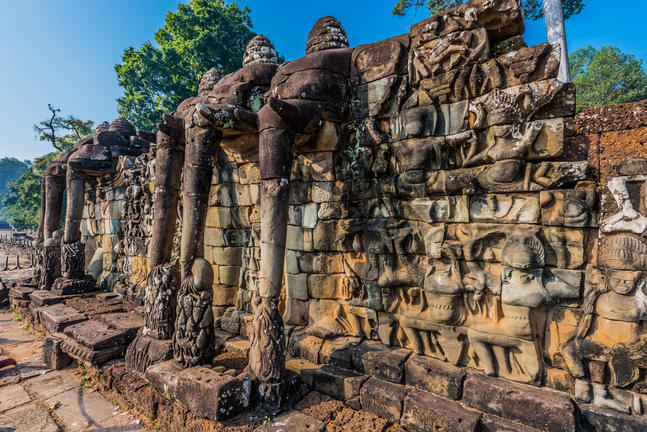
Set within Angkor Thom, the Terrace of the Elephants is one of the great ceremonial monuments of the Angkor world and an important part of understanding how the royal city once functioned. Stretching for around 300 metres along the front of the former royal enclosure, it served as a grand viewing platform from which the king and his court could watch military parades, public ceremonies and other state occasions. APSARA describes it as the king’s reception pavilion and notes that it stood at the ceremonial heart of Angkor Thom.
What makes the Terrace of the Elephants especially rewarding is that it adds a more civic and royal dimension to an Angkor visit. Unlike the temple experience of Angkor Wat or Bayon, this is a place that helps you imagine processions, public audiences and the wider ceremonial life of the Khmer capital. It was not simply decorative, but a key part of how power was displayed in the city.
The terrace takes its name from the carved elephants that decorate its walls, along with lions, garudas and other richly worked figures. APSARA highlights scenes of elephants in procession and hunting, while the stairways are flanked by the three-headed elephant Airavata, associated with prosperity and rain. These carvings are a major part of the appeal and make the terrace much more than a simple platform.
For most travellers, the Terrace of the Elephants works best as part of a wider visit to Angkor Thom, usually combined with Bayon and the Terrace of the Leper King. It may not be the single most famous monument in Siem Reap, but it adds important context, atmosphere and royal scale to the Angkor experience.